


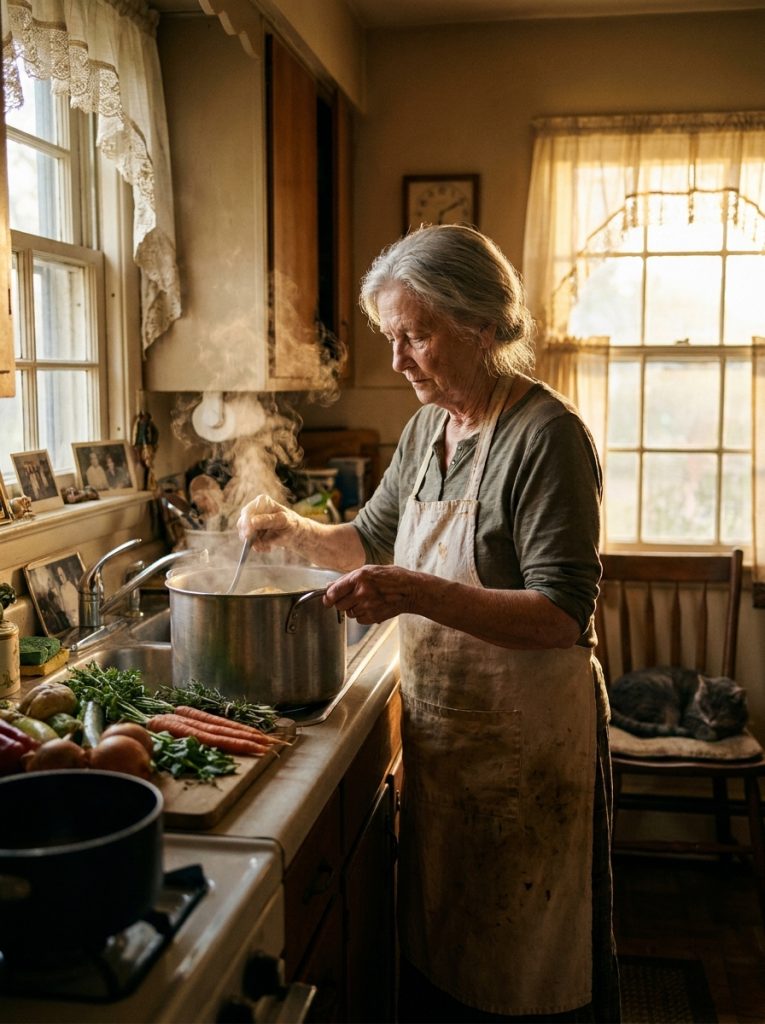
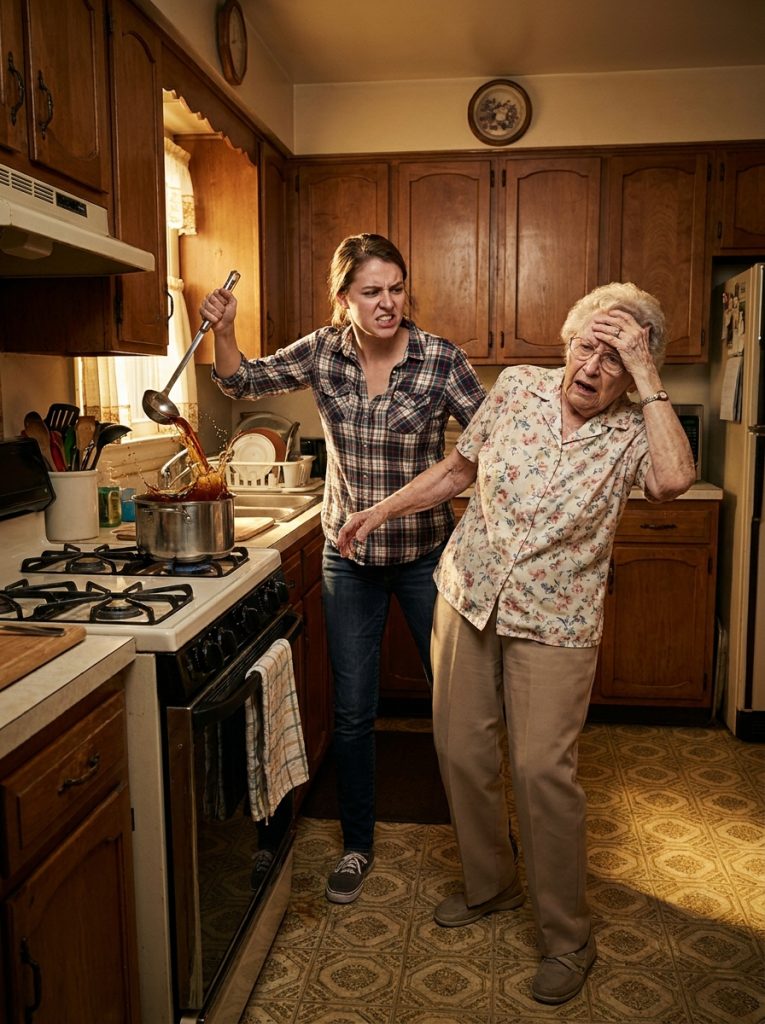
I was just stirring the soup when my daughter-in-law suddenly swung the ladle and smashed it against my head.
“Who cooks like this? You’re completely useless!” she screamed.
For a second, I didn’t understand what had happened. My vision blurred, the kitchen spinning as a sharp ringing filled my ears. My hand instinctively went to my temple, already throbbing, while the other still hovered over the pot as if my body hadn’t caught up with reality.
The smell of garlic, celery, and thyme lingered in the air—comforting, familiar, everything my home used to feel like.
Now it felt like a place I didn’t recognize.
I had made this soup a hundred times before. For my husband when he came home late from work. For my children when they were sick. For Mark, my son, who used to smile and say it tasted like home.
That was before everything changed.
Three months ago, Mark and his wife Brittany moved in with me. “Just until we get back on our feet,” he said. And I believed him—because he was my son, and because after losing my husband two years ago, the silence in this house had become unbearable.
I thought their presence would bring warmth back.
I didn’t realize I was inviting something else in.
At first, it was small things.
Brittany commenting on how I folded towels. Laughing at the way I organized the pantry. Telling me my cooking was “outdated,” my habits “too old-fashioned,” my voice “too soft.”
I told myself she was stressed. That losing her job had made her bitter. That their marriage was under pressure.
So I stayed quiet.
Because that’s what mothers do when they’re trying to keep a family from breaking.
But silence has a cost.
That afternoon, Mark had texted saying he would be late, so I started dinner early. I thought maybe a warm meal would help. Maybe it would make things feel normal again.
Brittany walked into the kitchen, her heels striking the tile sharply, her expression already irritated. She glanced at the pot and wrinkled her nose.
“What is that?” she asked.
“Chicken soup,” I said quietly. “Mark likes it when he’s tired.”
She let out a short, humorless laugh. “This looks disgusting.”
I swallowed. “I can season it more if you’d like.”
I didn’t even see her reach for the ladle.
The impact came fast, hard, shocking.
Metal against bone.
Pain exploded across my temple as I stumbled into the counter, the world tilting beneath my feet. For a moment, I couldn’t hear anything but that high, piercing ring.
That was the moment I realized this wasn’t just disrespect anymore.
It was something far worse.
I looked at her, stunned, my hand pressed against my head.
“Who cooks like this? You’re completely useless!” she repeated, her voice sharp, almost satisfied.
My own kitchen—my safe place—felt dangerous.
I had never imagined she would lay a hand on me.
Never.
Before I could speak, before I could even decide whether to cry or defend myself, the front door opened.
My daughter, Emily, stepped inside.
She paused the second she saw me.
Her eyes moved quickly—my face, the redness forming above my ear, the soup splattered across the stove, Brittany still gripping the ladle.
Everything.
Emily dropped her purse.
In three steps, she was beside me.
“Mom, are you hurt?” she asked, her voice suddenly gentle, her hand resting lightly on my shoulder.
“I’m okay,” I whispered.
But I wasn’t.
My head pounded, but it was the feeling in my chest that scared me more.
Shame.
Shock.
And something colder.
The realization that I had allowed this to go too far.
Brittany crossed her arms. “Oh, please. Don’t make it dramatic. It was an accident.”
Emily turned to her so quickly it made my breath catch.
“An accident?” she said, her voice low but trembling with anger. “You called her useless and hit her in the head.”
“She was making a mess,” Brittany snapped. “And she knows how to push people. You don’t even live here, so don’t act like you know what’s going on.”
That sentence landed harder than the ladle.
Because it was true.
Emily didn’t live here.
She hadn’t seen the slow erosion of my dignity. The daily criticisms. The quiet humiliation. The way Mark stood there—silent—every single time.
But in that moment, I understood something with painful clarity.
My silence hadn’t protected my family. It had protected the wrong people.
Emily pulled out her phone.
“I’m calling the police.”
Brittany’s confidence flickered. “Are you serious?”
“Yes,” Emily said. “Very.”
At that exact moment, the garage door opened.
Mark walked in.
He looked from Brittany to me to Emily, confusion settling on his face—until his eyes landed on the swelling at my temple.
“What happened?” he asked.
For one fragile, foolish second, hope rose in my chest.
That he would see.
That he would understand without explanation.
That he would become the son I raised.
That he would step between us and say, “Mom, I’m sorry. This ends now.”
But Brittany spoke first.
“She’s overreacting,” she said, pointing at me. “Your mother started it. Emily just made it worse.”
Mark looked at me.
Not with concern.
Not with anger.
But with irritation.
“Mom,” he said, “what did you say to her?”
Emily’s voice cracked. “Are you hearing yourself? She didn’t say anything. Brittany hit her with a ladle.”
Mark rubbed his face, exhaling like he was the one under pressure. “Can we not do this right now? We’re all stressed.”
That was the moment something inside me finally broke—quietly, completely, and beyond repair.
I straightened.
For the first time in months, my voice didn’t tremble.
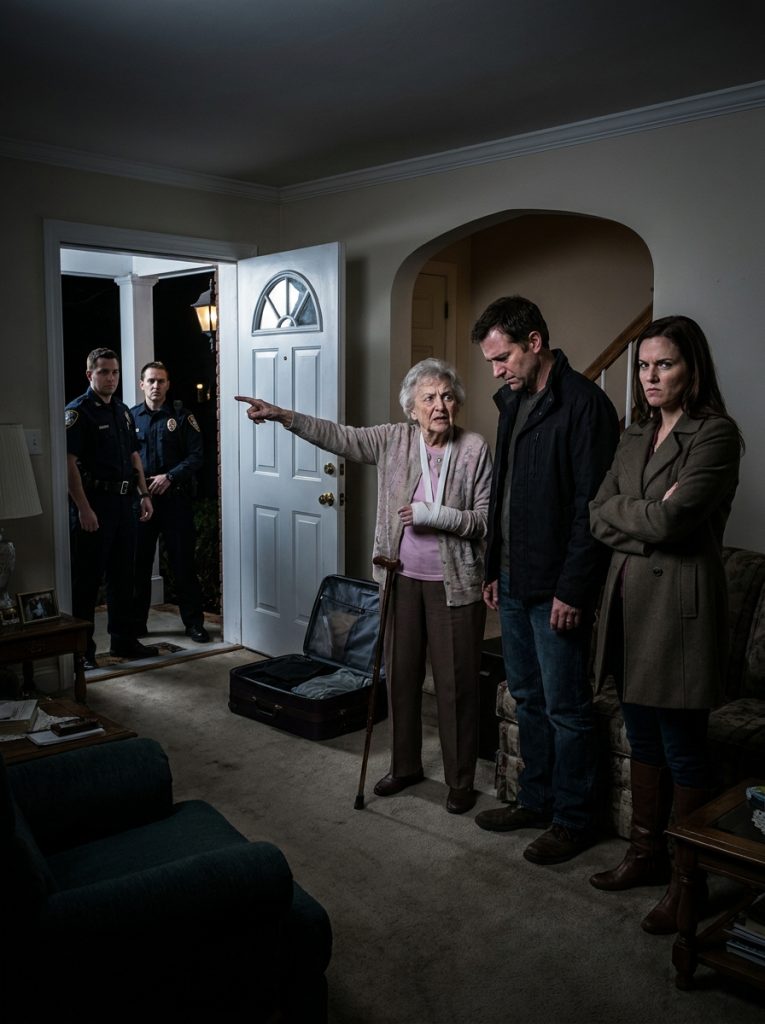
“Get out of my house.”
Mark blinked. “What?”
“You and your wife,” I said, louder now. “Get out. Tonight.”
Brittany let out a sharp laugh, but there was no confidence left in it. “You can’t be serious.”
Emily was already dialing. “She is.”
And somewhere in the distance, faint but growing louder—
a siren.
By the time the police arrived, the house felt different.
Not calmer.
But clearer.
One officer spoke with me while another stood near the doorway with Emily. I told them everything. No excuses. No softening the truth. Not anymore.
A paramedic checked my head and mentioned a possible concussion. Emily insisted I leave with her, but I refused.
Not until they were gone.
Mark tried to explain it away—“misunderstanding,” “family tension,” “stress”—but the officer cut him off.
“Sir, your mother has asked you to leave the property. Tonight.”
For the first time since they moved in, I wasn’t afraid of what would happen next.
Brittany paced upstairs, throwing things into suitcases. Mark lingered near me, his voice lowered.
“Mom… are you really doing this?”
I looked at him.
And what hurt most wasn’t what he said.
It was what he still didn’t understand.
“No, Mark,” I said quietly. “You did this.”
He froze.
“You stood by while your wife disrespected me in my own home,” I continued. “And today, she crossed a line no one comes back from.”
“She’s under pressure,” he said weakly.
“So was I,” I replied. “I buried my husband. I opened my home. I gave you both chance after chance.”
I paused.
Then said the truth I had been swallowing for months.
“Pressure does not excuse cruelty.”
He had no answer.
Within two hours, they were gone.
The next morning, Emily changed the locks.
She took me to urgent care, then back to her apartment. I slept more than I spoke. When I finally looked in the mirror, the bruise had darkened into a deep purple mark above my temple.
A reminder.
Not just of what happened—
but of how long I had allowed it.
A week later, Mark texted me.
Not to apologize.
Not to ask how I was.
Just to say he hoped I would “cool off soon.”
I read it twice.
Then I blocked his number.
That was the second turning point—the one no one saw coming, not even me.
Because walking away from pain is one thing.
Walking away from your own child is something else entirely.
But peace… real peace… sometimes comes at a cost people don’t talk about.
Sometimes, it means choosing yourself.
Even when it breaks your heart.
I never thought the hardest lesson of my life would happen in my own kitchen, with a pot of soup on the stove.
But it did.
And what I learned is this:
Family is not the people who demand your silence.
Family is the people who protect your dignity when it matters most.
Emily did that for me.
My son did not.
So let me ask you—
If you were standing where I stood, with everything on the line—
would you have forgiven him… or closed the door for good?
