


—
Captain Kendra Ellis’s uniform was soaked with coffee as passengers gasped in shock. The flight attendant smirked and whispered, “Your kind belongs in coach.” Kendra’s fingers trembled as she dialed a number that no one expected. Within moments, armed officers boarded the plane. “This plane isn’t going anywhere,” they announced.
Captain Kendra Ellis had spent her military career proving herself. As a black woman in the United States Army, every achievement required twice the effort, twice the excellence, and twice the composure of her white counterparts. Today should have been different. Today should have been her moment of vindication.
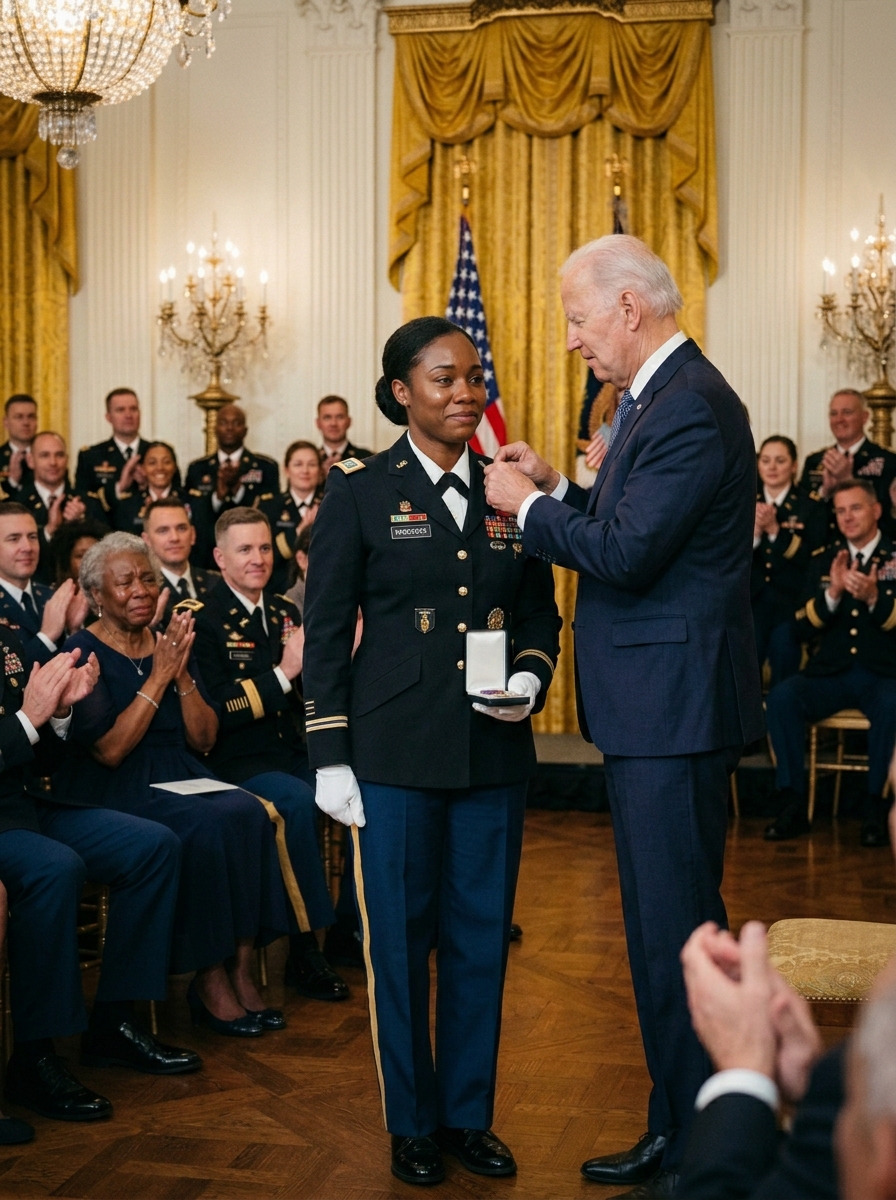
Her military record spoke for itself. Tours in Afghanistan, two Purple Hearts, and now a presidential commendation for extraordinary heroism after she had led an evacuation mission that saved civilians during an insurgent attack. The ceremony at the White House was scheduled soon, a career-defining moment that would finally silence the doubters who had followed her since basic training.
Kendra had grown up in Charleston, South Carolina, raised by a single mother who taught mathematics at an underfunded public school. Denise Ellis had instilled in her daughter two core principles. Excellence was non-negotiable and dignity was her birthright. These principles had carried Kendra through West Point, where she had graduated in the top percentage of her class and through her subsequent military career.
“Remember who you are,” her mother had told her that morning. “You wear that uniform because you’ve earned it. Every medal, every rank, every honor.” Kendra had spent time preparing for her flight from Atlanta to Washington, DC. Her dress uniform was impeccable—every crease sharp, every button polished, every medal precisely placed.
She had rehearsed her acceptance speech in the mirror until the words flowed naturally. The military had arranged her travel, including a first class ticket on Delta Airlines, acknowledging the importance of her arrival in pristine condition. As Kendra boarded the plane, she immediately sensed the shift in atmosphere.
First class passengers, predominantly white business travelers, glanced up with expressions ranging from surprise to unmistakable displeasure. A middle-aged white man in a tailored suit audibly sighed as she approached her seat in the third row. Another passenger whispered something to his companion, who stifled a laugh behind her hand.
Flight attendant Loretta Vaughn, a stern-faced woman with precisely styled blonde hair and lines around her eyes etched by life, approached as Kendra settled into her window seat. “Ticket, please,” Loretta demanded. Despite having already scanned Kendra’s boarding pass at the entrance, Kendra handed it over without comment.
Loretta examined it, flipping it over as if expecting to find evidence of forgery. “This says first class,” Loretta stated, her tone suggesting an impossibility.
“Yes, it does,” Kendra replied evenly.
“Are you sure you’re in the right seat? 3A.”
“I am certain. Thank you.”
Loretta’s lips tightened as she handed back the boarding pass with two fingers as if reluctant to touch it. “Very well.”
As pre-flight preparations continued, Kendra observed Loretta’s interactions with other passengers. The flight attendant smiled warmly at the businessman across the aisle, inquiring about his comfort and offering a pre-departure beverage with genuine hospitality. She joked with an elderly white couple, complimenting the woman’s scarf and addressing them as Mr. and Mrs. Harrove after a single glance at their boarding passes. When Loretta returned to Kendra’s row, her demeanor transformed. No smile, no eye contact, just a curt seat belt check before moving on without waiting for Kendra’s drink request. Kendra took a deep breath. This was nothing new. Throughout her military career, she had encountered similar treatment, subtle dismissals, assumptions that she did not belong in officer quarters, questions about whether she was really a captain.
She had learned to pick her battles. Today, with the White House ceremony approaching, was not the day for confrontation. The cabin filled as coach passengers filed past. Kendra noticed several double takes from travelers spotting her uniform in first class. A young black woman in Air Force fatigues gave her a subtle nod of respect. Kendra returned it, feeling a familiar pang of responsibility. Every black service member carried the additional burden of representation. Their individual actions were scrutinized and extrapolated to reflect on all black military personnel.
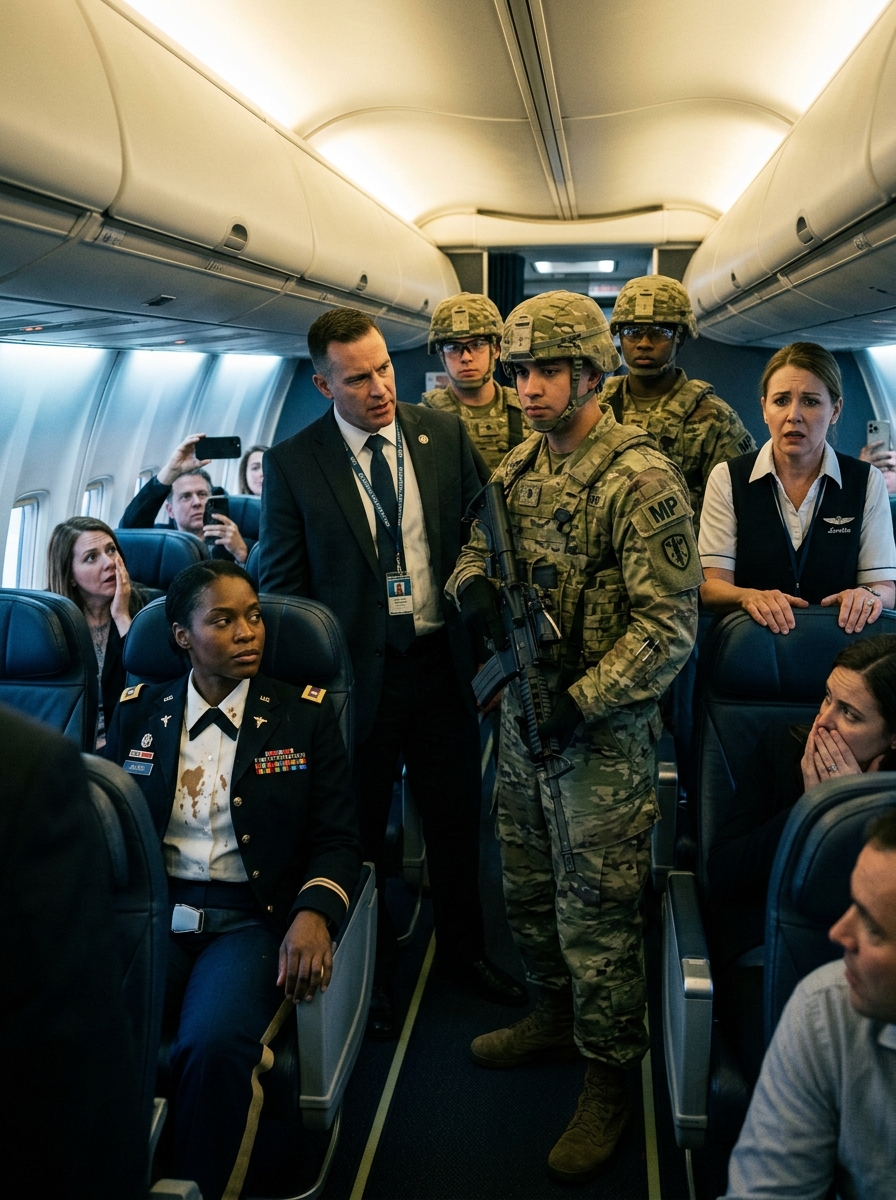
As the boarding process neared completion, Kendra realized she had been overlooked for the pre-flight beverage service. With the flight ahead and her throat already dry from airport air, she pressed the attendant call button. Loretta appeared quickly enough to suggest she had been watching for it.
“Is there a problem?” Loretta asked loud enough for nearby passengers to hear, implying that Kendra was being difficult.
“No problem at all,” Kendra replied with military calm. “I’d like a coffee before takeoff, please. Black, no sugar.”
Loretta’s eyes narrowed imperceptibly. “We’re about to close the cabin for departure.”
“There seems to be time,” Kendra observed, nodding toward another flight attendant still serving drinks two rows ahead.
“Fine,” Loretta said, walking away without another word.
Kendra turned to look out the window, focusing on her breathing. Just a minor unpleasantness, nothing worth disrupting her important day. The ceremony awaited. The president would shake her hand. Her mother would be watching. “Keep perspective,” she told herself.
When Loretta returned, she carried a steaming cup of coffee without a napkin or a saucer. As she extended it toward Kendra, something shifted. Later, multiple passengers would debate whether what happened next was intentional or accidental. The coffee cup tilted, scalding liquid cascaded directly onto Kendra’s immaculate uniform and lap. Kendra gasped as the hot liquid seared through the fabric onto her skin.
“Oh,” Loretta exclaimed with theatrical surprise. “How clumsy of me!”
The coffee formed an expanding dark stain across Kendra’s chest, soaking her medals and running down to her lap, where it brought an agonizing heat against her thighs. Years of military discipline prevented her from crying out despite the pain.
“Let me help you with that,” Loretta said, grabbing a thin cocktail napkin and dabbing ineffectually at the uniform. She leaned close and in a voice meant only for Kendra whispered, “Your kind belongs in coach.”
The words hung in the air between them like poison. The searing pain of the coffee burn paled in comparison to the scorching humiliation of Loretta’s words. Kendra sat perfectly still, coffee dripping from her soaked uniform as the flight attendant continued her performance of concern.
“These things happen,” Loretta announced loudly for the benefit of onlooking passengers. “I’m sure your uniform will clean up just fine.”
Kendra’s military training kicked in. Assess the situation. Control emotional response. Determine appropriate action. The coffee had soaked through her jacket, shirt, and pants, burning her skin underneath. Her carefully arranged medals were now stained and disarranged. The speech notes in her pocket were ruined. And more devastating than all of this was the deliberate nature of the assault and the racist sentiment behind it.
“I need your employee number and full name,” Kendra stated calmly, despite the adrenaline coursing through her body.
Loretta’s performative concern vanished instantly. “Excuse me.”
“Your employee identification number and full name,” Kendra repeated, “for my complaint to your employer.”
Across the aisle, a young white man in his 30s, later identified as Bryce Langford, discreetly positioned his phone to record the interaction. His marketing job had taught him to recognize significant moments as they unfolded, and his conscience would not allow him to simply watch in silence.
Loretta straightened, her face hardening. “Are you threatening me?”
“I’m requesting standard information for a customer complaint.”
“You’re being aggressive,” Loretta said, raising her voice. “I’ve apologized for an accident, and now you’re creating a scene.”
Two other flight attendants approached, drawn by the commotion. Without asking what had happened, they flanked Loretta protectively.
“Is there a problem here?” asked the taller one, a man with a military-style haircut and a name tag reading Derek.
“This passenger is being aggressive after an accidental spill,” Loretta explained before Kendra could speak.
“That’s not accurate,” Kendra began. But Derek cut her off.
“Ma’am, we need everyone to remain calm during boarding. If you have an issue, you can submit it through customer service after the flight.”
The third flight attendant, a younger woman named Brooke, looked uncertainly between Loretta and Kendra, noting the coffee-soaked uniform and the unmistakable military decorations. A flicker of doubt crossed her face, but she remained silent.
Kendra took another steadying breath. “I have been assaulted with hot coffee accompanied by a racist comment. I am requesting the flight attendant’s identification as is my right as a passenger.”
Loretta gasped theatrically. “Racist. I have never been so insulted in my years of service. She’s making that up because I accidentally spilled coffee.”
The commotion drew the attention of the flight captain who emerged from the cockpit still securing his tie. Captain Harlon Whitaker, a former Air Force pilot with a commanding presence, surveyed the scene with obvious annoyance. “What’s going on here?” he demanded.
Loretta immediately turned to him, eyes brimming with manufactured tears. “This passenger is making horrible accusations after an accident. Captain, she’s threatening me and disrupting the flight.”
“Captain,” Kendra began, noting his former military rank on his name plate. “I’m Captain Kendra Ellis, US Army. I’ve been—”
“I don’t care if you’re General Patton,” Whitaker interrupted. “You’re causing a delay to our departure. Either calm down and accept the flight attendant’s apology or I’ll have you removed from this aircraft.”
The first class cabin had gone silent. Every passenger was watching now. Bryce Langford’s phone continued recording, capturing everything.
“Sir,” Kendra said, struggling to maintain her composure. “Your flight attendant deliberately spilled coffee on me and made a racist comment. I am exercising my right as a passenger to file a complaint.”
—
