

**CHAPTER 1: The Strike in Terminal B**

The hum of Hartsfield-Jackson Atlanta International Airport carries its own brand of chaos. It is the sound of ten thousand wheels rolling across polished linoleum, the steady chime of gate announcements, and the thick, humid mix of Cinnabon and jet fuel. On the Sunday after Thanksgiving, the tension in Terminal B pressed down like a physical weight. Everyone was tired. Everyone was running late.
I was thirty-four years old, thirty-nine weeks pregnant, and at that moment, the most hated person in the airport.
“I’m so sorry,” I muttered for the third time, my voice trembling.
My suitcase had stopped at the worst possible place—the entrance to the moving walkway. A line of exhausted travelers stacked up behind me like cars piling up on I-85. My belly was so large that bending over felt like folding a bowling ball, yet I had to reach the wheel.
The problem was a clear plastic garment bag. It had slipped from the top of my carry-on and wrapped itself deep into the casters. Through the plastic, I could see the shimmering white satin of the christening blanket. I had spent every night for three months hand-stitching it from the fabric of my mother’s choir robe—the one she wore the day she died. It was my most precious possession. I refused to let it tear.
“Some of us have actual places to be, honey. This isn’t your living room.”
The voice cut like a razor blade wrapped in silk. I looked up, squinting against the harsh LED lights.
Standing over me was a woman who appeared carved from expensive marble. She was tall, with a platinum-blonde bob sharp enough to draw blood. Her camel cashmere coat draped perfectly over her shoulders, and her crimson lipstick remained flawless after a long flight. She held a boarding pass for a private charter in one hand and pure, unfiltered loathing in her eyes.
This was Victoria Langley. I didn’t know her name yet, but I knew the type. She was the kind of woman who never waited for anything and saw the rest of the world as background actors in her own movie.
“I’m sorry, ma’am,” I said, my hand resting instinctively on the curve of my stomach. “The wheel is jammed. I just need a second—”
“A second is money I don’t have to waste on people who can’t manage their own luggage,” she snapped. Her beige, pointed-toe, four-inch heels clicked impatiently on the floor. “Get out of the way. Now.”
“I can’t just leave the bag—”
“I didn’t ask for a dialogue.”
The crowd behind her began to murmur. I felt that old familiar heat rising in my chest—the desire to vanish, to apologize until I became invisible. It was a habit formed at twelve, singing a solo in church while my mother collapsed in the back row. I had kept singing because I didn’t want to cause a scene. I had performed strength until it became a cage.
I reached down once more, my fingers brushing the jammed wheel.
“I said,” Victoria’s voice dropped to a low, dangerous hiss, “MOVE.”
I never saw it coming.
She didn’t use her hands. That would have been too personal. Instead, she swung her leg in a calculated, forceful strike. The pointed toe of her designer heel drove straight into the soft, taut curve of my lower abdomen.
The air rushed from my lungs in a silent, agonizing wave.
I didn’t scream. My body simply shut down. I felt the impact echo through my spine. For a second, the entire airport fell silent. The rattle of suitcases, the gate calls, the crying babies—all of it vanished, replaced by the frantic thunder of my own heart.
I collapsed. My knees hit the floor with a sickening crack. I curled into a ball, arms wrapped around my belly, trying to protect the life inside me from a world that had turned violent.
“Oh my God!” someone screamed.
A few feet away, two paper cups of chamomile tea hit the floor. The lids popped off and hot liquid splashed across the white tile, inches from my face.
“Naomi!”
I knew that voice. It was the only thing anchoring me against the darkness. Malcolm.
My husband had only stepped away for five minutes to get something for my nerves. Now he was skidding across the floor, his gray overcoat flying behind him. He didn’t look like a powerful man in that moment. He looked like a man watching his entire world collapse.
“Naomi, look at me. Look at me,” he whispered, his hands shaking as he touched my face.
I couldn’t speak. I could only gasp, clutching his sleeves. “The baby… Malcolm, the baby…”
Behind us, Victoria Langley calmly straightened her coat. She looked down at me with an annoyed sigh instead of horror.
“Don’t be so dramatic,” Victoria said, her voice carrying over the gasping onlookers. “I barely touched her. She tripped over her own incompetence and now she’s looking for a settlement. I know the type.”
Malcolm froze. I felt the muscles in his back turn to steel. He stayed focused on me, scanning my face for signs of shock.
“Did she kick you?” Malcolm’s voice was unnervingly quiet. It was the voice he used in the operating room before he gave up his scrubs to run the empire.
“She… she kicked me, Malcolm,” I choked out.
A woman in a TSA uniform—no, a retired supervisor named Denise, I would learn later—stepped forward, phone held high. “I got it all on video, honey. Don’t you worry. I got her. She kicked this pregnant girl like she was a piece of trash.”
Victoria rolled her eyes. “Call airport security then. I have a flight to catch. I’m Victoria Langley, and I promise you, my time is worth significantly more than this… incident.”
At the sound of her name, a few people in the crowd whispered. They knew the Langley name. They knew the billion-dollar medical tech giant. They knew she was untouchable.
Victoria finally looked at Malcolm as more than just a man in the way. She saw his plain gray coat, sensible shoes, and lack of jewelry. She assumed he was a driver. An assistant. A nobody.
“Move her,” Victoria ordered Malcolm. “Before I have you both arrested for harassment.”
Malcolm slowly stood up. He no longer looked like a nobody. He looked like a storm.
He reached into his pocket and pulled out his phone. He didn’t call the police. He didn’t call an ambulance—not yet, since the airport medics were already sprinting toward us.
He dialed a number on speaker.
“This is Malcolm Carter,” he said into the phone. His voice was a low rumble that seemed to vibrate the glass walls of the terminal.
Victoria’s eyes widened slightly at the name. She knew Malcolm Carter. Everyone in the medical industry did. He was the legendary trauma surgeon turned venture capitalist. But she had never met him in person. The Langley Board had shielded her from the new Chairman for months.
“Malcolm?” a voice crackled over the line. It sounded like an executive, breathless and confused. “Is everything alright for the meeting tomorrow?”
“Cancel the meeting,” Malcolm said, his eyes locked on Victoria’s. The ice in his gaze made her take a half-step back for the first time. “And get the entire Langley Biomedical board on a secure line. Right now.”
Victoria’s face drained from pale to ghostly white. Her crimson lips parted, but no sound came out.
“Malcolm?” she whispered, her voice cracking. “You… you’re Malcolm Carter?”
Malcolm didn’t answer her. He looked down at me as the medics placed a blood-pressure cuff on my arm. He looked at the white christening blanket, now stained with spilled tea and floor dirt.
“Get the board,” Malcolm repeated into the phone, his voice echoing through the terminal. “Tell them there’s been a change in the agenda. We’re not discussing the merger anymore. We’re discussing the immediate termination of the acting CEO.”
Victoria was still shouting for airport police when Malcolm picked up my fallen phone, looked at the name on the screen, and said, “Get the Langley board on a secure line now.”
**CHAPTER 2 — The Pressure Builds**
The sterile smell of the airport medical suite stood in sharp contrast to the Cinnabon-scented chaos outside. I sat on the edge of a high exam table, legs dangling, feeling smaller than I had since I was twelve. My hands wouldn’t stop shaking. I kept folding a small blue hospital brochure into tiny perfect squares, over and over, until the paper turned soft and frayed.
It is a habit I can’t break. When the world feels like it is collapsing, I focus on the geometry of paper—the only thing I can control.
“Deep breaths, Naomi,” Malcolm whispered. He stood by my side, his hand firm on my shoulder. He hadn’t let go since the medics wheeled me in. His face showed professional calm, but I felt the tremors in his palm. I knew that look. It was the one he wore when bracing for impact.
“I’m okay, Malcolm,” I said, though my voice sounded like it belonged to someone else. “I’m sure it was just the shock. She… she didn’t mean to. I was in the way.”
Malcolm’s grip tightened slightly. “Stop it. Stop apologizing for existing, Naomi. She didn’t ‘touch’ you. She assaulted you.”
Before I could respond, the door swung open and slammed against the wall. Victoria Langley marched in, followed by two airport police officers and a nervous young man in a suit who was frantically typing on a tablet.
“This is an absolute farce!” Victoria shouted, her voice echoing off the tiled walls. She looked at me with predatory irritation rather than guilt. “I have missed my window for takeoff. My legal team is already drafting a countersuit for defamation and staged personal injury. You people picked the wrong woman to hustle.”
Officer Ramirez, a weary man with a thick mustache, stepped forward. “Ma’am, please. We are just trying to get statements while the doctor checks the victim.”
“Victim?” Victoria laughed, a sharp, jagged sound. “She is an obstacle. She intentionally blocked a high-traffic moving walkway during peak travel hours. That is a security risk. If anything, I was clearing a path for the safety of the public. And look at her—she’s sitting up, she’s fine. She’s probably been waiting for a billionaire to walk by so she could fake a fall.”
I looked at the floor. My stomach felt tight, a dull pulsing ache spreading from where her shoe had struck. Every word felt like another kick. I remembered my mother’s funeral—the way neighbors praised me for not crying, for being “strong” and “composed” while my heart broke. I realized I was doing it again, letting her rewrite the truth because I didn’t want to be “difficult.”
“Officer,” Malcolm said, his voice dropping to that dangerous low frequency again. “My wife is thirty-nine weeks pregnant. She is in active distress. Mrs. Langley is not here to give a statement; she is here to intimidate a witness. I want her removed from this room immediately.”
Victoria stepped toward Malcolm, eyes narrowed. She still didn’t understand. She still saw a man in a cheap-looking gray coat. “I don’t know who you think you are, but you don’t give orders to me. I own the equipment in half the hospitals in this state. I practically own the ground you’re standing on.”
“Actually,” the young man with the tablet whispered, his face turning a sickly gray. “Victoria… maybe we should step outside.”
“Shut up, Ethan,” she snapped. She turned back to Officer Ramirez. “I want her arrested. I want a drug test performed on her. No sane woman in her third trimester wanders into a busy airport and stops dead in the middle of a walkway unless she’s impaired or looking for trouble.”
“I was trying to save the blanket,” I whispered.
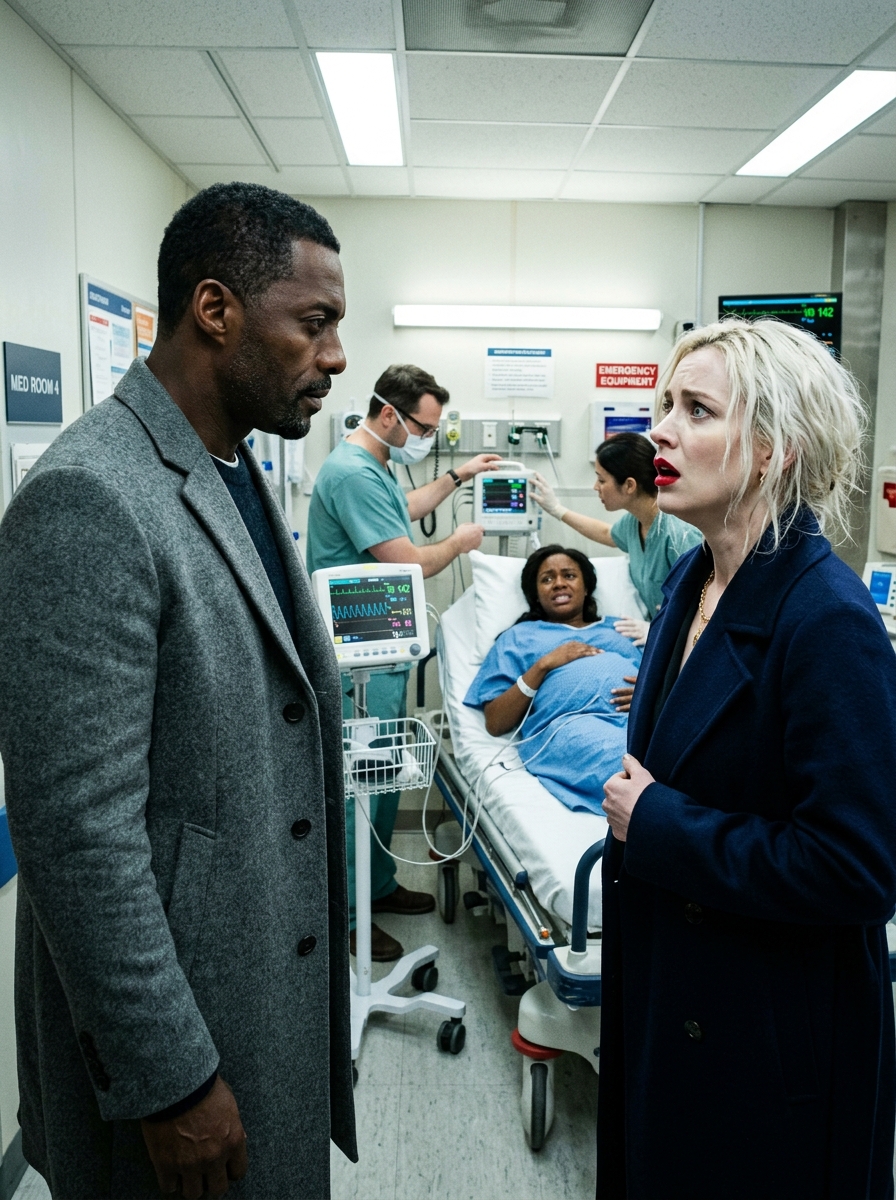
Victoria turned her gaze on me, dripping with condescension. “A blanket? You risked your child’s life for a piece of cloth? That tells me everything I need to know about your fitness as a mother.”
That was the moment something inside me snapped. The twelve-year-old girl who kept singing while her world ended finally stopped. I looked up at her, my eyes wet but steady.
“It was my mother’s choir robe,” I said, my voice gaining strength. “She died in the middle of a song. That blanket is the only thing my daughter will have of her grandmother. But you wouldn’t understand that, would you? You don’t see people. You see obstacles. You see ‘things’ to be moved.”
Victoria opened her mouth for another insult, but a sharp beep from the monitor behind me cut her off.
Dr. Priya Nair, the airport’s on-call physician, walked in. She wasn’t looking at Victoria or the officers. She was staring at the long strip of paper from the fetal heart rate monitor she had attached minutes earlier.
The room fell silent. Even Victoria sensed the shift in the air.
Dr. Nair’s face had lost all professional neutrality. She looked at the strip, then at me, then at the monitor screen where a jagged red line kept dipping lower.
“What is it?” Malcolm asked, his voice cracking for the first time. “Priya, tell me.”
Dr. Nair didn’t answer right away. She shook her head, fingers flying over the keypad to recalibrate. “I’m not getting the recovery I want to see. The heart rate is dipping. It’s called a late deceleration.”
“What does that mean?” I asked, my heart hammering against my ribs.
Dr. Nair looked at me, and for the first time I saw genuine fear in a doctor’s eyes. “It means the baby is under significant stress, Naomi. The impact might have caused a partial placental abruption.”
She turned to the officers, her voice sharp. “I need an ambulance on the tarmac now. Not the front entrance—the tarmac. We’re bypassing the ER and going straight to Labor and Delivery at Grady. Move!”
The room erupted. Officer Ramirez grabbed his radio. Ethan dropped his tablet.
But Victoria Langley stood her ground. She actually stepped in front of the door as the medics tried to push a gurney inside.
“This is a stunt,” Victoria hissed, though she looked slightly less certain. “You’re overreacting to protect your friend. I know how these things work.”
Malcolm didn’t argue or shout. He walked right up to Victoria, so close she had to tilt her head back. He leaned in and whispered something in her ear that made her entire body go rigid.
I didn’t hear what he said, but I saw the result. Victoria’s hand flew to her throat. She stepped aside, mouth hanging open.
As they lifted me onto the gurney, I saw the discarded blue brochure on the floor, crushed under the medics’ boots. I looked at Malcolm, who held my hand so tightly I thought he might break it.
“Is she going to be okay?” I sobbed. “Malcolm, is she going to die because I couldn’t move fast enough?”
“No,” Malcolm said, his eyes burning with a fire I had never seen. “She is going to be fine. But Victoria Langley? She is already dead. She just doesn’t know it yet.”
As we were wheeled out toward the ambulance bay, the bright airport lights felt like searchlights. People stared, filmed, and whispered. I saw Denise standing by the gate. She gave me a small, solemn nod.
But as the elevator doors began to close, I saw Dr. Nair look down at the monitor one last time.
The beeping of the heart monitor, which had been a steady thump-thump-thump, suddenly stretched into a long, terrifying flat drone.
**CHAPTER 3 — The Silence Is Broken**
The ambulance ride to Grady Memorial blurred into siren wails and the terrifying rhythm of the heart monitor. Malcolm held my hand so tightly I could feel the pulse in his fingertips. Every bump in the Atlanta streets made me wince from a new dull, heavy pressure in my lower back.
“Stay with me, Naomi,” Malcolm whispered, his eyes never leaving mine. “Just breathe. Focus on me.”
I tried. But my mind stayed in that airport corridor, replaying the moment Victoria’s shoe met my skin. I kept thinking about the baby—how she had been kicking all morning, excited by the airport hum, and how quiet she was now.
At the hospital, the doors burst open. A team of nurses and an unfamiliar resident rushed me into a bright white hallway. Malcolm was stopped at a set of swinging double doors.
“I’m the Chairman of the Board at Langley! I’m a surgeon!” he shouted, desperation clear in his voice.
“Right now, you’re a father, Dr. Carter,” a nurse said firmly, placing a hand on his chest. “Let us work.”
I was wheeled into a room that smelled of ozone and antiseptic. For the next hour I was poked, prodded, and scanned. I lay staring at the ceiling tiles, counting the dots to keep from screaming. In my head I was back in that church pew at twelve. I was singing. I was being “the strong one.” I was making sure no one else felt uncomfortable while my mother’s body was carried out the back.
I have to stop being quiet, I thought. If I’m quiet now, I’m losing her.
While I remained trapped in the sterile silence of the high-risk unit, a different storm broke back at Hartsfield-Jackson.
Victoria Langley paced in a private holding room near the Delta assistance desk like a caged panther, her heels clicking in a frantic, uneven rhythm. Ethan sat in the corner with his head in his hands.
“This is a shakedown, Ethan! Do you hear me?” Victoria spat, gesturing wildly with her phone. “That doctor is in on it. That ‘husband’ is probably some low-rent actor they hired to play the part of a businessman. Malcolm Carter? Please. The Chairman is a ghost. Nobody has seen him in a year.”
“Victoria,” Ethan whispered, his voice trembling. “I looked him up. On the internal portal. The private one.”
“And?”
Ethan turned his tablet toward her. It showed a grainy photo of Malcolm Carter from a medical gala three years earlier. He was younger and clean-shaven, but those cold, piercing surgical eyes were unmistakable.
Victoria’s breath hitched. She stared at the screen for ten long seconds, then straightened her coat.
“So he has a title. So what? I’m a Langley. My name is on the building. He’s an appointee. I’ll have him removed for conflict of interest before the sun comes up.”
The door opened. Officer Ramirez entered, looking grimmer than before. “Mrs. Langley, I need you to come with me to the security office. We’ve reviewed the footage.”
“I’m not going anywhere until my legal counsel arrives,” Victoria snapped.
“Actually, you are,” Ramirez said. “Because the woman who was filming just handed over a second video. One from before the incident.”
Victoria’s face paled, but she kept her edge. “Whatever she recorded was out of context.”
“In the video,” Ramirez continued, his voice heavy with disgust, “you are clearly heard telling your assistant, and I quote: ‘If these people don’t move, I’m going to give them a reason to run. They think being pregnant makes them a protected species. It makes them a target.’”
Victoria laughed—a thin, brittle sound. “That’s a figure of speech, Officer. Surely you understand the stress of high-level travel. I was venting.”
“You weren’t venting, Victoria,” a voice boomed from the doorway.
It was Malcolm. He had returned from the hospital, overcoat gone and shirt sleeves rolled up. He looked less like a husband and more like a judge. Behind him stood the airport’s lead legal counsel.
“Malcolm, darling,” Victoria said, her voice dripping with fake sweetness. “Let’s be reasonable. I had a momentary lapse in judgment. Travel fatigue is real. I’m happy to cover the medical bills, and perhaps a generous donation to your wife’s… charity?”
Malcolm walked into the room until he stood inches from her. Victoria flinched despite her bravado.
“My wife is in a surgical prep room because you caused a placental tear,” Malcolm said. Each word was jagged glass. “Our daughter’s heart rate is fluctuating because you thought a moving walkway was a throne room.”
“I didn’t know who she was!” Victoria cried, her voice rising to a screech. “How was I supposed to know she was married to you?”
“That,” Malcolm said, “is exactly why you are unfit to lead a company that specializes in human life. You only care about the people you think have the power to hurt you. You have spent your entire career stepping on those you think are beneath you.”
He turned to the legal counsel. “I want the board on the line. Now. Not tomorrow morning. Now.”
“You can’t do that,” Victoria hissed. “I have voting blocks. My family—”
“Your family sold their soul for profit years ago, Victoria. And the board has been waiting for a reason to excise the cancer from this company. Tonight, you gave it to them on a silver platter. With audio and video.”
Back at the hospital, the silence finally broke.
I was lying in the dark when a nurse came in. She took my hand without a word.
“Naomi? The doctor is coming back. We need to talk about an emergency C-section.”
The fear hit like a cold wave, but for the first time I didn’t try to be “good.” I didn’t try to be “strong” for the nurse. I gripped her hand until her knuckles turned white.
“Is my baby okay?” I demanded. No more whispering. No more apologies. “Tell me the truth. Is she okay?”
The nurse looked surprised by the fire in my voice. “She’s fighting, Naomi. But we need to get her out. Now.”
As they prepped me for surgery, the unit doors swung open. It wasn’t Malcolm. It was Denise from the airport. She clutched a clear plastic bag.
“They wouldn’t let me in,” Denise panted, security guards behind her. “But I told them I had a delivery for the mother.”
She held up the garment bag. Inside was the white lace christening blanket—wrinkled, stained with tea, plastic torn. But it was there.
“I went back and got it from the walkway,” Denise said, eyes welling with tears. “I cleaned it as best I could in the sink. I figured you’d want it close.”
I reached out and touched the lace through the plastic. The fabric of my mother’s robe. A sudden overwhelming peace washed over me. My mother hadn’t been quiet when she sang. She had filled the room. She had made people listen.
“Thank you,” I whispered.
Then I looked at the nurse. “Let’s go. My daughter is waiting.”
Back at the airport, in a soundproof glass conference room overlooking the dark tarmac, the screens flickered to life. Nine faces appeared—the titans of the medical industry, the Langley Biomedical board.
Victoria Langley sat at the far end of the table, hands trembling so violently she hid them under the mahogany. Her diamond bracelet tapped against the wood—tap, tap, tap—the sound of a clock ticking down to zero.
“Chairman Carter,” the board secretary said. “We have reviewed the files you sent over. The airport footage, the witness statements, and the internal HR complaints regarding Mrs. Langley’s treatment of pregnant staff members over the last three years.”
Victoria’s head snapped up. “What staff members? Those were performance-based transitions!”
“We have the NDAs, Victoria,” Ethan said from the corner, his voice finally firm. He held up a file taken from her own carry-on. “I couldn’t do it anymore. I’m done covering for you.”
Malcolm stood at the head of the table. He looked at the faces on the screen, then at the woman who had tried to kick the life out of his family.
“Victoria,” Malcolm said, “you once told me that ‘softness costs money.’ Tonight, your cruelty is going to cost you everything.”
For the first time all evening, Malcolm Carter raised his voice, and every Langley executive on the call went silent.
**CHAPTER 4 — The Gavel Falls**
The glass-walled briefing room in the private aviation suite felt like an aquarium suspended above chaos. Below, through the floor-to-ceiling windows, the Hartsfield-Jackson concourse remained a river of moving bodies, travelers unaware that a corporate execution was happening thirty feet above them.
The room was chilled to exactly sixty-eight degrees, but Victoria Langley was sweating. Moisture ruined the perfect set of her platinum hair, and her crimson lipstick looked like a jagged wound on her pale skin.
“Who authorized this circus?” Victoria demanded, her voice cracking as she glanced from the giant monitors to Malcolm at the head of the table. “This is a secure area. Malcolm, tell these people to leave. We can discuss your… settlement… in private.”
Malcolm didn’t move. He stood with his hands resting on the back of a leather chair, his face unreadable as a mountain. Beside him sat my suitcase—the wheel still jammed, the clear plastic bag torn, and the white christening blanket visible inside like a flag of surrender.
“You aren’t in a position to demand anything, Victoria,” Malcolm said. His voice wasn’t loud, but it carried a weight that sucked the oxygen from the room.
“I am the acting CEO of this company!” she shrieked, turning toward the monitors where the board members sat in grim silence. “Arthur? Julian? Are you seeing this? A chairman is holding a kangaroo court in an airport lounge because his wife had a stumble? This is a liability! We should be suing them for the PR damage!”
Arthur, the oldest board member, cleared his throat. His face on the screen showed deep disappointment. “Victoria, the PR damage was done the moment you raised your foot. We’ve already received three inquiries from major news outlets. Someone in Terminal B has already leaked a partial video to Twitter. It has four million views.”
Victoria’s hand went to her throat. Her diamond bracelet tapped against the glass table—click, click, click—the sound of a heartbeat running out of time.
“I was stressed!” she cried. “The merger… the travel… she was in my way! Do you know what happens to a company when its leaders are slowed down by every person who can’t manage their luggage?”
“You didn’t block a walkway tonight, Victoria,” Malcolm said, stepping forward. “You exposed an entire company. You showed the world that the ‘Langley Way’ isn’t about medical innovation. It’s about the belief that some lives are obstacles and others are elite.”
He leaned over the table, eyes locked on hers. “You kicked my wife while she was carrying my daughter. You looked at a pregnant woman in distress and saw a ‘performance.’ You didn’t just break the law; you broke the one thing a medical company cannot survive without: the public trust.”
“You can’t fire me,” she whispered, eyes darting toward the door. “The bylaws… the family shares…”
“The bylaws state that a CEO can be removed for ‘conduct unbecoming’ and ‘gross moral turpitude’ by a two-thirds vote of the board,” the board secretary intervened. “And as for the family shares… your uncle passed his voting proxy to the Chairman three months ago, Victoria. He was tired of the lawsuits you kept settling in secret.”
Victoria’s mouth opened and closed like a fish gasping for air. She turned to Ethan in the corner. “Ethan! Tell them! Tell them she provoked me! Tell them she was aggressive!”
Ethan slowly looked up. His eyes were red, but he no longer looked afraid. He looked relieved.
“She didn’t say a word to you, Victoria,” Ethan said, his voice steady. “She apologized. She said she was sorry. And you told me earlier that morning that you wanted to ‘clear the weeds’ from the office. You weren’t stressed. You were enjoying it.”
The silence that followed was absolute.
“The motion is on the floor,” the board secretary announced. “To remove Victoria Celeste Langley as acting CEO and President, effective immediately, for cause. All in favor?”
One by one, the tiles on the screen turned green. Arthur: Aye. Julian: Aye. Sarah: Aye.
“Wait!” Victoria lunged toward the screen. “I’ll resign! I’ll step down quietly! Just don’t do this! Think of the stock price!”
“The stock price will recover,” Malcolm said. “But my daughter’s safety is non-negotiable.”
The final vote came in. Nine to one.
“The motion carries,” the secretary said. “Victoria, security will escort you to your private jet—not to fly, but to retrieve your personal items. Your corporate accounts are frozen. Your access is revoked.”
Victoria sank into her chair. The billionaire heiress who had treated the airport like her throne room suddenly looked small and haggard. Her power had never truly been hers; it was a cloak, and Malcolm had stripped it away.
“Officer Ramirez?” Malcolm called out.
The officer stepped forward, handcuffs glinting. “Mrs. Langley, you are under arrest for felony assault. You have the right to remain silent…”
As they led her out, Victoria passed the suitcase one last time. She looked at the christening blanket—the hand-sewn lace from a dead woman’s choir robe—and for a fleeting second, a flicker of realization crossed her eyes. Or perhaps it was simply the fear of a woman who finally understood that the “obstacles” of the world have names.
**TWO WEEKS LATER**
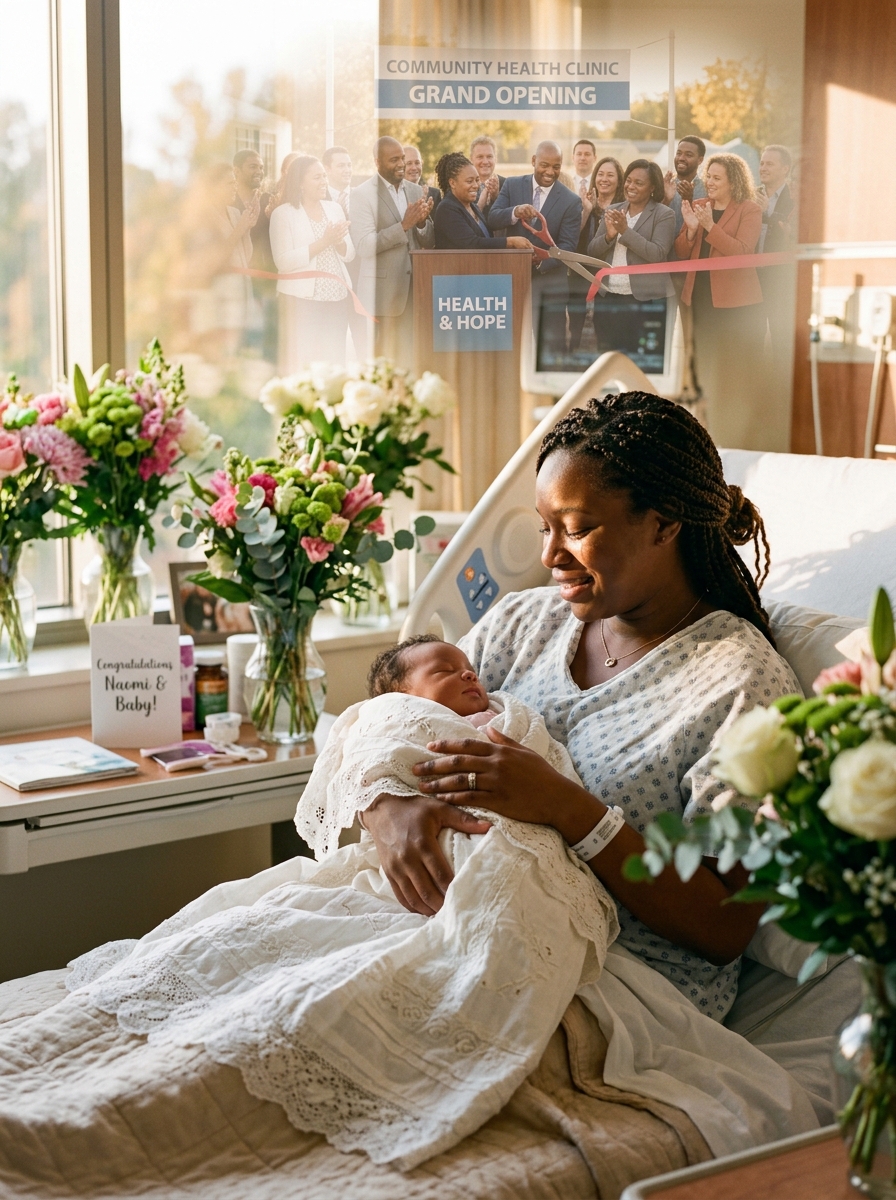
Sunlight streamed through the windows of the Grady Memorial maternity ward. The room overflowed with flowers—so many the nurses joked it looked like a botanical garden.
I sat up in bed, the dull ache of surgery fading into memory. In my arms, wrapped tightly in the white satin christening blanket, was Grace Elise Carter. She was small, and her cry was loud and demanding, filling every corner of the room.
The doctors called her a miracle. The placental tear had been serious, but the emergency C-section had been perfectly timed. She was healthy. She was perfect.
Malcolm sat beside me, his laptop closed for the first time in a week. He reached out and touched Grace’s tiny hand. She gripped his finger with surprising strength, making him smile.
“I spoke to the board today,” he whispered. “The independent investigation is complete. They found seventeen other women Victoria had bullied into silence. They’re all being compensated. The maternal-health partnership is being renamed after your mother, Naomi. It’s going to fund clinics in every underserved zip code in the state.”
I looked down at Grace. She slept peacefully now, her chest rising and falling in a steady rhythm.
“She’s never going to be quiet, Malcolm,” I said, my voice thick with emotion. “I’m going to teach her that she never has to apologize for taking up space. I’m going to tell her that her grandmother’s voice is in this lace, and her father’s strength is in her blood.”
“And her mother’s courage,” Malcolm added, kissing my forehead. “The woman who finally decided to stop singing for the crowd and start speaking for herself.”
**THE FINAL IMAGE**
A month later, news cameras gathered outside the new Naomi Elise Community Clinic on a bright, crisp December morning.
I stood at the podium in a navy wool coat, holding Grace against my chest. Malcolm stood ten feet behind me, leaning against a pillar with quiet pride that needed no title or gavel.
Hundreds of people had come—doctors, mothers, and even Denise, sitting in the front row in her best Sunday hat.
When it was my turn to speak, I ignored the prepared script. I looked at the crowd, at all the women who had spent their lives being told to move, to hurry, to stay quiet, to not be a “problem.”
I thought about that day in Terminal B. I thought about the cold floor and the pointed heel. And I thought about the moment I stopped being afraid.
“We are here today,” I said, my voice clear and ringing, “because no one should ever be told that their life, or the life of their child, is an obstacle to someone else’s progress.”
As the ribbon was cut, a group of travelers walked by on the sidewalk, suitcases rattling over the pavement. One woman stopped when her bag caught on a crack in the cement. She looked up, panicked, checking if she was in anyone’s way.
I caught her eye. I didn’t move. I didn’t scowl. I simply waited, giving her the space and time she needed.
This time, I did not move out of anyone’s way. And I never would again.
**THE END.**
