


One phone call to the Pentagon was all it took to end their careers and prove to the world that injustice can never stay hidden for long. It was meant to be an ordinary drive through a quiet stretch of Louisiana, the kind of place most people only pass through on their way somewhere else. General Naomi Ellsworth had made drives like this a hundred times before.
No security detail, no flashing lights—just her, a rental car, and a deadline. She had a classified meeting scheduled at Barksdale Air Force Base, and no time for distractions. But somewhere between Lake Charles and Shreveport, just outside a small town called Mosswood, Naomi saw the signal bars on her secure phone beginning to drop. She needed to make a call.
Not later. Not in an hour. Now.
She spotted an old, half-forgotten gas station—Kelly’s Fuel and Food—and pulled into the cracked, uneven lot. It wasn’t impressive, but it would do. Naomi parked near the edge of the building, away from the front entrance where a few locals stood leaning on pickup trucks, talking in the heavy heat. She didn’t think twice about it.
To her, it was simply a place to take a quiet minute. She picked up her secure device, stepped outside for better reception, and raised the phone to her ear. “General Ellsworth, verifying identity. Initiating briefing,” she said, voice low and professional. On the other end, the Pentagon officer immediately began the briefing.
Sensitive movements, real-time directives—information only a handful of people were cleared to hear. Naomi’s eyes kept moving, scanning the lot the way she had been trained, while staying locked into the call. A few people near the pumps began glancing her way. She didn’t look like anyone who usually stopped here, and certainly not someone in authority.
She wore jeans, plain sneakers, a loose olive-green jacket, and a ball cap pulled low over short twists. Ordinary clothes—nothing that suggested a four-star general. And that was exactly how she intended it. But not everyone saw it that way.
Inside the station, a woman named Paula Sweeney was watching from behind the counter. Mid-50s, tight blonde bun, permanent lines etched from a life spent judging others. Paula didn’t see a decorated war hero. She didn’t even see a woman on a phone call. She saw what she wanted to see: trouble.
Paula picked up the old landline and called the Mosswood Police Department. She lowered her voice so customers wouldn’t hear. “Yeah, we got a suspicious woman out here by the pumps,” Paula said. “Real shady. Might be on drugs or something. Acting strange. Y’all better come check it out.” She hung up before anyone could ask questions.
Across town, two officers heard the call over the radio and rolled their eyes. Nothing ever happened in Mosswood. A little excitement wouldn’t hurt. They put on their sunglasses, jumped into their cruiser, and sped toward the station.
Meanwhile, Naomi stayed by her car, focused on the Pentagon briefing. Critical information continued flowing—orders and updates that couldn’t be interrupted. She had no idea trouble was already on its way.
Just as she reached for her next instructions, flashing lights reflected off the station windows, and the atmosphere shifted instantly. Cruisers screeched into the lot, gravel spraying beneath the tires. Naomi lowered her phone briefly, squinting at the red and blue lights. Two officers jumped out before the vehicle had fully stopped.
Officer Randall Cooper, mid-30s, buzzcut, barrel-chested, unhooked his holster. Officer Sha Delaney, younger, leaner, and eager, followed his lead. Both moved like men expecting confrontation. Naomi felt the air tighten. She calmly set the secure phone on her car hood and kept her hands visible, palms open.
Her voice remained steady. “Good afternoon, officers. How can I help you?”
“License and registration, now,” Cooper barked.
Naomi stepped forward slightly, reaching slowly for her wallet in her back pocket. “Absolutely. My ID is right here. I’m active duty military. General Naomi Ellsworth. I’m on official business.”
Delaney scoffed. “General, huh? You expect us to believe that?”
Naomi produced her military credentials and federal travel orders, extending them calmly. Cooper snatched them, barely glancing before shaking his head.
“This is fake,” he said, tossing her ID onto the hood.
Naomi blinked, stunned.
“Sir, I assure you—”
“Shut up,” Delaney snapped. “You think you can play us? Wrong town for that.”
A small crowd gathered—customers, workers, passing drivers who decided to stay. Some whispered, others laughed. No one intervened.
Naomi’s training pushed her to de-escalate, but instinct told her these men weren’t listening. They had already decided who she was—and more dangerously, who she wasn’t.
She tried again, voice low and controlled. “Please contact your supervisor. You’re making a serious mistake.”
But Cooper already had cuffs in his hand. “Turn around. Hands behind your back.” Naomi didn’t move. She held her position—not out of defiance, but because something inside her had snapped loose. Something heavy.
“I am a general in the United States Army.” she said, her voice sharp now. “You are unlawfully detaining me.”
Cooper laughed. Actually laughed so loud it carried across the pumps for everyone to hear. “Yeah. And I’m the president.”
“Now turn around.”
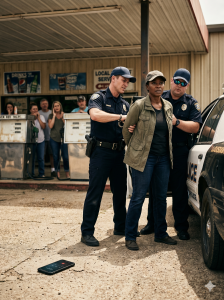
Before Naomi could speak again, Delaney seized her arm roughly. Cooper forced her other wrist behind her back. The cuffs snapped shut tight enough to bite into her skin. Naomi clenched her jaw, swallowing the sudden surge of humiliation that burned hot through her chest. Behind her, the secure phone—still connected to the Pentagon—hit the ground with a hard clatter.
The voice on the other end, hearing the chaos unfold, started calling her name. But the officers didn’t react. Or maybe they chose not to. Cooper shoved Naomi against the side of her rental car hard enough to rattle the door. Gasps spread through the small crowd. “Got her,” Delaney said, like they had just won something.
Naomi, breathing heavier now, stared forward at the dirty glass of Kelly’s Fuel and Food, her reflection broken and distorted by grime. In that moment, she wasn’t a general. She wasn’t even a person to them. Just someone to be handled because they could. But inside the Pentagon, alarms were already going off, and her disappearance would not stay hidden for long.
For illustrative purposes only
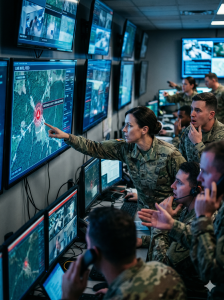
Back at the Pentagon, the secure call had shifted from unusual to critical in less than a minute. Lieutenant Commander Bryce Hanley, seated behind multiple monitors in Washington DC, stared at the blinking line labeled Jen Ellsworth. Secure. The audio feed was chaotic—background noise, scuffling, voices shouting words he couldn’t fully decipher. Then silence, broken only by static.
Bryce leaned into the microphone. “General Ellsworth, this is command operations. Do you copy? General Ellsworth respond.” No answer. He looked up at his supervisor, Colonel Dana Sharp, who was already moving across the room.
“Ping her location,” Sharp ordered, her voice cutting cleanly through the control room. “Right now.”
Within seconds, a technician brought up a blinking point on the map. It wasn’t near the base. She was stopped at a gas station off Highway 171 in Mosswood—a place most of the Pentagon had never even heard of.
Sharp leaned over Bryce’s shoulder, jaw tight. “Get Barksdale security on the line and patch me through to Jag. If something’s happened to Naomi, we’re moving immediately.”
Meanwhile, back in Mosswood, Naomi sat on the curb in handcuffs, her back against the station wall. “What’s your real name?” Delaney asked, looming over her. “Who you working for?”
Naomi exhaled slowly through her nose. “You have my ID, my travel orders. Everything you need is right there.”
Cooper snorted. “Lady, you’re about 2 seconds from being booked for obstruction. Don’t push it.”
Naomi said nothing. She refused to give them the satisfaction of a reaction. From the corner of her eye, she saw people filming, whispering, recording every second.
The manager, Paula, stood in the doorway with her arms crossed, smirking like she was watching entertainment unfold. The situation was spiraling, and no one seemed interested in stopping it.
Then Delaney’s radio crackled sharply. “Dispatch to Unit 3. Confirm you have detained subject.”
Cooper grabbed it immediately. “Affirmative. Female, early 40s, refusing to cooperate.”
A pause. Then: “Be advised, subject is flagged federal. Repeat, flagged federal. Pentagon has initiated emergency contact. Release immediately and await further orders.”
The color drained from Cooper’s face. Delaney’s expression dropped instantly.
“What the hell?” he muttered.
Naomi said nothing, just looked up at them.
Cooper fumbled with the keys and unlocked the cuffs without meeting her eyes. He muttered something that almost sounded like an apology but never fully became one.
Naomi rose slowly, rubbing her wrists where metal had dug into her skin. The crowd had gone completely silent. Even Paula’s smirk had disappeared.
Naomi picked up her phone from the ground. The screen was cracked. “Connection lost. Sensitive information possibly compromised.” She looked both officers dead in the eye. “You’re going to regret this,” she said quietly. “Not tomorrow, not next week, today.”
Cooper opened his mouth to respond, but new flashing lights flooded the lot. This time, it wasn’t local police. A convoy of black SUVs from Barksdale Air Force Base tore into the parking lot, tires screaming against the pavement.
But Naomi wasn’t waiting for backup.
She had already gathered herself for what came next. The doors of the black SUVs opened almost in perfect sync, like a scene staged for a film—but there was nothing cinematic about the urgency in the officers’ movements. No smiles, no greetings, only sharp commands and tense expressions. At the front was Lieutenant Colonel Darren Mosley, mid-40s, sharp-eyed and clearly not there to socialize.
He crossed the lot with long, decisive strides, a folder tucked under his arm, his attention locking straight onto Naomi. “General Ellsworth, are you injured?” Mosley asked, his voice projecting across the space.
Naomi shook her head once. “No, Colonel, minor abrasions. The bigger injury was to their careers.”
Cooper and Delaney shifted uneasily, realizing far too late how serious the situation had become.
The Air Force security team quickly formed a protective perimeter around Naomi, positioning themselves between her and the Mosswood officers without needing instruction. Mosley turned to the local police, his expression hardened to stone.
“You are hereby ordered to stand down pending federal investigation. Any further action on your part could be construed as obstruction of justice.”
Cooper stammered, “We didn’t know who she was.”
“That’s not an excuse,” Mosley cut in immediately. “You had documentation in your hand. You had everything you needed.”
Delaney tried to hold onto his authority. “She was acting suspicious.”
Mosley stared at him for a long moment, then said quietly, “You saw a Black woman on a phone call and made a choice. That’s going to follow you for the rest of your life.”
The Air Force team efficiently guided Naomi into one of the SUVs, ensuring she was seated safely inside. As the convoy pulled away, she looked back once—just long enough to see Cooper wiping sweat from his forehead with a shaking hand and Paula rushing back inside the station like she was hiding from the light.
Inside the vehicle, Naomi remained silent, staring out at the long stretch of highway, her thoughts moving faster than the SUV. After a while, Colonel Mosley broke the silence.
“Pentagon’s coordinating a full investigation, ma’am. Internal affairs, civil rights division. It’s going public whether Mosswood likes it or not.”
Naomi didn’t nod. She didn’t smile. She didn’t react.
“They should have known better,” she said simply.
Mosley gave a slow nod. “They’re going to learn what it feels like to be seen for exactly who they are.”
The convoy moved on, passing fields of tall grass and leaning telephone poles, heading toward the Air Force base where Naomi’s authority—and her dignity—would finally be restored.
But she understood the real battle was only beginning, and this time the entire country would be watching.
News of the incident broke into national headlines before Naomi had even finished her debrief at Barksdale. Someone had uploaded the cellphone footage online—raw, shaky video showing two Mosswood officers handcuffing a woman calmly stating she was a U.S. Army general.
No shouting, no struggle—just the unmistakable image of someone being stripped of dignity by people too convinced of their own assumptions to see the truth. It spread rapidly. By morning, Mosswood was no longer just a small dot in Louisiana—it had become the center of national outrage.
Networks replayed the footage nonstop. Commentators reacted in disbelief. Civil rights leaders called it a clear case of racial profiling and abuse of power. Even veterans’ organizations, usually cautious about political statements, demanded justice for General Ellsworth.
Back in Mosswood, the police department scrambled to control the fallout. Chief Vernon Grady, more accustomed to rural routine than press conferences, stood before a wall of cameras, sweat forming beneath his cowboy hat.
“We regret the misunderstanding,” he said stiffly, avoiding the reporters’ eyes. “The officers involved have been placed on administrative leave pending a full review.”
A reporter from Baton Rouge interrupted him mid-sentence. “Chief Grady, why were trained officers unable to recognize clearly presented military credentials? Was race a factor in this so-called misunderstanding?”
Grady stumbled, muttering about confusion and heightened tension, but it was clear to everyone watching—the department had no real defense left.
Meanwhile, Cooper and Delaney had gone silent. Their identities leaked within hours, spreading across headlines, social media, and public forums. Anonymous internal sources revealed both men had prior complaints—excessive force, racial profiling—buried in the past. Not this time.
Civil rights attorneys from New Orleans and Washington D.C. filed federal complaints on Naomi’s behalf. The Department of Justice launched an independent investigation. Even the Louisiana governor called the incident an “appalling miscarriage of justice against a national hero.”
It was no longer just about Naomi.
It had become about every person ever dismissed, doubted, or degraded because of a uniform they didn’t wear, a color they couldn’t change, or an assumption someone else refused to question.
At Barksdale, Naomi remained in constant briefings—lawyers, Pentagon officials, and White House liaisons all requesting updates.
She answered every question in the same steady tone she had once used to command troops in war zones. Yet when she was alone in the quiet of her quarters, the reality pressed heavily against her chest. Not because she was shocked, but because after all the medals, after all the service, after all the sacrifice, a dusty parking lot in Mosswood had still reduced it all to nothing.
Still, she hadn’t spent her life avoiding battles. And she had no intention of starting now. But if Naomi was going to speak, she knew it had to be on her own terms—not only for herself, but for every silent witness watching from the shadows.
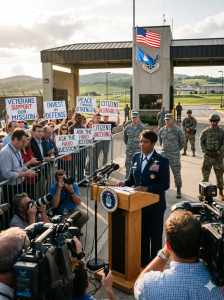
The press conference was set for noon on a Saturday outside the gates of Barksdale Air Force Base. Cameras were already arranged in tight, restless rows. Microphones were stacked two and three deep. Reporters spoke in low bursts into phones. The air was thick, heated, charged with the sense that something significant was about to unfold.
For illustrative purposes only
Naomi Ellsworth stood at the podium in her full dress uniform for the first time in months. Medals caught the light against deep blue fabric. Her posture was firm, her expression unwavering. She wasn’t there to entertain anyone. She wasn’t there to soothe discomfort.
Colonel Mosley stood off to the side, arms folded, watching with quiet vigilance. A few senior Pentagon officials stood nearby, faces set and serious. They had offered carefully prepared statements, diplomatic phrasing, and a safe route through the moment.
She had politely refused.
When Naomi finally spoke, her voice carried cleanly through the heat and noise, cutting through camera shutters and distant traffic. “My name is General Naomi Ellsworth,” she began. “I have spent 29 years serving this country, leading soldiers, advising presidents, defending the ideals written into the Constitution.”
“Yesterday in Moswood, Louisiana, none of that mattered.”
She paused, letting the silence settle.
“I was judged not by the content of my character, not by the uniform I’ve earned, but by the color of my skin and the assumptions made about me because of it.”
Reporters wrote rapidly, pens moving without pause. But Naomi wasn’t speaking to them. She was speaking to the people who had watched the video, who had felt that familiar tightening in their chest—the memory of being dismissed, doubted, or diminished.
“I’m not here today for an apology,” she said. “I’m here because silence is not an option. Accountability matters. Respect matters. Human dignity matters. And none of these are negotiable based on someone’s prejudice or someone’s ignorance.”
Behind the cameras, members of the local community stood gathered—Black families, veterans, students holding handwritten signs. Naomi saw their faces in fragments between lenses and lights. Some carried anger. Some carried hope. All of them were waiting for something rarely given. Real leadership.
“Injustice is not new,” Naomi continued. “But change only happens when enough people refuse to look away.”
She ended without flourish, without slogan, only truth. “I was not humiliated yesterday. They were, and history will remember it that way.”
She stepped away from the microphone without taking questions. The applause began scattered, uncertain, then grew into something fuller, something alive.
As she walked back toward the base, Naomi didn’t change her pace. Not faster, not slower. Just steady—one step after another—carrying more than her own story.
Because she knew the world would not change overnight. It might not even change in her lifetime.
But maybe, just maybe, it would change a little because she refused to stay quiet.
When you’re treated unjustly, your voice is your greatest weapon. Speak the truth even when your hands are shaking. Someone out there needs the strength you show. If you believe in standing up for dignity and accountability, share this story. Speak up when you see wrong. Change starts with people willing to call it by its.
