


CHAPTER 1
The air in the terminal felt recycled and thin, much like my own patience. At eighty-five, your bones warn you about the weather before the forecast does, and mine were screaming that a storm was coming. Not outside—the Ohio sky was a clear, piercing blue—but inside my chest. I was heading to see my granddaughter, Maya, graduate from medical school in Seattle. It was the only thing keeping me upright.
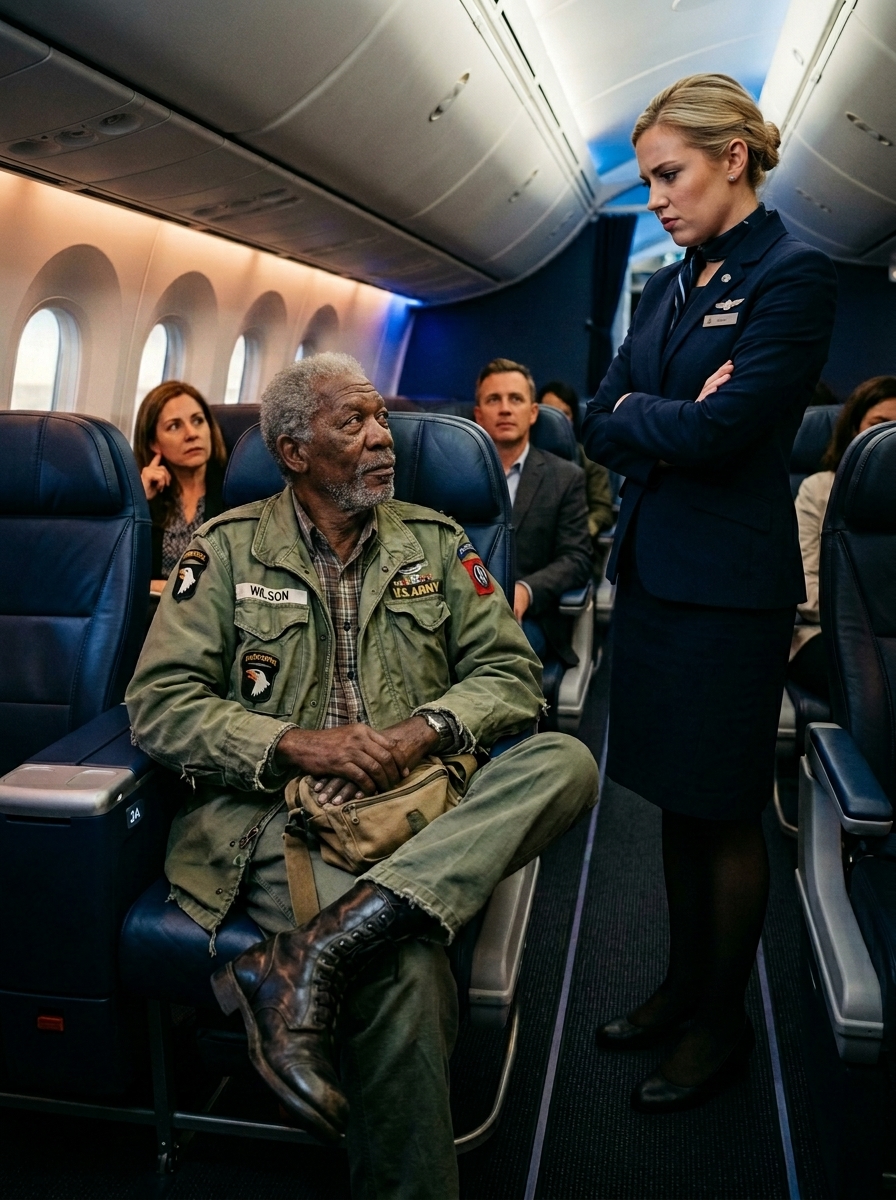
I walked toward Gate B12, leaning heavily on my cane. I wasn’t wearing a suit. I didn’t have a Rolex. I was wearing my old M-65 field jacket, the one I’d kept since my final tour. It was faded, the patches were frayed, and it smelled faintly of cedar and old memories. My boots were polished, but they were the same heavy-duty pair I’d worn for a decade. To most people in that terminal, I looked like a homeless man who’d wandered into the wrong building.
I didn’t mind. When you’ve survived the mountains of Afghanistan and the jungles before that, you stop caring about whether a stranger thinks you’re “stylish.”
“Boarding for First Class,” the agent announced.
I stood up, my knees popping like bubble wrap, and made my way to the front. I handed over my ticket—a seat I’d paid four thousand dollars for because my back couldn’t handle the cramped quarters of coach anymore.
The gate agent looked at the ticket, then at my jacket, then back at the ticket. She didn’t smile. She didn’t say, “Thank you for your service.” She just jerked her head toward the jet bridge.
I found seat 2A. It was plush, wide, and smelled like expensive leather. I sat down, let out a long sigh, and closed my eyes for a second. I just wanted to sleep until we hit the West Coast.
“Excuse me?”
The voice was high-pitched and sharp, like a whistle. I opened one eye. Standing in the aisle was a woman in her late twenties, her uniform perfectly pressed, her blonde hair pulled back so tight it looked painful. She wasn’t looking at me; she was looking at my jacket.
“Sir, I think there’s been a mistake,” she said. She didn’t offer a greeting. “The economy cabin starts at row 20.”
“No mistake, ma’am,” I said, my voice gravelly but polite. “2A. I checked it twice.”
“Can I see your boarding pass?” she asked, her hand already out, palm up. It wasn’t a request; it was a demand.
I pulled it from my pocket and handed it to her. She squinted at it, her nose wrinkling as if the paper itself smelled bad. Across the aisle, a man in a bespoke navy suit looked up from his Wall Street Journal. He looked at me, then at the flight attendant, and let out a loud, theatrical huff.
“Is there a problem, Tiffany?” the man asked. He looked at me like I was a grease stain on a white shirt. “I paid for a premium experience, not to sit next to a… well, you see the situation.”
Tiffany, the flight attendant, gave him a sympathetic look. “I’m so sorry, Mr. Sterling. We’re handling it.”
She turned back to me, her voice dropping the fake sweetness. “Sir, this seat is reserved for our elite passengers. There must have been a glitch in the system. I’m going to have to ask you to move to the back. We have a middle seat in row 34 that’s open. It’ll be much more… appropriate for you.”
I felt a heat rising in my neck—a heat I hadn’t felt in years. “I paid for this seat, Tiffany. Full price. I’m not moving.”
The man in the suit, Sterling, laughed. “Full price? With what? Your pension check? Look, old man, you’re making people uncomfortable. Look at your clothes. You’re dirtying up the upholstery. Just go to the back before we have to call security.”
At that moment, the plane grew quiet. I realized that the group of young men sitting in the rows just behind us—military academy students by the looks of their haircuts and posture—were all watching. One of them had his phone out, recording.
“I am an American citizen, a veteran of two wars, and I have a valid ticket for this seat,” I said, standing up slowly. I was shorter than the man in the suit, but I stood as straight as my spine would allow. “I am not moving.”
Tiffany’s face turned a blotchy red. She stepped back and grabbed the intercom. “Security to Gate B12. We have a non-compliant passenger in First Class.”
The passengers started whispering. Some were recording, some were looking away in embarrassment, and Sterling was just smirking, waiting for the “trash” to be cleared out.
I sat back down and buckled my seatbelt. My heart was racing, but my hands were steady. I knew something they didn’t. I knew that the man who’d just signed the acquisition papers for this struggling airline was currently being threatened with eviction from his own property.
But more importantly, I knew the name of the man who was about to walk out of that cockpit.
**CHAPTER 2**
The silence that followed Tiffany’s call for security was heavy, like the air right before a tornado touches down in the Midwest. I sat there, my hands folded over my lap, feeling the eyes of every passenger on me. To my left, Sterling was smirking, a man who believed that money bought the right to be a bully. Behind me, the young men from the academy had gone silent, their phones still held up like digital witnesses.
“Sir,” Tiffany said, her voice trembling with a mix of anger and self-righteousness. “This is your last chance. If you don’t move now, I will have you forcibly removed from this aircraft. You are interfering with flight operations.”
I didn’t blink. I didn’t raise my voice. “I am sitting in the seat I purchased. If you want me out of it, you’ll have to justify why a veteran with a valid ticket is being evicted to satisfy the ego of the man in 2B.”
Sterling let out a dry, jagged laugh. “Veteran? Please. You probably found that jacket in a donation bin. Look at you. You’re a disgrace to the uniform if you even served.”
At that moment, the cockpit door opened with a metallic click. A man in a crisp pilot’s uniform stepped out. He was tall, his hair peppered with gray at the temples, carrying the weight of thousands of flight hours on his shoulders. This was Captain Miller. To the rest of the passengers, he was just the pilot. To me, he was the nineteen-year-old kid I’d dragged through the mud and blood of a valley in the Hindu Kush while bullets chewed up the ground around us.
Tiffany scurried over to him like a child looking for protection. “Captain, thank God. We have a situation in 2A. This individual is refusing to comply with crew instructions. He’s being aggressive and making the other first-class passengers uncomfortable. I’ve already called for airport police.”
Captain Miller didn’t look at her. His eyes were fixed on me. I saw the moment the recognition hit him. It wasn’t a gradual realization; it was a physical shock. His face went from professional mask to ghostly pale in three seconds. He looked like he’d seen a ghost—because, in a way, he had. He hadn’t seen me in fifteen years, not since the day they medevacked him out and I stayed behind to finish the job.
“Captain?” Tiffany prompted, her brow furrowed. “The police are on the jet bridge.”
Miller ignored her. He took a slow, deliberate step toward me. The entire cabin held its breath. Sterling leaned back, crossing his arms, clearly expecting the Captain to drag me out by my collar.
“Sir?” Miller’s voice was barely a whisper. It wasn’t the voice of a Captain; it was the voice of that terrified private I’d saved a lifetime ago. “Is that… is that really you?”
I looked him dead in the eye and gave him a tiny, almost imperceptible nod. “It’s been a long time, Miller. You’ve put on some rank since the valley.”
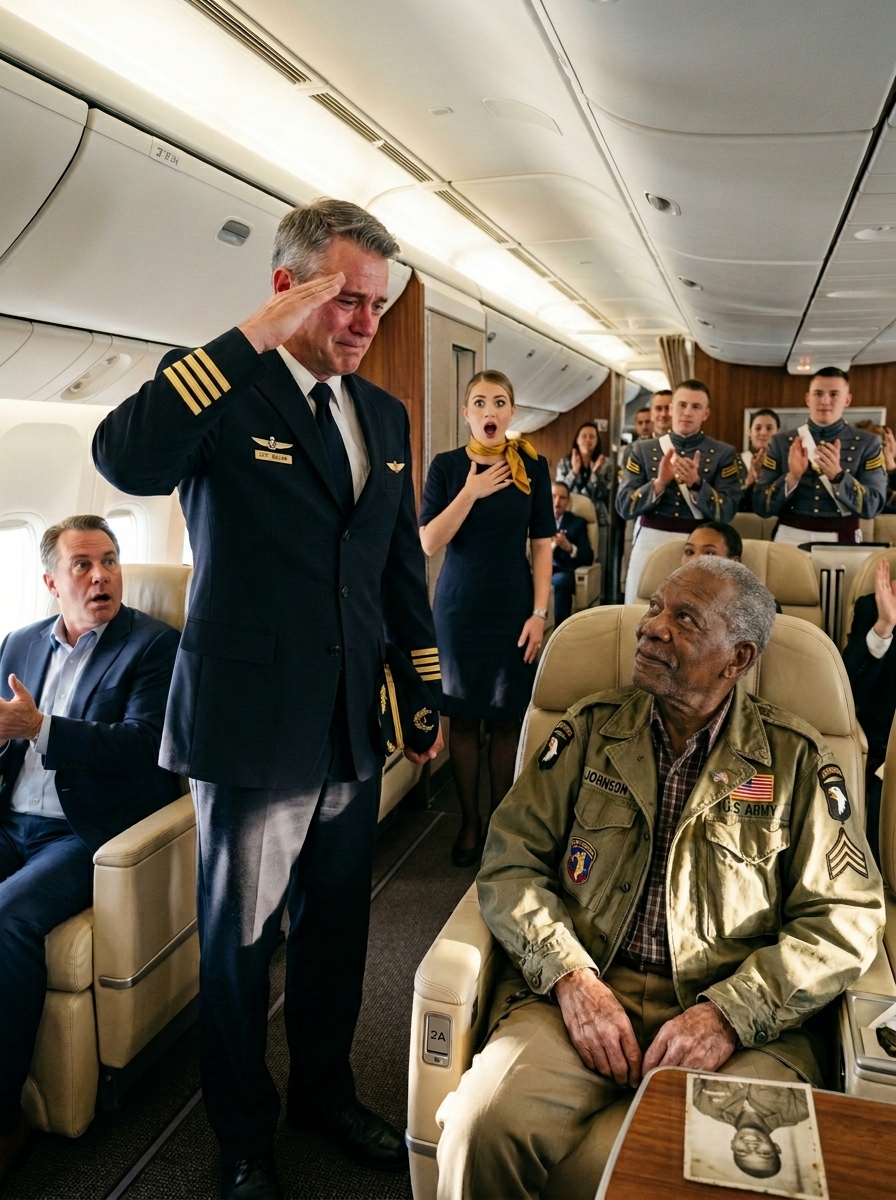
The Captain didn’t say another word. Instead, he did something that made the entire first-class cabin gasp. He snapped his feet together, pulled his shoulders back, and brought his hand to his brow in a razor-sharp, trembling military salute. He didn’t care about the passengers, the flight attendant, or the wealthy man in the suit. He stood there, at rigid attention, honoring the man everyone else had just spent ten minutes trying to humiliate.
The silence was now deafening. Tiffany’s mouth actually hung open. Sterling’s smirk vanished, replaced by a look of profound confusion.
“Captain?” Tiffany stammered. “What are you doing? This man is—”
“This man,” Miller said, his voice now booming with an authority that shook the cabin, “is the reason I am standing here today. He is the reason I have a wife and children. He is a Medal of Honor recipient, and if he wants to sit in this seat, he sits in this seat. In fact, he could sit in my damn cockpit if he wanted to.”
He turned his gaze toward Sterling, and the look in his eyes was cold enough to freeze jet fuel. “And as for you, sir, if you have a problem with my friend’s attire, I would be more than happy to find you a seat in the very last row of economy. Or better yet, you can wait for the next flight. My plane, my rules.”
Sterling opened his mouth to protest, but the words died in his throat. He looked around and realized he was suddenly the most hated person on the aircraft. The military students in the back began to clap—low at first, then louder, until the sound filled the cabin.
But the twist was only beginning.
I looked at Tiffany, who was now backed against the galley wall, her face a mask of horror. “I appreciate the gesture, Captain,” I said, standing up and smoothing out my old jacket. “But I think there’s someone else we should call before the police get here. We need to talk about the new ownership of this airline.”
I pulled a second document from my jacket—not a boarding pass, but a notarized acquisition summary.
“Tiffany, was it?” I asked quietly. “You mentioned that I didn’t belong ‘up front.’ Well, as of nine o’clock this morning, I own this entire fleet. And I don’t think you belong on my payroll.”
The color didn’t just leave her face; it seemed to leave her soul. She looked at the paper, then at the Captain, who was grinning for the first time.
“You bought… the airline?” she whispered.
“I bought it to save it from bankruptcy,” I said. “Because I care about the people who work here. But I don’t think you’re one of those people anymore.”
Just then, the airport police burst through the door, zip-ties in hand. They headed straight for me, but Captain Miller stepped in their way, his arms crossed.
“Change of plans, fellas,” the Captain said. “The man you’re looking for isn’t the one in the jacket. He’s the one in the suit—and the lady who called you. We’ve got a lot to sort out before this bird takes off.”
The drama was escalating, and the students in the back were capturing every single second of it. I knew that by the time we landed, the whole world would know what happened in Seat 2A. But I wasn’t done yet. This wasn’t about revenge; it was about a lesson that was long overdue.
**CHAPTER 3**
The silence in the first-class cabin was thick enough to choke on. Every eye was locked on the small, notarized folder I held in my hand. Tiffany, the flight attendant who had just minutes ago treated me like a stray dog, looked like she was about to faint. Her hands were gripped so tightly around the edge of the galley counter that her knuckles were ghostly white.
“Captain,” I said, my voice steady, “I’m sure you’re aware that Global Sky Air was on the brink of liquidation. The board of directors finalized the sale this morning. I’m the majority shareholder of the investment group that stepped in.”
Captain Miller didn’t even look at the papers. He didn’t need to. He knew me. He knew that when I said something was done, it was done. He looked at Tiffany, then at the two airport police officers who were standing awkwardly in the aisle, looking like they wanted to disappear into the carpet.
“Gentlemen,” Miller said to the officers, “this man is the owner of this aircraft. Unless you’re planning on arresting a man for sitting in his own chair, I suggest you clear the jet bridge.”
The officers didn’t wait for a second invitation. They turned and beat a hasty retreat. But the atmosphere inside the plane was still electric.
I turned my attention to the man in the navy suit, Mr. Sterling. He was trying to shrink into his seat, his expensive leather briefcase pulled up to his chest like a shield. He didn’t look so “elite” anymore. He looked like a bully who had just realized he’d picked on the wrong person.
“Mr. Sterling,” I said, stepping closer. I didn’t raise my voice; I didn’t need to. “You were very concerned about the ‘upholstery’ and the ‘premium experience.’ You felt that my presence here devalued your four-thousand-dollar ticket.”
Sterling gulped. “Look, I… I didn’t know. I was just… it’s a misunderstanding.”
“It’s not a misunderstanding,” I countered. “It’s a character flaw. You looked at a man in an old jacket and decided he wasn’t human enough to sit next to you. You didn’t see a father, a grandfather, or a veteran. You saw a budget. And that is exactly why this airline was failing—because it started catering to people who think money is a substitute for decency.”
I turned back to Tiffany. She was shaking now, her eyes darting toward the cockpit as if hoping for a miracle. “Tiffany, I’m not going to fire you right this second. Not because you don’t deserve it, but because I want you to work this flight. I want you to spend the next five hours serving every person on this plane with the same respect you would give a billionaire. I want you to look at every passenger—the elderly woman in 32B, the kid with the backpack in the last row—and I want you to remember that you have no idea who they are or what they’ve sacrificed.”
Her voice was a tiny squeak. “Yes, sir. I… I’m so sorry, Mr. Grant.”
“Don’t apologize to me,” I said. “Apologize to the uniform you’re wearing. You’ve disgraced it.”
As I sat back down, the cabin erupted. The military academy students in the rows behind me began to whistle and cheer. One of them, a young man with sharp eyes and a buzz cut, stood up.
“Sir!” he called out. “Permission to speak?”
I smiled. “Granted, son.”
“I’m Cadet Miller—no relation to the Captain. We’ve been watching this whole thing. We’ve got it all on video. The way you stood your ground… it’s exactly what they teach us at the academy. It’s an honor to fly with you, sir.”
I felt a lump in my throat. These kids were the future. They were the ones who would be carrying the torch when I was long gone. “Thank you, Cadet. Just remember: a leader isn’t the one with the loudest voice or the most expensive suit. A leader is the one who stands up when everyone else is trying to keep someone down.”
Captain Miller leaned over and whispered to me, “Sam, I need to get back to the flight deck so we can get this bird in the air. But after we land in Seattle… we’re talking. I owe you more than just a salute.”
“You don’t owe me a thing, Miller,” I said, patting his arm. “Just fly the plane.”
As the Captain returned to the cockpit, the tension began to bleed out of the cabin, replaced by a strange, buzzing energy. Passengers who had previously ignored me were now leaning over their seats to get a glimpse of “the man who bought the airline.”
But I wasn’t interested in the fame. I leaned my head back and closed my eyes, the hum of the engines beginning to vibrate through the floorboards. I thought about the mountains in Afghanistan. I thought about the night I carried a bleeding Miller through a ravine while the world was exploding around us. I remembered the weight of him on my shoulders, the way my lungs burned, the way I refused to let him go.
Back then, I didn’t care about “appropriate attire.” I didn’t care about “elite status.” I only cared about the man next to me.
I drifted into a light sleep as the plane taxied toward the runway. But even in my dreams, I could feel the eyes of the passengers. The story was already moving. The video the cadet had filmed was being uploaded to the plane’s Wi-Fi. By the time we reached thirty thousand feet, the incident at Gate B12 was trending across the country.
The world was about to learn a very important lesson about Samuel Grant. And the wealthy Mr. Sterling was about to find out that his “premium experience” was just beginning.
We were two hours into the flight when the second twist of the journey occurred.
The “fasten seatbelt” sign dinged, and the Captain’s voice came over the intercom. But he wasn’t giving the usual weather report.
“Ladies and gentlemen, this is Captain Miller. I usually don’t do this, but we have a very special guest on board today. Most of you saw what happened during boarding. What you don’t know is the history behind that man in seat 2A.”
The cabin went silent. Even the sound of ice clinking in glasses stopped.
“Fifteen years ago, I was a nineteen-year-old kid in a place called the Korengal Valley. I was wounded, pinned down, and 100% sure I was going to die. A Sergeant named Samuel Grant ignored direct orders to retreat. He ran through two hundred yards of open fire, picked me up, and carried me to safety. He took a bullet in the shoulder doing it. He never asked for a thank you. He never asked for a medal.”
I opened my eyes, feeling a heat in my cheeks. I hadn’t expected him to go public with it.
“Today,” Miller’s voice crackled slightly, “somebody told him he didn’t belong in First Class because of his jacket. Well, I just wanted to let you all know that as long as I am the Captain of this flight, Mr. Grant belongs wherever he damn well pleases. And for the rest of you… I hope you take a moment to think about the people who made it possible for you to sit in a pressurized cabin at 35,000 feet in total safety.”
When the intercom clicked off, the applause was thunderous. Even Tiffany was clapping, though her eyes were red-rimmed from crying.
But then, the plane took a sudden, violent lurch.
The nose dipped sharply. The oxygen masks dropped from the ceiling with a terrifying clack-clack-clack. Screams filled the cabin as the aircraft banked hard to the left.
I gripped the armrests, my old instincts kicking in. This wasn’t turbulence. This was a mechanical failure.
I looked toward the cockpit door. It remained closed, but the “Cabin Call” light was flashing frantically.
The “Secret Investor” and the “War Hero” was about to have one more role to play on this flight. Because as the plane began to lose altitude, I realized that the Captain who owed me his life was now in a position where he might have to give it up to save mine.
**CHAPTER 4**
The oxygen masks dangled like plastic ghosts in front of our faces. The cabin was a symphony of chaos—high-pitched screams, the frantic rustle of seatbelts being tightened, and the roar of wind as the plane fought against its own weight. I didn’t look at the masks. I looked at the cockpit door.
“Everyone, masks on! Breathe normally!” Tiffany shouted, her voice cracking. She was gripped by terror, but to her credit, she was trying to do her job.
I ignored the mask. At eighty-five, I’ve breathed enough air for ten lifetimes. I stood up, bracing my weight against the seats as the plane rolled another fifteen degrees to the left.
“Sir! Sit down!” Tiffany screamed at me, her eyes wide with panic. “You have to sit down!”
“Get out of my way, Tiffany,” I said. It wasn’t a suggestion. It was the voice of the Sergeant who had led men through hell. She froze, and I pushed past her toward the cockpit.
I pounded on the door. “Miller! Open up! It’s Sam!”
The door clicked open inches. The co-pilot, a young man whose face was slick with sweat, looked out. “Sir, you can’t be here—”
“I’m a mechanical engineer by trade and I own this damn plane,” I growled, shoving my way inside. “Now tell me what the hell is happening.”
The cockpit was a Christmas tree of red warning lights. The yoke was vibrating so hard in Miller’s hands that I could see his forearms bulging.
“Hydraulic failure in the left wing,” Miller shouted over the alarm. “The flaps are locked. We’re losing lift, and the autopilot just disconnected. I can’t level her out, Sam!”
“The manual override,” I said, pointing to a panel near the floor. “The old Boeing 737 models had a physical cable backup. This bird is a legacy refurb—is the cable still there?”
“It’s jammed!” the co-pilot yelled. “We pulled the lever, it won’t budge!”
“Give me the wrench,” I demanded.
I dropped to my knees—knees that had been shot, knees that had carried Miller across a desert—and crawled under the instrument panel. The air was thin, and my chest felt like it was being squeezed by a vice. I found the emergency cable housing. It was rusted, neglected by the previous owners who had skimped on maintenance to save a buck.
“You’ve got thirty seconds, Sam!” Miller yelled. “We’re dropping through ten thousand feet!”
I grabbed the metal housing with my bare hands. The heat was intense. I pulled. Nothing. I pulled again, screaming as the skin on my palms tore against the jagged metal. I didn’t feel the pain. I felt the lives of the two hundred people behind me. I felt the weight of those military students. I felt Maya’s face waiting for me in Seattle.
“C’MON!” I roared.
With a sickening crack, the rust gave way. The cable snapped into place.
“I’ve got pressure!” Miller shouted. “The nose is coming up! Sam, you did it! Get back to your seat!”
I crawled out from under the dash, my hands dripping blood onto the cockpit floor. I looked at Miller. He looked at me. There were no words. We were back in the valley. We were survivors.
I stumbled back into the cabin. The plane had leveled out, though it was still vibrating. The silence in the back was absolute. Every passenger was staring at me. They saw my blood-stained jacket. They saw my mangled hands.
I walked past Sterling. He looked at my bloody hands and turned green. He looked like he wanted to apologize, but he was too small of a man to find the words.
I sat in 2A. Tiffany approached me, her face wet with tears. She didn’t say a word. She knelt down, took a first-aid kit, and began to wrap my hands in gauze. She did it with a tenderness I hadn’t seen earlier.
“I’m sorry,” she whispered as she tucked the bandage. “I’m so, so sorry.”
“Just finish the flight, Tiffany,” I said softly.
When we touched down in Seattle, the landing was rough, but we were on the ground. The tarmac was a sea of red and blue flashing lights. Fire trucks and ambulances surrounded the plane like a protective ring.
As the engines whined down to a stop, the cabin remained silent. Usually, people are jumping up to grab their bags, pushing to get out. Not today.
I stood up, grabbing my bag with my bandaged hands.
“Sir?”
It was the military student, Cadet Miller. He and his classmates were standing in the aisle. They weren’t moving. They were forming two lines, creating a corridor from my seat to the exit.
As I walked toward the door, they snapped to attention. One by one, as I passed, they saluted. It was a silent tribute that echoed louder than any shout.
I reached the door where the Captain was waiting. Miller stepped out of the cockpit, his hat under his arm. He didn’t say anything. He just gripped my shoulder, his eyes glistening.
“I’ll see you for dinner, Sam,” he said. “My treat. For the rest of our lives.”
I walked down the jet bridge and into the terminal. A crowd had gathered at the gate. The video had gone viral. Millions of people had watched the old man in the jacket get insulted, and millions had watched the plane nearly go down.
A news crew tried to shove a microphone in my face. “Mr. Grant! You’re the new owner! Are you going to sue? Are you going to fire the staff? What’s your revenge?”
I stopped. I looked at the camera, then at the people watching.
“I don’t want revenge,” I said, my voice carrying through the terminal. “Revenge is for people who have nothing left to build. I want this airline to be a place where a man’s worth isn’t measured by his suit. I’m mandating a total retraining of every employee on this payroll—from the CEO to the janitors. We are going to learn how to see people again. Especially the veterans, the elderly, and the forgotten.”
I saw a flash of white in the distance.
“Grandpa!”
Maya came running through the crowd. She didn’t care about the cameras or the “Secret Investor.” She threw her arms around my neck, sobbing into my old green jacket.
“I saw the news,” she cried. “I thought I lost you.”
“Not today, honey,” I whispered, burying my face in her hair. “I had a flight to catch.”
As we walked away, I looked back one last time. The airline logo was glowing on the wall. It was my airline now. But as I looked at my bandaged hands and the girl beside me, I realized I’d already gotten the only thing I ever really wanted.
I was home. And for the first time in a long time, the world felt like it was finally heading in the right direction.
