


The War Hero Fell on the City Hall Steps. Then the Mayor Heard the Recording.
Chapter 1: The Fall on the Marble Steps
The old man struck the marble steps so hard the whole crowd heard the crack, but he did not scream.
He only lifted his bloodied face toward the golden doors of City Hall and smiled as if the men who had thrown him there had just made the worst mistake of their lives.
For three weeks, people had seen him outside the building in a faded army coat, a dented thermos, and a cardboard sign that read, Ask where the veterans’ money went.
Most laughed.
Some dropped coins at his boots.
For illustrative purposes only
The mayor’s staff labeled him a nuisance.
That morning, Mayor Calvin Royce hosted cameras, donors, and polished speeches for a new housing program for former soldiers.
Flags lined the plaza.
A brass band performed near the fountain.
Reporters gathered under white tents.
And a ragged Black veteran forced his way through the crowd, a brown envelope tucked beneath his coat.
His beard was gray and patchy.
His boots were torn at the soles.
His left hand shook around an old military ID, worn so thin the name was nearly unreadable.
“I need to speak before he signs that bill,” the man said.
A young aide stopped him with a practiced smile.
“Sir, this is an official event.”
“That bill is a cover,” he said quietly.
“The money is already gone.”
The aide’s smile vanished.
Two security officers moved in, broad-shouldered and restless.
One of them, Captain Deller, scanned the old man up and down as if he were trash blown against the wrong doorway.
“You again?” Deller muttered.
“I warned your office yesterday,” the veteran said.
“You warned nobody,” Deller snapped.
“You smelled up the lobby.”
The crowd started to turn.
Phones rose.
A few people chuckled.
The mayor paused on the top step, silver hair gleaming under the morning sun, his smile fixed for the cameras.
He noticed the old man.
For a second, his expression changed.
Not fear.
Recognition.
Then it was gone.
“Remove him,” Mayor Royce spoke into the microphone, still smiling.
The officers seized the veteran by both arms.
He did not resist.
He only looked up at the mayor and said, “Calvin, you should have burned the shipment logs.”
The mayor’s smile flickered.
Chapter 2: The Name Buried Under Dust
Captain Deller wrenched the veteran’s arm behind his back.
The crowd gasped as the old man stumbled.
Someone shouted, “Leave the poor guy alone.”
Someone else laughed, “He picked the wrong day to beg.”
The veteran’s envelope slipped from his coat, scattering papers across the marble.
Deller kicked them aside.
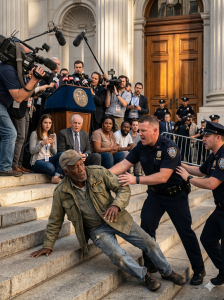
Then, with both hands, he pushed the old man down the steps.
The veteran rolled once.
Then twice.
His forehead hit the edge of a lower step.
A dark line ran down his cheek.
For a moment, the plaza fell silent.
Then a woman near the fountain whispered, “Oh my God.”
The veteran propped himself up on one elbow.
His breathing came rough and heavy.
His eyes remained calm.
He reached into his coat again, and every officer nearby froze.
Not because he drew a weapon.
But because he pulled out a small black drive sealed inside a cracked military evidence pouch.
The police chief’s face went pale.
Mayor Royce whispered something the microphone did not catch.
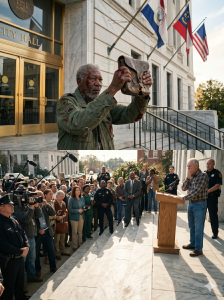
The veteran held the pouch high so the cameras could see.
“My name is Sergeant Major Elijah Cross,” he said, his voice slicing through the plaza like a blade.
Reporters stiffened.
A cameraman zoomed closer.
An older veteran in the crowd suddenly straightened, staring in disbelief.
“Silver Star,”
“Two Purple Hearts.”
“Former logistics investigator for Joint Recovery Command.”
“And for the last eleven months, I have been living on your streets because this city needed to believe I was nobody.”
The crowd shifted.
The laughter died completely.
Elijah turned his bloodied face toward the mayor.
“This drive contains procurement records, off-book transfers, and sworn testimony proving that the mayor’s office, the police chief, and Harren Defense diverted forty-eight million dollars from veterans’ housing funds into shell companies.”
Mayor Royce stepped away from the microphone.
Chapter 3: The Man Nobody Wanted to Hear
Police Chief Harold Voss moved closer to the mayor and spoke through his teeth.
“Shut him down.”
But the words had already escaped into the morning.
They moved through camera lenses.
They entered livestreams.
They struck every phone held high in the plaza.
Elijah slowly rose, swaying but unbroken.
His jacket hung crooked from one shoulder.
Blood ran into his gray beard.
Yet his hand stayed raised.
A young reporter named Tessa Monroe pushed through the crowd with her microphone.
“Sergeant Major Cross, are you saying the mayor knowingly stole veterans’ funds?”
Elijah looked at her, and something in his expression softened.
“No,” he said.
“I’m saying he sold wounded soldiers twice.”
A wave of noise rolled through the crowd.
Mayor Royce snapped, “This man is disturbed.”
“He has been harassing city workers for weeks.”
“He is not a source.”
“He is a threat.”
Elijah gave a dry, bitter laugh.
“Funny.”
“That is what you called the men who came home asking for the beds you promised them.”
He bent slowly and picked up a muddy invoice page.
His fingers left a red mark on the paper.
“This shelter was paid for three times,” he said.
“It was never built.”
He lifted another page.
“These medical transport vans were purchased with federal grant money.”
“They were never delivered.”
Captain Deller stepped down one stair.
“Drop the papers.”
Elijah turned toward him.
“And this officer,” Elijah said, “signed security logs for cash pickups from the evidence garage.”
Deller’s face tightened.
“That is a lie.”
Elijah’s eyes narrowed.
“Then you will not mind the cameras seeing your signature.”
Tessa grabbed the page before Deller could kick it away.
The crowd exploded.
Chapter 4: The Recording in the Pouch
Mayor Royce looked toward the golden doors behind him.
For the first time, his polished expression cracked.
He was not searching for help.
He was searching for an exit.
The brass band had fallen silent.
Only the fountain kept running, bright water falling as if nothing had changed.
Police Chief Voss stepped to the microphone.
“This event is suspended.”
“Everyone needs to leave immediately.”
But no one moved.
A group of veterans near the back pushed forward together.
Some wore old caps.
Some leaned on canes.
One man in a wheelchair raised a shaking hand and shouted, “Let him speak.”
Another yelled, “We slept in cars while you stole from us.”
Elijah closed his eyes for half a second.
The sound hit him harder than the fall.
Because those voices were not strangers.
They were the reason he had slept under bridges.
The reason he had let strangers spit near his boots.
He had gone undercover without a badge, without backup, without a name anyone respected.
For eleven months, he had watched trucks arrive behind police property at night.
He had followed contractors to warehouses meant to be veteran clinics.
He had counted men freezing beneath highway ramps while politicians posed beside blueprints.
And he had waited for the one day the mayor would gather every camera in the city.
Today.
The bill-signing.
The celebration.
The perfect stage.
“Calvin,” Elijah said, louder now.
“Tell them about Room 6B.”
The mayor froze.
Police Chief Voss turned sharply.
Captain Deller stopped moving.
A whisper moved through the officials behind the podium.
Elijah raised the evidence pouch higher.
“Room 6B was where Harren Defense kept the private ledger.”
“It was also where your people decided which veterans could be left homeless because dead men do not file complaints.”
The crowd fell into a heavy, deathlike silence.
Chapter 5: The Doors Open
Deller lunged forward.
His hand shot toward the evidence pouch.
Elijah did not move back.
Before the officer could make contact, three veterans stepped between them.
Then five more.
Then the entire front row shifted like a barrier forming.
Deller shoved one man at the shoulder.
The man stayed upright.
He only stared and said, “Not this time.”
The phrase spread across the plaza.
Not this time.
Not this time.
Not this time.
Mayor Royce retreated toward the golden doors.
“Chief,” he hissed.
“Do something.”
Voss reached for his radio.
But the radio crackled first.
A voice came through, cold and official.
“Chief Voss, place your hands where we can see them.”
The gold doors swung inward.
Three federal agents stepped out.
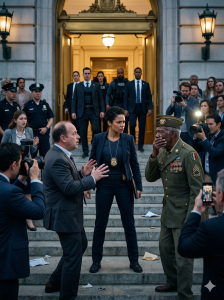
The woman in front wore a dark suit and held a badge high enough for every camera to capture.
Her gaze locked on the mayor.
Her expression stayed steady.
Too steady.
Mayor Royce stared at her as though he had seen a ghost.
“No,” he whispered.
Elijah looked up the steps.
For the first time that morning, pain crossed his face.
Not from the fall.
From memory.
The lead agent descended one step.
“Calvin Royce,” she said, “you are under federal investigation for conspiracy, fraud, obstruction, witness tampering, and misuse of veteran relief funds.”
The crowd erupted.
Reporters shouted over one another.
Phones trembled in raised hands.
Voss turned as if to flee.
Two agents blocked him.
Captain Deller reached toward his belt, then stopped when every veteran nearby turned toward him.
Elijah exhaled slowly.
The lead agent looked down at him.
For one fragile moment, the battlefield vanished.
The marble steps became a hospital corridor.
The crowd became distant thunder.
For illustrative purposes only
Chapter 6: The Daughter Who Was Not Dead
The agent removed her sunglasses.
Her eyes were the same deep brown as Elijah’s.
The mayor saw it too.
That was why his knees seemed to weaken.
That was why all color drained from his face.
Tessa Monroe whispered into her microphone, “The lead agent appears to know Sergeant Major Cross.”
Elijah swallowed hard.
The woman stepped closer.
“Hello, Dad,” she said softly.
The plaza fell into stunned silence.
Eleven years earlier, Captain Naomi Cross had been declared dead after a convoy attack overseas.
Elijah had buried an empty coffin.
He had folded a flag with shaking hands.
He had carried guilt every night since.
But Naomi Cross stood now on the steps of City Hall.
Alive.
Federal.
And staring at the mayor with a cold fury that stopped the air.
Mayor Royce shook his head.
“That is impossible.”
Naomi turned toward the cameras.
“You paid Harren Defense to erase my unit’s report,” she said.
“You buried the theft under a casualty file.”
“You used our dead to hide your money.”
Then she looked at her father.
“And Sergeant Major Cross spent eleven months pretending to be forgotten so we could catch every man who thought he was.”
Elijah’s mouth trembled, but he did not cry.
Not yet.
Naomi reached into her coat and pulled out a second evidence pouch.
Inside was a small recorder.
The mayor made a broken sound.
Police Chief Voss whispered, “Calvin, what did you do?”
Mayor Royce spun toward him.
“You were there.”
The microphone was still live.
Every speaker around City Hall carried the words across the plaza.
The crowd gasped as Royce realized what he had done.
His panic had opened the final door.
Naomi nodded once to Elijah.
Elijah lifted his bloodied hand and pointed at the mayor.
“Now play the recording.”
For illustrative purposes only
Naomi pressed the button.
A voice burst from the speakers.
It was Mayor Royce, clear as glass.
“Move the veterans out of the old shelters before inspection.”
“If Cross keeps digging, make him disappear.”
“And if his daughter survived, bury that too.”
The plaza stopped breathing.
The mayor’s face collapsed.
The police chief stepped back from him.
Captain Deller stared at the ground as if the marble had split open beneath him.
Elijah looked at the crowd that had mocked him.
Then at the cameras that finally saw him.
Then at the daughter he had buried and found again on the same steps where they tried to break him.
Naomi lifted her badge toward the mayor.
For illustrative purposes only
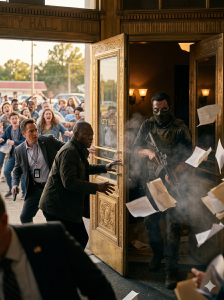
But before she could speak the arrest order, a gunshot cracked from somewhere inside City Hall.
The gold doors flew open behind her.
Everyone screamed.
And Elijah saw the one man walking out with a weapon who should have been dead for eleven years.
