


Chapter 1
The laughter came before anything else.
Not the insult, not the judgmental looks, not even the embarrassment.
Just that sharp, merciless laugh cutting through the showroom like a knife.
It stopped me cold, one grease-marked hand still resting against the hood of the EV-7.
The silver finish shimmered beneath the lights, catching the chandelier above in long streaks of white.
For one careless moment, I had forgotten exactly where I was.
I had driven forty-five minutes nonstop from the engineering lab without bothering to change clothes.
My flannel shirt still carried the faint scent of solder smoke.
There was dried motor oil smeared across my cheek and dark grime packed beneath my fingernails.
I knew perfectly well how I appeared.
Like the mechanic they only accepted through the service entrance.
Like the guy meant to repair things, not create them.
But none of that mattered to me.
Not when the car sitting in front of me had taken three years of my life and somehow returned purpose at the same time.
Not when this was the first time I had seen it completely assembled outside the lab.
Soft blue light glowed from the interior through the windshield.
I had built that interface at three in the morning during a thunderstorm, wrapped in a ripped blanket, begging my code to stop failing.
The vegan leather seats were so smooth they almost looked liquid.
For a single heartbeat, I wasn’t twenty-nine anymore.
I was fourteen again, standing across the street from this same dealership, trembling beneath a damaged bus stop shelter.
Back then, I used to press my face against the glass and stare inside.
I wasn’t fantasizing about money.
I wasn’t fantasizing about status.
I was dreaming about security.
I grew up inside a foster system so damaged it almost seemed built to teach children never to rely on permanence.
Beds changed.
Rules changed.
Adults changed.
Everything shifted except the cold.
Cars failed in every chapter of my childhood.
Group-home vans stalled on dark roads.
Cheap sedans blew smoke in the middle of winter.
I learned young that when transportation stopped working, everything else collapsed with it.
So I made myself a ridiculous promise.
One day, I would create a vehicle so dependable, so intelligent, and so safe that no one inside it would ever feel abandoned.
A machine that protected people in ways life never had.
Then the saleswoman said, loud enough for nearly the entire showroom to hear, “Can I help you find the nearest homeless shelter?”
Laughter burst through the room.
Her red lipstick flashed as she grinned.
Her name tag read MANDY in polished gold letters pinned to a white blazer that probably cost more than my first computer.
She looked me over like I had tracked dirt across holy ground.
Behind her, two younger sales reps leaned over their desks with smug smiles.

A couple wrapped in designer coats turned away from a sports car to stare openly at me.
The man let out a snort over his latte.
The woman glanced at my boots, then toward the exit, like she was waiting for security to step in.
Heat flooded my face so quickly my vision almost blurred.
For a moment, old survival instincts closed around my throat.
Leave.
Apologize.
Disappear before things get uglier.
I nearly did.
I nearly turned around, drove home, and came back wearing the navy suit hanging in my closet for next week’s National Innovation Award ceremony.
I nearly allowed clothing to determine whether I deserved to stand beside something I had created with my own hands.
But something stubborn buried deep inside me refused.
I had slept next to prototype batteries that exploded without warning.
I had rebuilt torque maps through bloodshot eyes and caffeine tremors.
I had earned the right to stand there exactly the way I was.
“I’m here to ask about the EV-7,” I said.
My voice stayed calm, surprising both of us.
Mandy blinked once before laughing even harder.
“Sweetheart, this car costs one hundred and twenty thousand dollars,” she said.
“That’s more than you’ll make in years doing whatever it is you do.”
Then she brushed two manicured fingers against my sleeve like she was touching contamination.
“We don’t allow loitering,” she added.
“The used lot is down the road.”
Every line landed with the precision of something practiced.
The ironic part was that she had no idea she was mocking the only person in the showroom who knew where every concealed wiring channel ran beneath the chassis.
She had no idea I could identify, just from the startup pulse of the headlights, which supplier assembled the final control boards.
She had no idea my signature was embedded into the battery safety architecture underneath that polished paint.
Instead of racing, my pulse slowed.
That was the moment I realized I wasn’t leaving.
I slipped my hand inside my jacket and wrapped my fingers around the folded contract.
Chapter 2
“What, a coupon?” Mandy said the second she noticed the paper.
“That’s adorable.”
The laughter around us sharpened instantly.
I unfolded the document carefully.
Not for dramatic effect.
Because my hands had begun trembling and I refused to let anyone notice.
At the top of the first page sat the embossed logo of Vantage Horizon Automotive.
Beneath it was the finalized procurement and licensing agreement valued at twenty-four million dollars.
The CEO’s signature ink was still fresh enough to smell.
Nobody in the room knew that yet.
All they saw was a grimy Black man in a ripped flannel shirt holding documents.
Experience had taught them exactly what conclusions to jump to.
“I’m not here to buy the EV-7,” I said.
“I’m here because your company placed my design on the showroom floor before the final review.”
Mandy stared at me for half a second before bursting into laughter again.
“Oh, wow.”
“So now you designed it too?”
One of the sales reps muttered, “This is getting good.”
I didn’t break eye contact.
“The thermal recovery system, regenerative brake tuning, emergency battery isolation, child-lock override, cabin biometrics.”
I pointed through the glass.
“Those are mine.”
That earned several confused looks.
Not from Mandy.
From the floor manager standing just behind her.
He had been observing the entire scene with the careful stillness of someone deciding whether this situation was amusing or dangerous.
According to the stitched name tag on his charcoal suit, his name was Dean.
The second I listed the subsystems, something changed in his face.
Mandy caught it immediately.
She flipped her hair back and folded her arms.
“Dean, seriously, are we entertaining this?”
Dean stepped closer wearing the kind of smile managers use when they fear lawsuits but still enjoy authority.
“Sir, if you have business with corporate, this isn’t the proper way to handle it.”
His voice was smoother than hers, but only barely.
“This vehicle shouldn’t be sold until my authorization is entered into the final compliance file,” I said.
His smile widened.
“And who exactly are you?”
It should have felt satisfying to answer.
Instead it felt draining.
Because underneath every version of that question I had heard my entire life was the same meaning.
Who are you to stand here?
Who are you to want more?
Who are you to create something this world values?
“My name is Isaiah Raines,” I said.
“I’m the lead architect on the EV-7 platform.”
The silence that followed dropped so suddenly it almost sounded staged.
A salesman coughed awkwardly.
Someone near the coffee station turned around.
Mandy’s smile didn’t disappear, but it stiffened into something fragile.
“No, you’re not,” she said.
It wasn’t disbelief.
It was rejection.
A refusal to allow reality to rearrange itself in front of her.
I reached into my back pocket and pulled out my employee badge from the lab.
Dean took it, glanced down, and the color drained from his face.
He hid it quickly, but not quickly enough.
Mandy grabbed his arm.
“It’s fake, right?”
He ignored her question.
Instead, he looked directly at me.
“Why are you here without an appointment?”
“Because your CEO asked me to inspect the launch units personally after I warned him your timeline was reckless.”
I folded my arms.
“And because he still hasn’t answered my final safety concern.”
Dean swallowed hard.
One of the younger sales reps stopped grinning.
Across the showroom, the wealthy couple suddenly became very focused on avoiding eye contact.
Mandy gave a short, irritated laugh.
“This is ridiculous.”
Then she pointed toward the car.
“If you’re so important, prove it.”
I looked at the EV-7 and felt that ache return.
Not pride.
Not really.
Something much closer to sorrow.
“Open the rear passenger door,” I said.
Dean hesitated for a moment, then motioned to one of the reps, who clicked the showroom key fob.
The door released with a soft hiss.
“Lift the floor panel beneath the third row.”
The rep obeyed.
Underneath sat the emergency service module and the sealed battery isolation switch.
Color drained slightly from Mandy’s face.
I continued.
“Now remove the blue cap and check the serial engraving.”
The rep crouched down, narrowed his eyes, and read the number out loud.
It matched the one listed on the patent filing registered to Isaiah D. Raines.
My patent.
My sleepless nights.
My entire life condensed into eight digits and one shocked silence.
Dean turned fully toward me then, his smile completely gone.
Mandy opened her mouth, shut it, then tried again.
The whole showroom felt trapped inside glass.
Before anyone could say another word, the showroom lights flickered.
Chapter 3
Every engineer understands the difference between a harmless malfunction and the first warning sign of catastrophe.
The flicker lasted less than a second.
That was enough.
The EV-7’s dashboard pulsed twice behind the windshield.
Then the overhead demo display beside the vehicle flashed red.
A soft warning chime echoed from inside the cabin.
My stomach sank.
“No one touch the vehicle,” I snapped.
Nobody moved.
Dean went rigid.
Mandy stepped backward.
The couple near the sports car retreated so quickly the woman nearly spilled her drink.
The warning tone sounded again.
Short.
Controlled.
Wrong.
I moved to the driver-side window and looked inside.
The battery thermal monitor was jumping between normal and fault.
That should have been impossible with the isolation architecture I designed.
Unless corporate had bypassed something.
Unless they had altered one of my fail-safes to satisfy the rushed launch schedule.
Unless my worst fear had become reality.
“What did they install from the Helix batch?” I asked without turning around.
Dean stayed silent.
I looked sharply at him.
“What cells are in this demonstration unit?”
His silence answered before his words ever did.
“Mandy,” he said quietly, “call service.”
She didn’t react.
“Now,” he barked.
The younger sales rep fumbled nervously for his radio.
The vehicle released a low, rising whine.
Not loud.
Not yet.
But I recognized that sound.
I had heard it once in the lab at two in the morning before a prototype vented heat so violently it blistered paint off the wall.
That sound had followed me into my sleep for months.
It was the noise of stored energy deciding whether it still intended to obey.
“There are people too close,” I said.
“Clear the showroom.”
Dean finally snapped into motion, shouting for everyone to get back.
Panic spread through the room in an ugly wave.
The wealthy couple ran first.
One salesperson bolted toward the offices.
Mandy remained frozen beside the vehicle, every trace of cruelty stripped away and replaced with empty terror.
“Move!” I shouted at her.
She stared at me like she no longer understood words.
Then she whispered, “What’s happening?”
I yanked open the rear door and reached toward the manual override compartment.
“The battery pack may be entering thermal runaway.”
My fingers found the access latch.
“If I’m right, we have maybe seconds before the containment system fails.”
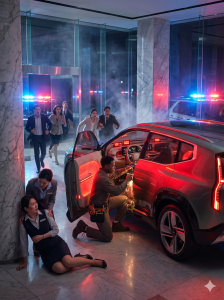
Dean let out a choked sound.
Mandy stumbled backward, one heel slipping against the polished floor.
She crashed down hard, her ankle twisting underneath her.
The warning tone inside the vehicle escalated into a piercing alarm.
I dropped to one knee, ripped open the panel, and grabbed the emergency isolation lever.
It wouldn’t budge.
My heart slammed hard against my ribs.
Someone had swapped out the original mechanical disengage for a cheaper electronic lockout.
They had transformed my final fail-safe into software.
Into a budget shortcut.
Into a death trap.
“Who approved this?” I shouted.
Dean stayed silent.
His face had gone pale gray.
The alarm climbed louder.
I could practically feel the battery pack heating beneath the floor.
The air around the vehicle carried a faint metallic smell, like overheated coins and electricity.
Mandy was still on the ground.
She had crawled only a few inches before freezing there, stunned and crying silently.
For one awful moment, I was fourteen again, watching adults lock up while disaster decided who it would take.
I made the decision before I fully processed it.
“Everyone out!” I yelled.
“Now!”
They scattered instantly.
Dean ran.
The reps ran.
Even the receptionist vanished behind a pillar.
Only Mandy stayed behind.
Her ankle was obviously broken or badly sprained.
She tried to stand, then collapsed again with a sob.
Our eyes locked.
Five minutes earlier, she had called me trash in front of an entire room of strangers.
Now she looked like every terrified kid I had ever met.
Not powerful.
Not cruel.
Just helpless.
I slid my arm beneath hers and dragged her away from the vehicle.
Her trembling fingers clutched my flannel shirt.
“Why are you helping me?” she gasped.
Because leaving people behind is how monsters are created, I almost answered.
Because no machine I ever built was supposed to teach me to become one.
Instead, I pulled her behind a marble column and told her to stay low.
Then I turned and sprinted back toward the car.
Chapter 4
Fear distorts time in strange ways.
The entire showroom felt too bright, too sharp, too slow.
I could hear every footstep, every distant yell, every thin electric whine rising from the EV-7 like a scream trapped inside a throat.
I grabbed the service trolley near the detailing bay and ripped loose the insulated emergency hook.
My hands moved before my thoughts could catch up.
Pop the manual cabin release.
Shut down the infotainment bus.
Force the thermal system into dead loop.
Pray.
The driver-side door swung open.
Heat rolled out, faint but horrifying.
Not flames.
Not smoke.
That would have been easier.
Smoke means the secret is already out.
Heat means there’s still enough time for things to become worse.
I reached beneath the steering column and tore away the trim panel with my bare hands.
Plastic cracked apart.
My knuckles split open.
The hidden override port sat exactly where I had designed it, except someone had sealed it with a proprietary latch that wasn’t supposed to exist.
I cursed and slammed the emergency hook against it.
The cap snapped free.
From the far side of the showroom, Dean shouted, “Fire department’s on the way!”
“We don’t have time for the fire department,” I yelled back.
If the cell cluster vented indoors, the glass facade would explode outward into the street.
People outside could die.
Families.
Pedestrians.
The bus stop across the road.
That bus stop.
The same one where I had once slept beneath a thin worn coat, counting headlights just to stay awake.
The memory hit so hard I nearly lost hold of the tool.
I shoved the override pin deep into the port and held it in place.
The cabin alarm sputtered.
The display flickered.
For one desperate second, I thought it had worked.
Then the center screen went black and rebooted with a message I had never seen before.
REMOTE PROTOCOL ACTIVE.
My blood turned to ice.
That wasn’t factory software.
That wasn’t my system.
Someone had installed a remote lockout layer over the emergency controls.
From behind the pillar, Mandy shouted my name.
Not “hey.”
Not “you.”
My name.
I turned toward her.
She was holding something up with both shaking hands.
A slim black tablet had fallen out of Dean’s leather portfolio when he fled.
Its screen glowed with a live diagnostics dashboard connected to the EV-7.
“Isaiah!” she cried.
“It says admin override.”
I sprinted toward her, grabbed the tablet, and understood everything in a single glance.
There it was.
A hidden beta command architecture linked to a remote investor presentation mode.
Someone at corporate had ordered a secret software patch that locked the mechanical safety pathways during demos so nobody could “accidentally disrupt investor experience.”
Investor experience.
I stared at the phrase and nearly laughed.
They had rewritten my vehicle to impress wealthy investors.
And in the process, they had destroyed the very thing I designed it to do.
The authorization line displayed the approving executive.
Not the CEO.
Not Dean.
Naomi Vale, Chief Financial Officer.
My breathing stopped.
Naomi Vale.
My biological mother.
The woman who signed away her parental rights when I was six years old.
The woman whose face I only knew from an old courthouse document and one blurry newspaper photograph.
The woman I had discovered months earlier was now one of the most powerful executives inside the same company licensing my technology.
I had never told anyone.
Not the CEO.
Not the board.
Not even myself in any truthful way.
Cold spread through my entire body.
This carried her fingerprints.
Her greed.
Her shortcut.
Her name buried inside my machine.
The tablet requested a six-digit code for admin release.
Mandy stared at me, pale and trembling.
Dean had disappeared completely.
“Can you guess it?” she whispered.
I looked at Naomi’s name glowing on the screen and something ancient and buried clawed its way up from the darkest corner inside me.
The courthouse file.
My birth date blacked out.
One handwritten date still visible in the margin.
The day she surrendered custody.
I entered the numbers.
The tablet flashed green.
The car went silent.
Not slowly.
Not with any warning.
Just silence—heavy, impossible silence—dropping across the showroom like a curtain.
For one long second, nobody moved.
Then the hazard lights blinked twice and shut off.
The thermal alarm vanished.
The battery monitor returned to safe.
I let out a breath so hard it hurt.
My knees buckled beneath me.
I dropped onto the cold marble floor with the tablet resting in my lap and started laughing, half from relief and half from the sheer insanity of what had almost happened.
Sirens screamed outside.
The glass doors burst inward.
Emergency crews poured into the showroom.
And behind them, stepping into the wrecked dealership in a black coat and expressionless heels, was Naomi Vale.
Chapter 5
She noticed me before she noticed the damaged vehicle.
I knew because something flickered across her face so quickly most people would have missed it.
Recognition.
Then calculation.
Then nothing at all.
Naomi Vale carried elegance the way expensive knives do.
Everything about her looked measured, sharpened, deliberate.
Her dark hair was pinned flawlessly.
Her coat probably cost more than the first foster family had been paid to take me in.
The CEO followed close behind her, flushed and out of breath, demanding answers.
Firefighters surrounded the EV-7.
Paramedics examined Mandy’s ankle.
Dean finally emerged from somewhere near the offices, his tie crooked and his courage nowhere to be found.
Naomi’s eyes lowered to the tablet in my hands.
Then to the shattered panel beneath the steering column.
Then to the contract sticking halfway out of my jacket.
“I told you,” I said quietly as I rose to my feet, “the launch wasn’t ready.”
The CEO immediately began talking.
“Isaiah, thank God you’re okay. We need to understand what happened—”
“No,” I cut in.
“You need to understand who altered my emergency systems and why.”
The room fell silent again.
Naomi stepped forward.
Her voice was smooth as silk.
“This is hardly the moment for accusations.”
I looked directly at her and, for the first time in my life, saw not an absence but a person.
Not the ghost from a file.
Not the empty space in my history.
A real woman.
A powerful one.
And somehow that felt even worse.
“You approved a remote investor lockout that bypassed mechanical safety access,” I said.
I lifted the tablet slightly.
“Your name is attached to the authorization.”
The CEO turned pale.
Dean stared at the floor.
Mandy, now seated in a wheelchair with ice wrapped around her ankle, looked openly between the two of us.
Naomi didn’t deny it.
That would have shocked me less than what she actually chose to say.
She met my eyes and replied, “I did what was necessary to keep the company solvent.”
A harsh laugh escaped me.
“You almost turned my car into a bomb to protect quarterly numbers.”
Her expression hardened.
“Your car?” she repeated.
Then, in front of the entire showroom, while cameras from arriving local news crews swung toward us, she spoke the words that shattered the world open.
“You think your brilliance happened in spite of me?”
The air vanished from my lungs.
The CEO frowned in confusion.
Mandy’s jaw dropped.
Naomi stepped closer, lowered her voice, and finished the sentence anyway.
“I never signed you away because I didn’t want you.”
“I signed you away because your father was going to kill you.”
My ears rang violently.
The marble floor felt like it tilted beneath me.
Every sound in the showroom seemed to sink underwater.
She kept talking.
When I was six years old, I had witnessed my father sabotage a transit van for insurance money.
Two children had almost died.
He beat Naomi after she threatened to testify.
When she discovered he planned to use me in another staged crash, she disappeared with me.
For three weeks she kept us hidden.
Then a judge told her the fastest way to sever my father’s legal access was to surrender me into protected state custody under seal while federal investigators built their case.
She believed she would get me back.
Instead, my father’s partners found her first.
She ran.
She changed her identity.
She spent years helping prosecutors dismantle the network.
By the time she finally had enough money and power to search for me safely, my records had been sealed and scattered through a broken system.
She had spent fifteen years looking.
I wanted to call her a liar.
I wanted to reject every word she said.
Then she reached into her coat and pulled out an old photograph sealed inside a clear evidence sleeve.
A little boy in a red knit cap grinning from the seat of a city bus.
My red knit cap.
The one I remembered because she had hand-stitched my initials into the lining.
On the back, visible through the plastic, was one faded sentence written in blue ink.
For Isaiah. Build things that keep people safe.
My legs nearly collapsed again.
All those years, I thought the sentence belonged to me.
A promise born from emptiness.
But it had started with her.
Naomi’s composure finally cracked apart.
Tears filled her eyes and, for the first time, made her look human.
“I saw your name on the licensing file six months ago,” she whispered.
“I knew it was you.”
“Then why didn’t you say anything?” I asked.
Her face twisted painfully.
“Because I knew you’d hate me.”
The answer was so raw, so pathetic, so painfully real that it shattered whatever script I had been holding onto.
The CEO interrupted in a strained voice.
“Naomi, the board will remove you for this.”
She looked at him without flinching.
“Then they should.”
Mandy began crying quietly in her wheelchair.
Dean looked nauseous.
Outside, camera flashes burst against the showroom glass like distant lightning.
I looked from the mother I had lost, to the vehicle I had built, to the executives who had nearly destroyed both in pursuit of profit.
Then I made the only decision that still felt clean.
I pulled the twenty-four-million-dollar contract from my jacket.
The entire room watched in silence.
Slowly, carefully, I tore it in half.
Then into quarters.
Then into smaller pieces.
Gasps swept across the showroom.
The CEO lunged forward.
“Isaiah, don’t—”
“I’m not licensing the EV-7 to a company that mistakes luxury for worth and risk for efficiency,” I said.
I dropped the shredded pieces onto the marble floor between us.
“They don’t deserve it.”
Then I turned toward Mandy.
She flinched instantly.
I knelt until we were eye level.
“You humiliated me because you thought I was powerless,” I said.
“You almost died because powerful people cut corners to impress each other.”
Mascara streaked down her face as she cried harder.
“I’m sorry,” she whispered.
I believed she meant it.
That didn’t make the damage disappear, but it made her human.
When I stood again, Naomi was still looking at me like she was waiting for judgment.
I didn’t give her one.
Not yet.
Some wounds don’t heal because the truth finally arrives.
Some doors don’t swing open simply because the lock finally makes sense.
But as I walked toward the shattered showroom doors, past the cameras, the fire crews, and the torn remains of the deal that would have made me rich, I slipped the photograph into my pocket.
Not forgiveness.
Not yet.
Just proof that the story I had always been told about being abandoned was never the complete story.
Three months later, footage from that day would trigger federal investigations, executive resignations, and the public collapse of Vantage Horizon’s luxury division.
Six months later, I would open RAINES TRANSIT LABS inside a converted warehouse across town with one mission painted above the entrance in blue letters.
BUILD THINGS THAT KEEP PEOPLE SAFE.
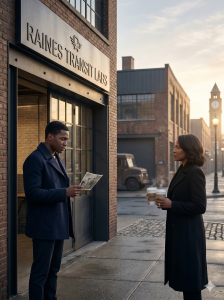
And on the first morning we opened, before the employees arrived and before the city fully woke, a woman in a black coat stood silently across the street holding two cups of coffee, waiting to see if I would invite her inside.
