

“The Woman in Handcuffs Was the Law. By the time the courthouse doors opened, everyone on those steps had already ruined themselves.
The slap cracked through the morning air like a rifle shot, and for one unbearable moment the entire courthouse plaza seemed to stop breathing.
Judge Kesha Williams tasted blood.

It was warm and metallic at the corner of her mouth as her head snapped to the side, dark curls falling across her cheek, briefcase slipping from her grip. It hit the granite steps and burst open. Legal papers—annotated, tabbed, meticulously prepared through a sleepless night—scattered across the stone and lifted into the wind like frightened birds.
A silence dropped over the small crowd outside the Fulton County Courthouse. Lawyers in gray suits froze mid-step. Two reporters turned sharply. A delivery driver stopped at the curb, holding a crate against his side. No one moved toward her.
Then Officer Daniel Martinez laughed.
“Didn’t I tell you?” he said, loud enough for everyone to hear. “They never learn.”
He stepped forward, broad and rigid in his pressed uniform, badge catching the pale morning light. His jaw carried the satisfaction of someone performing for an audience. Behind him, two other courthouse officers drifted closer, sensing entertainment.
Kesha steadied herself with one hand against the wall.
She wore no robe. No judicial pin. No outward sign of authority. Only a charcoal dress, low heels, and the leather briefcase now spilled open at her feet. She had chosen civilian clothes because the judges’ elevator was under repair, and she preferred the public entrance when possible. It reminded her, at times, of who the law was meant to serve.
This morning, that choice had placed her directly in Martinez’s path.
He blocked the steps with his body. “ID.”
Kesha’s cheek burned. “You struck me before I could answer.”
Something flickered in his eyes—surprise, then irritation. He had expected fear, apology, pleading. Not calm.
“I said ID,” he repeated. “Or maybe you don’t understand English.”
A snicker rose from one of the officers behind him.
Kesha reached slowly for the wallet in her coat pocket. Martinez moved faster. His hand shot to her throat, fingers digging into the soft space below her jaw, and slammed her back against the cold stone wall so hard her skull clicked.
Gasps ran through the crowd.
“Filthy animals like you belong in cages, not courthouses,” Martinez hissed, his face inches from hers, breath sharp with stale coffee and authority.
Pain flared white behind Kesha’s eyes. Her lungs locked. Instinct screamed at her to fight—to break free, to strike, to survive as a woman before thinking as a judge.
But Kesha Williams had spent forty-six years learning the distance between impulse and consequence.
So she did the most dangerous thing possible in front of a bully.
She met his eyes without flinching.
That only fueled him.
He wrenched her arms behind her back. Another officer, Boyle, a younger man with freckles, helped force them higher until pain tore through her shoulders. Metal cuffs snapped shut around her wrists.
Somewhere in the crowd, a phone lifted. Recording.
“Resisting already?” Boyle said, grinning.
“I haven’t moved,” Kesha said.
Martinez laughed. “They always say that.”
Her papers slid across the steps. A legal pad slapped a column. A typed motion slipped under a woman’s shoe. The woman quickly stepped away, as though the pages were contaminated.
Kesha took one shallow breath, then another. Cold stone pressed into her back. Blood thudded in her ears. The courthouse rose around her in polished stone and brass, imposing and indifferent. Above the entrance, the bronze nameplate caught the sun.
Superior Court of Fulton County.
She lifted her eyes and held them there.
Martinez tightened his grip. “Look at that,” he mocked. “She knows where she belongs.”
A few uneasy laughs followed. Not from humor, but from fear seeking cover.
“Got another one,” Boyle said. “Won’t even make it past booking.”
Kesha stayed silent.
But something in her settled.
Not breaking. Settling.
Like dust after an explosion—revealing what remains.
She knew both officers by reputation. Not personally, but through internal notes, memoranda, and quiet warnings from clerks and bailiffs who understood what could never be written openly. Complaints that disappeared. Patterns ignored. Behavior excused. She had already planned a review of courthouse security this month.
Now her cheek throbbed against that delayed decision.
A slim woman with a messenger bag stepped forward. “Officer, I saw it. She didn’t do anything.”
Martinez turned his head slowly. “You want to interfere with an arrest?”
The woman hesitated. Her lips parted, then closed.
That was enough. Fear always spreads faster than truth in systems built on rank.
Kesha watched her step back and felt no anger. Only the familiar sadness of watching decent people retreat when authority turned cruel.
The courthouse doors stayed shut.
That unsettled Boyle more than anything. “Where is everyone?”
“They’ll come out when they come out,” Martinez said.
A black sedan approached, then drove on. Two assistant district attorneys stood near a column, whispering. One recognized Kesha—shock flashed across his face—then vanished as he looked away.
Kesha smiled.
Small. Controlled. Barely visible.
Martinez noticed it immediately.
“What’s so funny?”
“Nothing,” she said quietly.
“Think someone’s coming for you?”
She met his eyes. “No.”
That answer disturbed him more than resistance ever could. He understood fear, anger, pleading. But certainty—calm, unshakable certainty—felt wrong.
He tightened his grip. “Search her bag.”
Boyle knelt, gathering scattered pages. His smirk faded as he looked closer.
“Uh… Martinez?”
“What?”
“There’s…” He pulled out a thick red-tabbed binder, then sealed court documents, then an official docket packet. “A lot of judicial material here.”
Martinez grabbed a page. His expression shifted slightly, then hardened.
“Could be stolen.”
Kesha gave a quiet breath of almost-laughter.
“Sure,” she said. “I stole thirty-seven pages of annotated voir dire notes, a sealed in-camera memorandum, and revised sentencing recommendations for State v. Harlow.”
Boyle blinked. “How would she know the case name?”
“Shut up,” Martinez snapped.
The air had changed. More people were watching now, drawn by phones, by curiosity, by the tension of something beginning to tip. The courthouse doors finally moved.
Then opened.
Three bailiffs stepped out first.
Not rushing. Not shouting. But moving with controlled urgency. Behind them came court administrator Evelyn Price, silver-haired, composed, known for a calm that never broke.
It broke now.
Her eyes locked on Kesha.
Then the cuffs.
Then Martinez.
Color drained from her face.
“Oh my God,” one reporter whispered.
Price descended the steps with steady precision. “Release her. Now.”
Nobody moved.
Martinez swallowed hard. “Ma’am, this woman—”
Price’s voice shattered like glass. “Officer Martinez, you have placed your hands on Judge Kesha Williams, presiding over Courtroom 4B, and if those cuffs are not removed from her within the next three seconds, I will personally ensure your career ends before lunch.”
Silence detonated through the plaza.
Boyle staggered back. “Judge?”
The younger officers looked as though the ground itself had shifted. One dropped his phone outright.
Martinez’s hold loosened. For the first time, genuine fear crossed his face—ugly, exposed, undeniable.
Kesha turned her head slightly and extended her cuffed wrists with the same calm dignity one might offer a coat check slip.
“Officer?” she said.
His hands shook as he reached for the keys. The first missed. The second failed to catch. On the third attempt, the cuff clicked open. Boyle hurried to release the other side, nearly scraping her skin in his rush.
The restraints fell away.
A wave moved through the crowd—shock, regret, curiosity. Reporters pushed forward. Cameras fired. One assistant district attorney muttered, “Jesus Christ.”
Kesha slowly rotated each wrist. The skin beneath the metal had already darkened to bruised purple. Her cheek was swelling. A faint red imprint marked her throat where Martinez had grabbed her.
Evelyn Price stepped in. “Judge Williams, are you injured?”
Kesha bent, picked up a fallen page, and squared its edge with the stack in her hands before replying.
“Yes,” she said. “But not in any way that surprises me.”
That hit harder than any raised voice.
Martinez finally spoke. “Your Honor, I—I didn’t know.”
Kesha looked at him at last.
There was no performance in it. No anger. No theatrics. She did not grant him the title as refuge or mercy. Her gaze was level, almost mournful, and that made it worse.
“You were right about one thing,” she said. “You didn’t know.”
His posture collapsed slightly, as if something inside him had given way.
Price motioned to the bailiffs. “Take these officers inside. Separate them. Pull all body camera footage. Lock down exterior security feeds. Contact Internal Affairs and the Sheriff’s Office immediately.”
The bailiffs moved in.
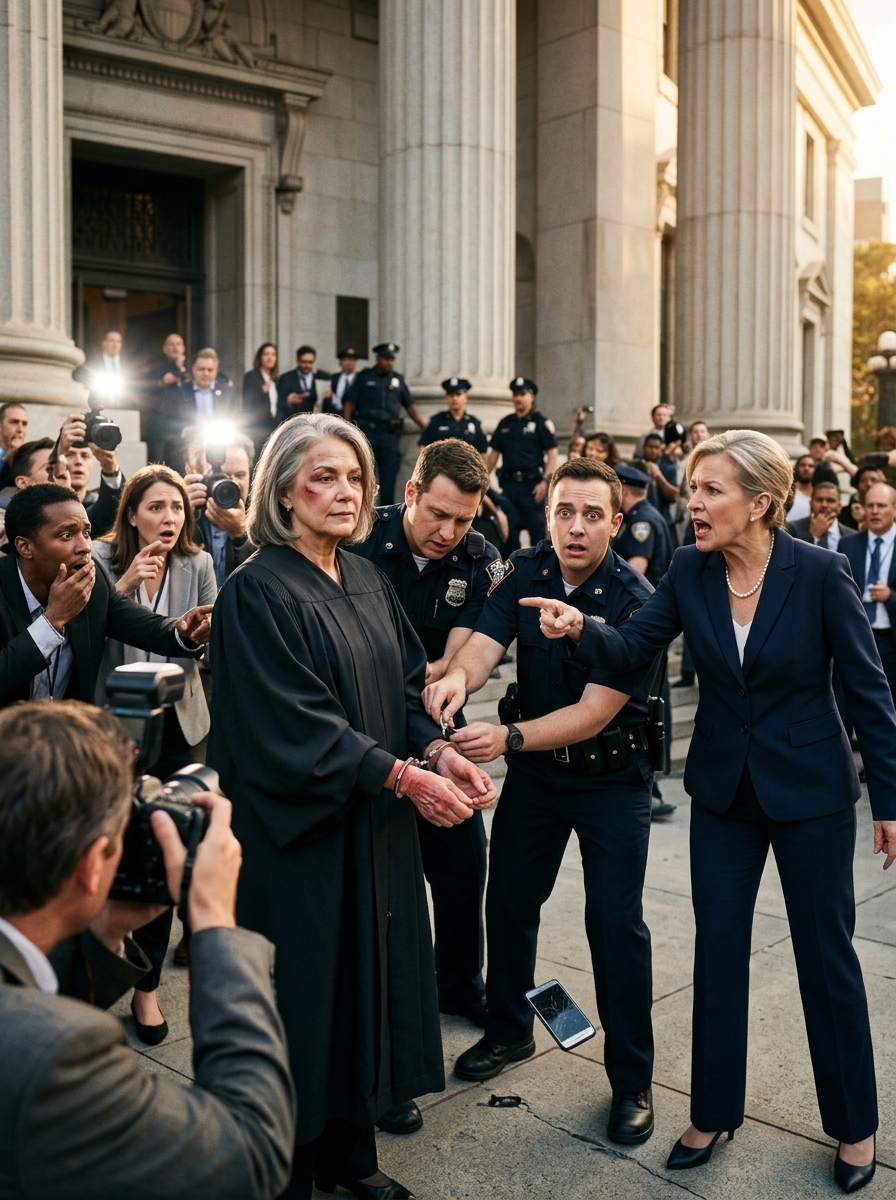
Martinez lifted his hands. “Wait—”
“No,” Price said. “You wait.”
He glanced back at Kesha, pleading without words, as if she could undo what had already been set in motion. The oldest instinct of authority surfaced—the belief that consequences were negotiable.
Kesha gathered the remaining papers from the steps. Strangers now moved to help her—too late, but trying. The woman with the messenger bag placed the legal pad into her hands, fingers trembling.
“Thank you for speaking,” Kesha said.
“I’m sorry I didn’t do more.”
Kesha accepted the pad. “Most people don’t.”
The reporters surged forward.
“Judge Williams, will you press charges?”
“Your Honor, was this racially motivated?”
“Did they know who you were?”
Kesha did not answer them. Instead, she turned to Evelyn Price. “Call chambers. Tell them I’ll be ten minutes late.”
Price stared. “Late?”
“I have a docket full of people whose lives don’t pause because mine became inconvenient.”
“But after what just happened—”
Kesha looked toward the courthouse doors, the columns, the seal, the structure of authority that so often failed those without it until it was forced to confront itself.
“That,” she said quietly, “is exactly why I’m going in.”
Price nodded once, eyes glistening.
The crowd parted as Kesha ascended the steps.
Each step carried pain. Her ribs ached. Her throat burned. Her cheek pulsed with every heartbeat. Still, she walked upright, chin raised, refusing to let violence dictate her posture.
Halfway up, Martinez called out.
“Your Honor!”
She stopped but did not turn.
“I’m sorry,” he said, voice breaking. “I have a wife. Two kids. I made a mistake.”
A long silence settled.
When she finally turned, her expression had changed—not softened, but sharpened into clarity.
“No,” Kesha said. “A mistake is misreading a filing or missing a turn. This was recognition. You saw a Black woman and understood her exactly as you’ve been conditioned to. The only difference is that this time, the woman you struck held a title you were trained to fear.”
No one on those steps would ever forget it.
Martinez looked like he might collapse.
Kesha turned away and disappeared inside.
The courthouse swallowed her whole.
The plaza erupted.
Phones rang. Reporters shouted over each other. Staff rushed in every direction. Deputies arrived at a run. Someone demanded footage preservation. Someone else ordered exits secured. Boyle sank onto the steps, head in his hands.
Above it all, the city continued—traffic moving, sirens fading in the distance, indifferent to the fact that a single act of violence had just rewritten everything.
Inside Courtroom 4B, the room was already full.
Defendants in wrinkled clothing. Families clutching tissues. Attorneys poised over notes. A nervous witness. A man in county orange staring at his shackled hands. They all rose when Kesha entered through the side door ten minutes late, now in her black robe, the marks on her face unmistakable.
A collective stillness spread through the room.
She took the bench.
For a moment, she said nothing. She looked at them—the accused, the frightened, the exhausted, the skeptical. People accustomed to being diminished before they spoke a word.
Then she called the docket.
Her voice was steady.
Cases proceeded. Motions argued. Rulings delivered. Objections sustained and denied. The machinery of justice—imperfect, slow, persistent—continued under a woman who had been attacked at its entrance and still chose to preside over it rather than abandon it.
By noon, the story had gone statewide.
By one, national outlets picked it up.
By two, Martinez’s history surfaced: prior complaints, quietly buried. Boyle’s messages in an officers’ chat began circulating. The courthouse video spread online. Millions watched the slap. Millions heard the words.
By evening, protests gathered outside.
By night, the governor issued a statement.
But that still was not the turning point.
The real shift came at 8:43 p.m., when a quiet records clerk—Mrs. Delaney, thirty-one years in the courthouse, observant as ever—opened a file prepared for emergency review.
Inside was a sealed packet submitted by Kesha Williams at 6:10 a.m., hours before she ever arrived at the courthouse.
The cover page read:
Petition for Immediate Appointment of Special Prosecutor and Authorization of Coordinated Corruption Inquiry into Courthouse Security Division.
Inside were affidavits, financial trails, internal emails, dates, names, transfer logs, missing footage records, suppressed complaints, vendor bribes, and a network spanning six years.
And at its center—
Officer Daniel Martinez.
Not just an abusive officer with authority.
But a key operative in a broader system moving detainees, silencing witnesses, and manipulating evidence across cases involving wealthy defendants and corrupt intermediaries.
Kesha had known.
Not that he would strike her. Not that he would choke her. But that he was compromised—and she had come that morning carrying the file that would end him. She had chosen the public entrance because she wanted to see, one last time, the men whose names were about to enter evidence.
What she had not expected was that Martinez, sensing pressure he could not define, would reveal himself so completely in public view.
By attacking her, he had done what corruption rarely survives:
He had made itself visible.
Before midnight, six officers were suspended.
By dawn, three judges recused themselves from related cases.
By week’s end, twelve arrests followed.
And Daniel Martinez—who had laughed while restraining a woman he thought powerless—was led back through those same courthouse doors in cuffs, cameras flashing, his head lowered under charges he never anticipated.
Kesha passed him in the hallway on her way to chambers.
He looked up once, hollow-eyed, searching her face for something—anger, triumph, cruelty.
He found none.
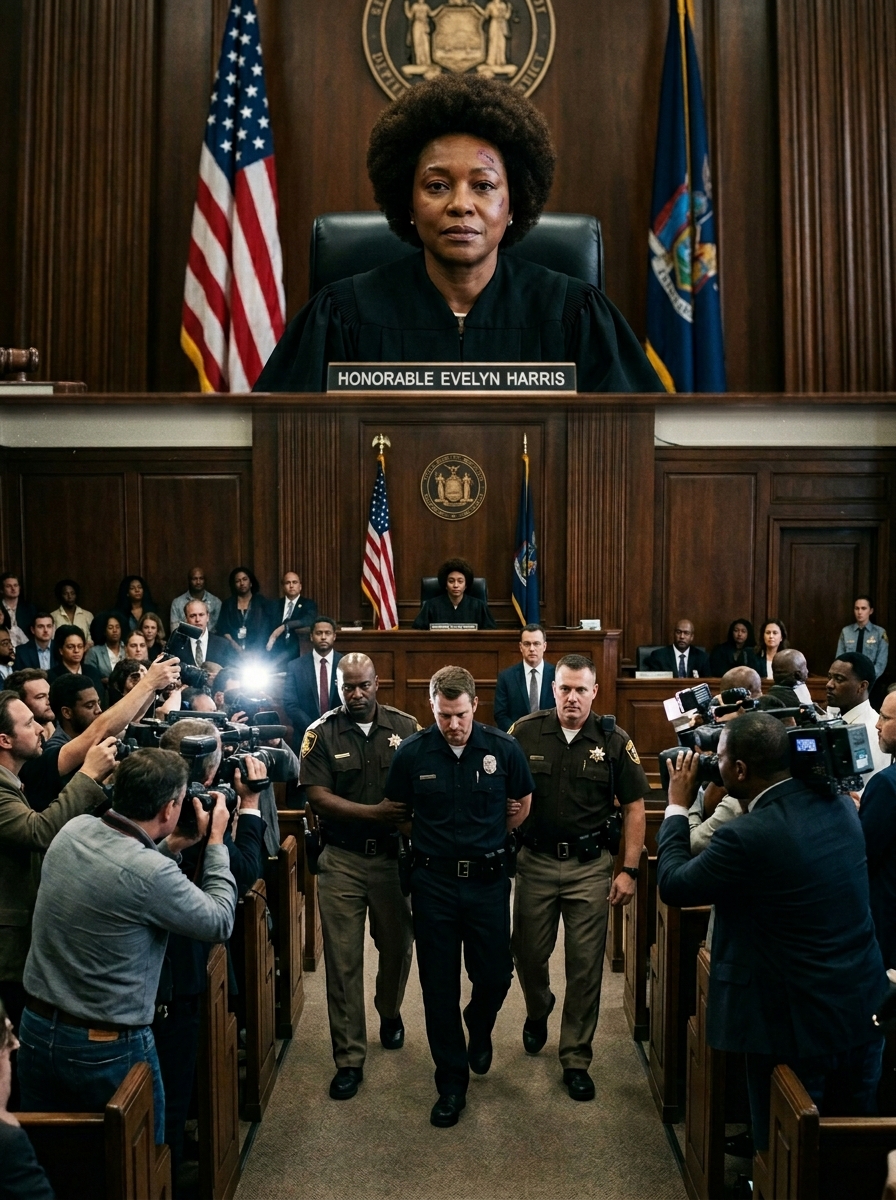
Only that same steady clarity.
The clarity of someone who had endured the worst attempt at breaking her—and still became the mechanism of accountability.
“Your Honor,” he whispered.
Kesha stopped.
The hallway held still.
Then she spoke the last words he would ever hear from her.
“Officer,” she said, “welcome to the part where the law finally knows exactly who you are.”
