

The highway shimmered under the late afternoon sun, alive with the endless movement of traffic. Engines roared across the asphalt in constant waves while heat rose from the pavement like smoke. Cars rushed past in both directions, their drivers barely noticing the police cruiser parked on the shoulder with its lights flashing blue and red against the bright sky.
A black motorcycle stood several feet ahead of the cruiser.
Beside it stood the rider.

He was tall, broad-shouldered, and calm in a way that immediately drew attention. His worn leather vest carried an American flag patch stitched across the chest. Dust from the road covered his boots, and dark sunglasses rested in his hand instead of on his face. He looked neither nervous nor angry. He simply waited.
Officer Daniel Harper stepped out of his patrol vehicle with visible irritation already written across his face. He slammed the car door harder than necessary before walking toward the biker with the aggressive confidence of someone already convinced he knew exactly what kind of person he was dealing with.
The officer stopped only a few feet away.
“You think you can just fly down my highway like you own the place?” Harper snapped.
The biker said nothing.
His silence somehow made the officer even more annoyed.
Harper had been on edge all week. Long shifts, endless complaints, pressure from supervisors, and a growing frustration with people he believed disrespected authority had slowly turned his patience into hostility. When he spotted the motorcycle weaving through traffic earlier, he had instantly decided what kind of man was riding it before he ever activated his lights.
To him, the leather vest and motorcycle already told the whole story.
“I’ve seen your type before,” Harper continued. “Rolling through town late at night, acting tough, pretending the law doesn’t apply to you.”
The biker slowly lifted his eyes toward the officer.
“What exactly is my type?” he asked calmly.
The question should have made Harper pause.
Instead, it pushed him further.
“You know exactly what I mean,” the officer said. “Guys riding around looking for trouble. Half the time there’s drugs involved. Other half, it’s weapons.”
The traffic continued screaming past behind them, but the tension on the shoulder had become heavier than the noise of the highway itself.
The biker crossed his arms slowly.
“You pulled me over for speeding?” he asked.
“I pulled you over because I had reason to,” Harper answered sharply.
“That’s not what I asked.”
Harper stepped closer.
“You got an attitude problem?”
The biker’s jaw tightened slightly, but his voice remained controlled.
“No,” he replied. “But I think you do.”
For a brief second, the officer looked stunned that someone would speak back to him so directly. Then his expression hardened.
“License. Registration. Now.”
The biker reached slowly into his vest pocket and handed over his identification without resistance. Harper barely glanced at it before shoving it into one hand.
“What’s in your pockets?” the officer demanded.
“Personal belongings.”
“I’m going to need you to empty them.”
The biker stared at him for a moment.
“Do you have probable cause?”
“I don’t need a lecture from you.”
“You do if you’re violating procedure.”
That answer hit Harper like a personal insult.
Drivers passing by had begun slowing slightly to look at the scene. Another patrol vehicle moved through traffic several lanes away. The officer suddenly became aware that people were watching, and instead of calming down, his pride took control.
“I know exactly how this works,” Harper said loudly. “You people think you can intimidate officers by acting calm and smart.”
The biker’s expression finally changed.
Not fear.
Disappointment.
“You’re making a serious mistake,” he said quietly.
Harper laughed once.
“Oh really?”
“Yes,” the biker answered. “A career-ending mistake.”
The officer shook his head.
“You threatening me now?”
“No,” the biker replied. “I’m warning you.”
For a moment the wind swept dust across the shoulder between them. The biker stood completely still while the officer’s anger kept growing.
“You’re not in a position to warn anybody,” Harper snapped. “Now empty your pockets before I do it myself.”
The biker inhaled slowly.
“You should have asked my name before you started talking,” he said.
Harper frowned.
“What’s that supposed to mean?”
Before the biker could answer, another vehicle appeared behind the patrol car.
It was not another standard police cruiser.
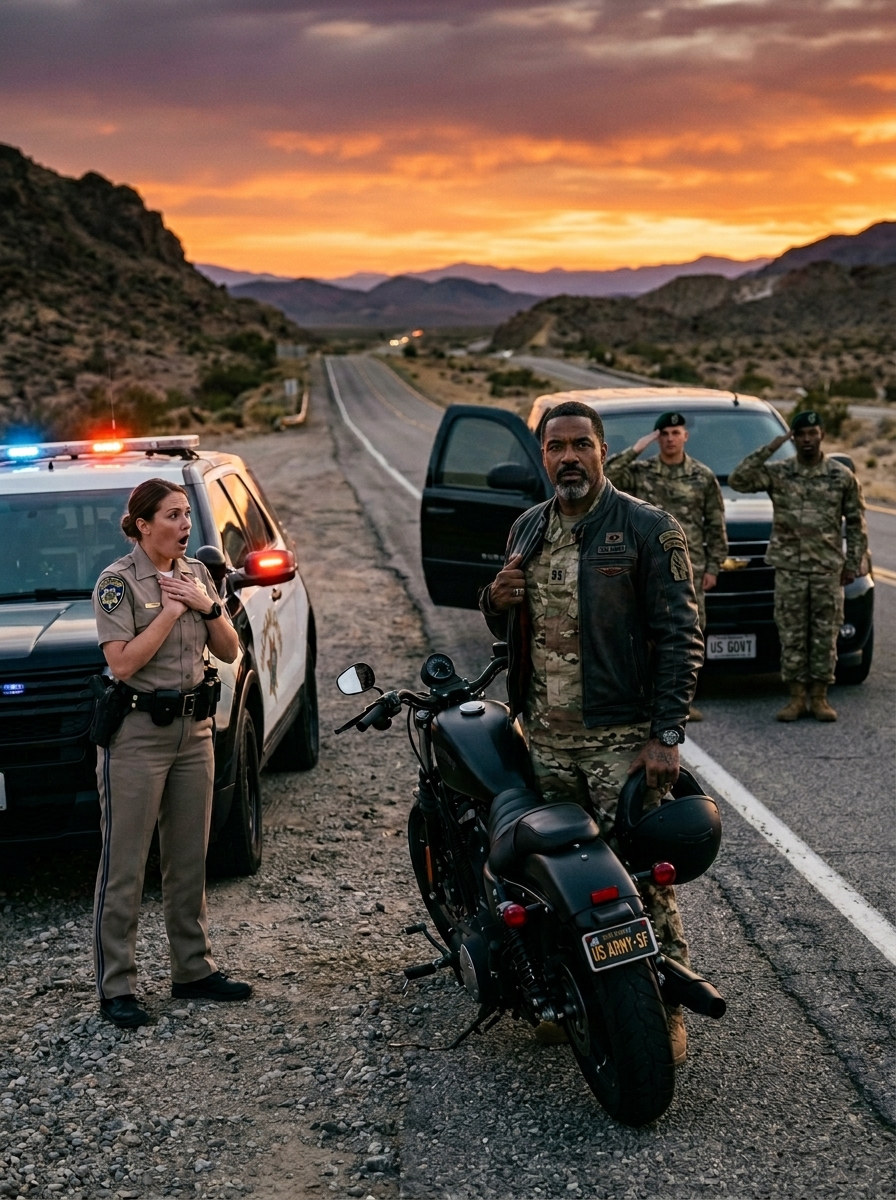
A dark government SUV pulled onto the shoulder with deliberate speed. Two uniformed personnel stepped out immediately. Unlike Harper, they moved with discipline and urgency instead of aggression.
One of them spotted the biker and instantly straightened his posture.
“Captain Reed, sir,” the man called out respectfully. “The unit is here.”
Everything changed in a single second.
Officer Harper blinked in confusion.
The biker turned slightly toward the arriving personnel before looking back at the officer.
“My name,” he said calmly, “is Captain Marcus Reed.”
Harper’s face lost color.
“United States Army Special Forces,” Reed continued. “Active duty.”
The silence that followed felt louder than the highway itself.
Harper suddenly looked down at the identification card still in his hand. This time he actually read it carefully.
Captain Marcus Reed.
The realization hit him all at once.
The man standing in front of him was not some reckless criminal or troublemaker. He was a decorated military officer. A soldier trusted with responsibilities far beyond anything Harper had imagined when he first saw the motorcycle.
Every assumption the officer had made collapsed instantly.
The second uniformed man approached Captain Reed carefully.
“Sir, we received your location after the delay report came through,” he explained. “Is everything alright?”
Reed glanced at Harper before answering.
“That depends,” he said.
Officer Harper swallowed hard.
His earlier confidence had disappeared completely. The aggressive posture, the raised voice, the accusations — all of it suddenly looked reckless and humiliating.
“I… I didn’t know,” Harper muttered.
Captain Reed looked directly at him.
“That’s the problem,” he replied. “You decided who I was before you knew anything at all.”
Harper opened his mouth but could not find words fast enough.
“I was just doing my job,” he finally said weakly.
“No,” Reed answered calmly. “You were judging me.”
The statement landed harder than shouting ever could have.
Traffic continued flowing beside them, but the atmosphere on the roadside had completely shifted. A few drivers still stared as they passed, sensing that something significant had happened even if they did not know the details.
The unit officer beside Reed spoke carefully.
“Captain, do you want this incident formally documented?”
Harper’s eyes widened immediately.
The fear on his face became obvious.
Until that moment, he had still hoped the situation might quietly disappear. But now the reality of what he had done — and how he had behaved — stood directly in front of him.
Captain Reed remained silent for several seconds.
He looked at the officer carefully, almost as if measuring whether the man understood the seriousness of his actions.
Finally, he answered.
“Yes.”
Harper lowered his head slightly.
“But not because of who I am,” Reed continued. “Because this happens to people every day who don’t have rank, connections, or anyone arriving to defend them.”
The words struck harder than any threat.
The officer beside Reed nodded immediately.
“We’ll proceed through official channels, sir.”
Harper looked visibly shaken now.
“I made a mistake,” he admitted quietly.
Captain Reed studied him for a long moment.
“You made several.”
The wind moved across the highway again, carrying the smell of hot asphalt and gasoline through the air. Somewhere farther down the road, a truck horn echoed loudly before fading into traffic.
Harper finally spoke again.
“I thought—”
“That’s exactly what you did,” Reed interrupted calmly. “You thought instead of asking questions. You saw a motorcycle, a leather vest, and decided you already knew my character.”
The officer had no response.
Because it was true.
Reed stepped closer, though his tone never became hostile.
“A badge gives you authority,” he said. “But authority without discipline becomes dangerous.”
Harper stared silently at the pavement.
“You assumed I was carrying drugs.”
No answer.
“You assumed I was a criminal.”
Still nothing.
“You assumed I was beneath your respect.”
The officer’s shoulders dropped.
“I understand,” he said quietly.
Captain Reed shook his head once.
“No,” he replied. “You understand now because the person standing in front of you turned out to be someone important.”
That sentence cut deeper than anything else.
Because Harper knew it was true.
If Captain Reed had simply been an ordinary civilian, the stop likely would have continued differently. The accusations might have escalated. The humiliation might have become worse. And Harper probably would have justified every second of it afterward.
The realization sat heavily on him.
The second unit member approached carefully again.
“Captain, transportation is ready whenever you are.”
Reed nodded once before turning back toward his motorcycle.
For a moment it seemed the encounter was finally over. But before putting on his gloves, Captain Reed stopped and looked at Harper one final time.
The highway noise faded into the background as he spoke.
“Respect should never depend on uniforms, race, clothing, or appearance,” he said. “The people you stop on this road are human beings before anything else.”
Harper slowly lifted his eyes.
“And one more thing,” Reed added. “Never confuse power with permission.”
The officer stood frozen beside his patrol car.
No argument came this time.
No anger.
No excuses.
Only silence.
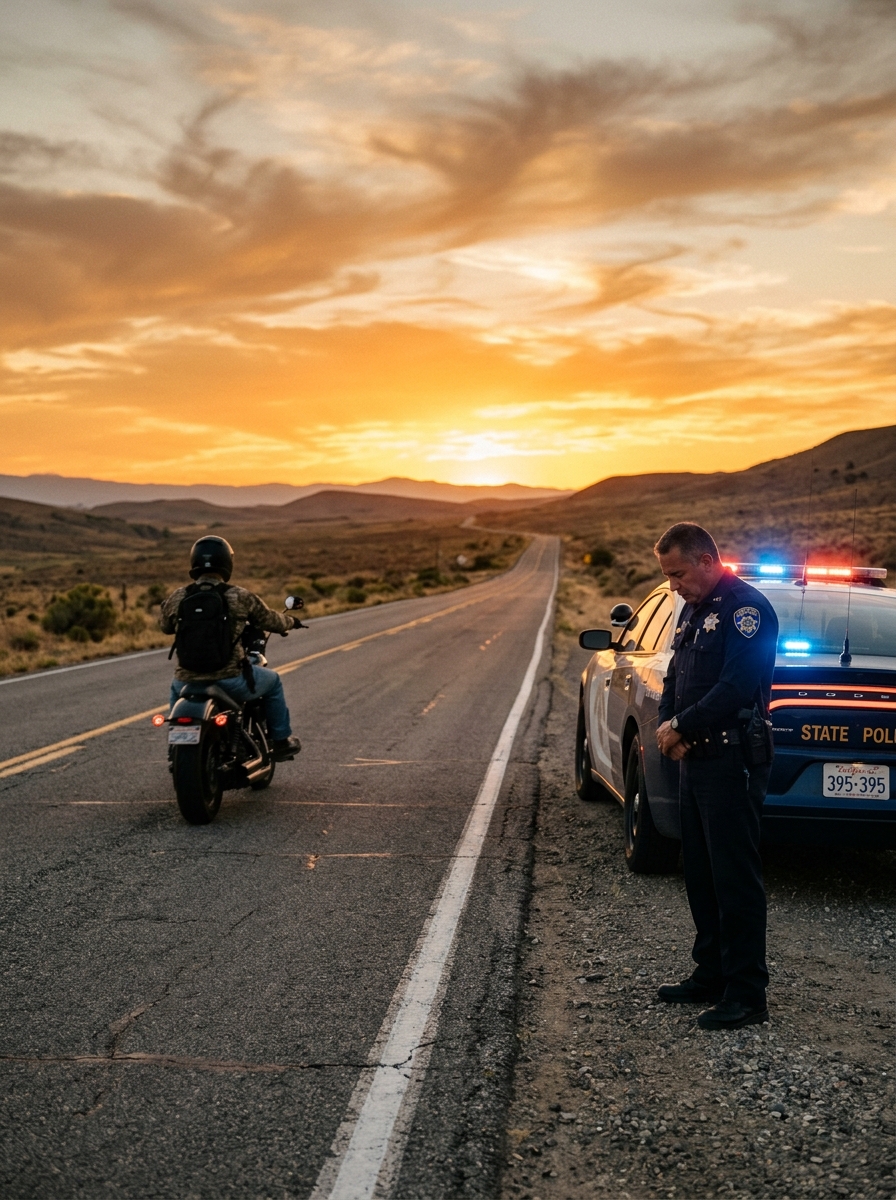
Captain Reed placed his sunglasses back on, climbed onto the motorcycle, and started the engine. The powerful sound echoed across the shoulder before settling into a steady growl.
The military unit escorted him carefully back onto the highway.
Within seconds, the motorcycle disappeared into traffic.
The flashing police lights remained behind.
Officer Harper stood alone beside the road long after the vehicles were gone. Cars continued racing past exactly as before, but the moment had changed something permanently.
For the first time in a very long while, he was forced to confront a truth he had spent years ignoring.
He had judged people before knowing them.
And eventually, that judgment had exposed him instead.
The highway slowly returned to normal.
But the lesson remained clear for everyone who witnessed what happened that day:
True character is not revealed by appearance, status, or assumptions.
It is revealed by how a person treats others when they believe nobody important is watching.
