


I’ve worked as a Federal Air Marshal for nineteen years, accumulating thousands of hours quietly observing people at thirty thousand feet, yet nothing prepared me for the disturbing cruelty I witnessed in the first-class cabin of Flight 404.
My name is Thomas Vance. I am a White, forty-five-year-old man paid to sit on airplanes and pass as an ordinary businessman. My duty is to blend in, remain silent, and only step in if the aircraft’s safety is at risk.
I’ve seen passengers argue over reclined seats, I’ve watched people drink too much, and I’ve endured plenty of adult outbursts. But I had never seen a grown person deliberately torment a disabled child for amusement.
It was a Tuesday morning flight from New York to Seattle, a long cross-country route. I was seated in 2A, the window seat on the left side of the aircraft.
In 2B beside me was a young boy named Julian. He was a nine-year-old Black child traveling alone as an unaccompanied minor.
Julian was a polite, well-mannered kid, neatly dressed in a blue sweater, carrying a foldable white mobility cane. He was completely blind.
Flight attendants had escorted him to his seat and made sure he was comfortable. He sat quietly with his cane secured across his lap, patiently waiting for departure. I introduced myself, and we spoke briefly about baseball. He was nervous about flying alone but trying to stay brave.
Then she boarded.
The woman in seat 1B arrived at the very last moment. She was a White woman in her late forties, wrapped in a designer trench coat and carrying a handbag likely worth more than my car.
She carried an overpowering expensive perfume and an unmistakable air of entitlement. Before even sitting down, she was already complaining to the flight attendant about boarding, cabin temperature, and the absence of immediate champagne.
Her name was Eleanor. I would learn more about her later, but in that moment she was simply an irritating passenger making everyone around her uncomfortable.
She tossed her bag into the overhead bin with exaggerated frustration, then dropped into the seat directly in front of Julian.
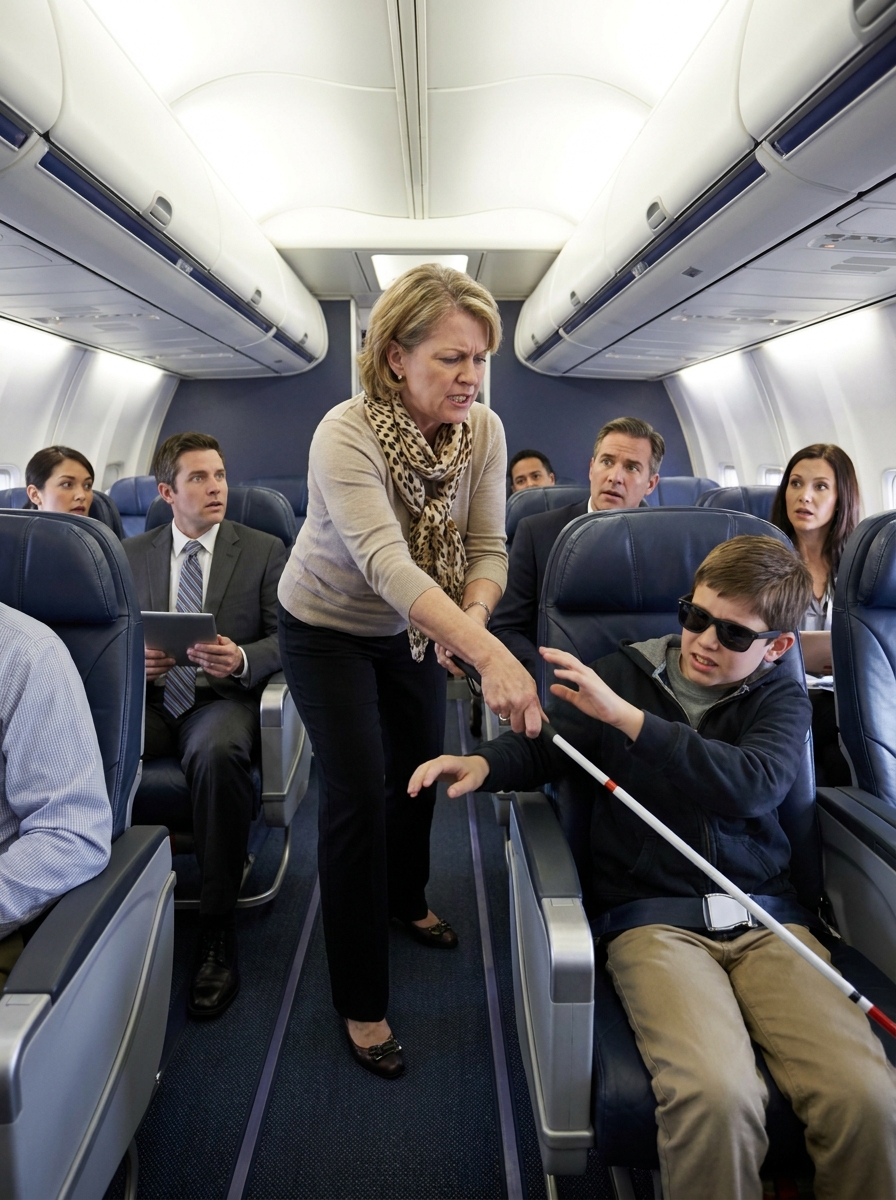
As she forcefully pushed her seat back to recline, it struck Julian’s knees. Startled, the boy flinched, and his white cane slipped from his lap, tapping against the metal leg of Eleanor’s seat.
It was a faint sound. Barely a click.
Eleanor snapped her head around and stared through the seat gap. “Excuse me,” she snapped, her voice sharp and loud enough for the entire first-class cabin. “Keep your toys to yourself. I am trying to relax.”
Julian looked confused, his unseeing eyes turning toward her voice. “I’m sorry, ma’am,” he said softly, lifting the cane back onto his lap. “It’s my cane.”
“I don’t care what it is,” she scoffed, turning forward again. “Just keep it quiet.”
A surge of anger tightened in my chest, but training kept me motionless. Do not break cover over a rude passenger, I reminded myself. Stay out of it.
For the next two hours, the flight stayed relatively calm. Julian fell asleep, and Eleanor drank three mimosas while aggressively typing on her laptop.
Then we hit severe turbulence over the Rocky Mountains. The plane suddenly dropped and shook violently as the seatbelt sign chimed.
Julian woke instantly. The violent movement terrified him. Unable to see the cabin, the chaos must have felt overwhelming, like the world itself was breaking apart.
He gripped the armrests tightly. In panic, he reached for his white cane, his only way to interpret his surroundings. He unfolded it, holding it shakily as the plastic tip tapped against the floor with each violent jolt.
It was a coping mechanism. He was grounding himself.
Eleanor let out an exaggerated sigh and slammed her laptop shut. “Are you kidding me?” she yelled over the engine noise.
She unbuckled her seatbelt despite the glowing warning sign, stood up, and turned toward Julian, her face flushed with anger.
“I told you to stop making that noise!” she shouted.
“I’m sorry, I’m just scared,” Julian whimpered, his hands trembling on the cane.
Before I could unbuckle to intervene, Eleanor reached over the seat.
She violently snatched the white cane from Julian’s hands.
“Hey!” I yelled, finally breaking my silence.
Eleanor ignored me. She lifted the cane and laughed cruelly. “If you can’t behave like a normal person on a flight, then you don’t get to have your little stick,” she sneered.
Julian froze. Pure panic overtook him. He reached out into empty space, completely exposed and terrified. “Please,” he cried. “I need that. I can’t see.”
“Good. Maybe you’ll learn some manners,” she replied coldly. She shoved the mobility cane into the overhead bin, slammed it shut, and sat back down as if she had resolved a minor annoyance.
The entire cabin went dead silent. The turbulence faded, leaving only the sound of a blind nine-year-old quietly sobbing beside me.
My blood ran cold. The level of cruelty she had just displayed defied comprehension.
I unbuckled my seatbelt and stood up. I reached into my jacket and pulled my federal badge. I was about to arrest her right there in the aisle.
But then I remembered the flight manifest I had reviewed before takeoff. I remembered who Julian’s father was. And more importantly, I remembered who was waiting at the arrival gate in Seattle.
I looked down at Eleanor, who was sipping her drink and smiling to herself. She believed she was untouchable. She believed she had just humiliated a helpless child without consequence.
She had no idea that her life, her husband’s business, and her entire privileged world were about to collapse the moment she stepped off that plane.
The silence that followed the overhead bin slamming shut was heavy, suffocating, and charged with a tension I hadn’t felt since basic training. In first class, you expect decorum—or at least a baseline of human decency. What I had just witnessed was the collapse of both.
Julian was trembling. His small shoulders shook in a rhythm that made my chest tighten. He didn’t scream or lash out. He simply sat there, his sightless eyes wide with tears, hands hovering as if trying to grasp something that wasn’t there. To a blind child, that cane is not just an object—it is their connection to the world. Their safety. Taking it meant stripping away that connection entirely.
I looked at Eleanor’s reflection in the polished bulkhead. She was calmly smoothing her skirt, as though she had done something reasonable. She even looked satisfied.
“Julian,” I whispered, leaning closer. My voice stayed steady, trained. “Julian, listen to me. It’s Thomas. I’m right here.”
He turned toward my voice, lip trembling. “Mr. Thomas? She… she took it. I can’t find it.”
“I know she did, buddy,” I said softly, placing a hand on his shoulder. His muscles were rigid. “I saw where she put it. You’re safe. I’m not letting anything else happen to you. Do you understand?”
He nodded quickly, but the tears kept falling.
At that moment, Sarah, the lead flight attendant, hurried down the aisle. She had clearly heard what happened. A seasoned professional I had flown with before, she took in the scene immediately—crying child, tense passengers, and the smug woman in 1B.
“Is everything alright here?” Sarah asked, though she already knew the answer.
Eleanor didn’t even look up. “Everything is fine now. I dealt with the noise. You should be grateful; I’m sure everyone was tired of that clicking.”
Sarah turned to me, silently asking for clarity. I didn’t hold back.
“This woman just snatched that boy’s mobility cane from his hands and shoved it in the overhead bin because he was scared during turbulence,” I said firmly. “She touched an unaccompanied minor and confiscated a medical device. That is not ‘fine.’”
A low wave of murmurs spread through the cabin. A man across the aisle shook his head. “Unbelievable,” he muttered.
Sarah’s tone shifted—professional, firm, controlled. “Ma’am, you cannot touch another passenger, especially a minor. And you cannot take a mobility aid. That cane is essential to his mobility. I need you to open that bin and return it immediately.”
Eleanor finally looked up, offended rather than concerned. “Do you have any idea who I am? My husband sits on multiple development boards in the Pacific Northwest. We donate more to charity in a weekend than most people make in a year. I am not ‘touching’ anyone. I am making sure my flight—which I paid five thousand dollars for—is not ruined by a child who cannot sit still.”
“I don’t care who your husband is,” Sarah said sharply. “The boy is blind. He was frightened. Return the cane.”
“No,” Eleanor said flatly, turning back to her laptop. “It stays there until landing. He needs to learn his disability isn’t an excuse for disruption.”
The badge in my pocket felt heavier. Every instinct as a federal officer pushed me to stand, identify myself, and place her under arrest for interference with flight operations and assault.
I could have done it. I had the authority.
But as I looked at Julian, I understood that a mid-air arrest would only deepen his trauma. He was already frightened. If I initiated a physical intervention or formal detention procedure at 35,000 feet, the cabin would spiral into chaos.
More importantly, I knew something Eleanor didn’t.
When I reviewed the manifest at the gate, I noticed Julian’s surname: Vance-Holloway. I recognized it instantly because I had spent three weeks the previous year assigned to protective detail support for his father during a high-profile racketeering trial.
Julian’s father was the Honorable Arthur Holloway. Not just any judge—he was a Senior Federal Judge for the Western District of Washington. A man known for two defining traits: absolute devotion to the law, and an unshakable, protective bond with his adopted son.
Judge Holloway was the kind of man who could make a single phone call and see an entire corporation collapse by midday. He was also a widower who had lost his wife to cancer three years earlier, leaving Julian as the center of his world.
I glanced at Eleanor. She sat there typing away, entirely unaware she hadn’t just bullied an ordinary child. She had poked a sleeping lion with a very short stick.
“It’s okay, Sarah,” I said, meeting the flight attendant’s gaze. I gave her a precise look—the kind that communicated I was handling this on a level she couldn’t yet see. “Let her keep it there for now. We’re about ninety minutes out from Seattle.”
Sarah looked uncertain, but she caught the intensity in my expression. She knew my background, even if she didn’t know the specifics of today’s mission. She nodded slowly.
“Julian,” I said, leaning back toward the boy. “Can you do something for me? Can you be the bravest kid on this plane for just a little while longer?”
Julian wiped his nose with his sleeve. “I’m trying, Mr. Thomas.”
“I know you are. Listen,” I whispered. “Your dad is already at the airport. I checked. He’s waiting at the gate. And I’ve already sent a message to the ground. He knows everything.”
That wasn’t fully accurate—I hadn’t contacted him yet—but I was about to. As an Air Marshal, I had access to an encrypted satellite communication channel for emergencies. While this wasn’t classified as a terrorist threat, it was still an offense involving a protected individual under my watch.
Julian’s expression brightened slightly at the mention of his father. “Is he mad?”
“He’s not mad at you, Julian,” I said, glancing toward Eleanor’s smug profile. “But I think someone else is about to have a very, very bad day.”
I pulled out my agency-issued device. It resembled a standard phone but was connected to the federal network. I began typing.
TO: FIELD OFFICE SEATTLE / PORT POLICE. REF: FLIGHT 404. INCIDENT INVOLVING UNACCOMPANIED MINOR JULIAN HOLLOWAY. SUBJECT: ELEANOR R. (SEAT 1B). HARASSMENT, SEIZURE OF MOBILITY AID, INTERFERENCE. NOTIFY JUDGE HOLLOWAY. REQUEST IMMEDIATE INTERCEPTION AT GATE D7.
I hit send.
For the remainder of the flight, first class felt like a pressure cooker. Passengers whispered, casting sharp glances at Eleanor. She attempted to order another mimosa, but Sarah ignored her for nearly twenty minutes. When it finally arrived, she set it down so abruptly that liquid splashed onto Eleanor’s silk blouse.
“Careful!” Eleanor snapped.
“Oops,” Sarah replied flatly. “Turbulence.”
There was no turbulence.
As the pilot announced descent into Sea-Tac, the atmosphere shifted from anger to expectation. I watched Eleanor apply fresh lipstick, checking her reflection in a compact mirror. She looked satisfied, convinced she had asserted dominance over both “help” and “nuisance.”
Julian sat still, hands folded tightly in his lap. I leaned over and squeezed his hand. “Almost there, buddy. Stay with me.”
“I want my cane, Mr. Thomas,” he whispered. “I don’t like not knowing where I am.”
“I know. The moment we land, I’ll get it back for you. And if she tries to interfere, she’s going to learn I’m not just a businessman.”
The aircraft descended through thick gray Pacific Northwest clouds. Landing was smooth—the tires chirping against the runway. As we taxied toward Gate D7, Eleanor stood the moment the plane slowed, reaching for the overhead bin.
“Sit down, ma’am,” Sarah called from the jumpseat. “The seatbelt sign is still on.”
“Oh, shut up,” Eleanor snapped. She grabbed her designer bag, then with theatrical arrogance seized Julian’s white cane. She didn’t return it—she tucked it under her arm like a trophy. “I’ll give this to the gate agent. He clearly can’t be trusted with it.”
I stood immediately. I didn’t speak. I simply moved into the aisle, blocking her path. At six-foot-two, built like a linebacker, I saw the first real flicker of uncertainty in her expression as she realized I wasn’t stepping aside.
“Move,” she ordered.
“No,” I said coldly. “You’re staying right here until the door opens. And you’re going to hold that cane very carefully. Because in about two minutes, you’re going to realize it’s the most expensive thing you’ve ever touched.”
“You’re insane,” she hissed, trying to push past me.
I didn’t move. I looked toward the cabin door. Through the small window, the jet bridge was aligning. Ground crew were visible. And at the edge of the frame, I caught the dark outline of a suit and the unmistakable flash of a gold badge.
The Judge was there. And he hadn’t come alone.
I glanced at Julian and gave him a small wink, though he couldn’t see it. “Here we go, Julian. Time to meet your dad.”
The hydraulic hiss of the cabin door opening sounded like a starter pistol. Normally, that sound brings relief—the end of confinement, the return to open air. But in that moment, it felt like the beginning of something far more consequential.
Eleanor vibrated with a toxic mix of adrenaline and misplaced victory. Julian’s cane remained tucked under her arm like stolen proof of dominance. She looked at me, lips curling into a practiced sneer.
“Step aside, you Neanderthal,” she hissed. “I have a car waiting, and I’m done dealing with the lower class for one day.”
I didn’t move. I stayed centered in the aisle, arms crossed. I felt like a barrier holding back something inevitable, and she was pressing against it with blind confidence.
“You’re not going anywhere until Julian gets his cane back,” I said evenly.
But Eleanor’s sense of consequence had long since eroded under privilege. She laughed sharply. “And who exactly is going to stop me? You? The flight attendant? I’ll have your badge and her job before dinner. Move.”
“Thomas,” Sarah whispered behind me, tense with concern. She had no idea what was already in motion.
I looked back at Julian. He had risen now, one small hand gripping the seatback for stability. Without his cane, he was anchored in place, unable to navigate even a few feet. The vulnerability in his face was devastating.
“I’ve got you, Julian,” I said. “Take my arm.”
He reached out, trembling, until his hand locked onto my forearm with surprising strength. I turned slowly, positioning myself between him and the woman who had spent the flight dismantling his sense of safety.
“Fine,” Eleanor snapped as I moved toward the door. “We’ll let ground staff handle this. I’m sure they’ll be fascinated to hear about the ‘Air Marshal’ who allowed a child to harass a premium passenger.”
She pushed past us the moment a gap opened, her heels striking the jet bridge floor with sharp, aggressive clicks as she stepped into it. She had no idea she was walking straight into a situation she had unknowingly set in motion throughout the entire flight.
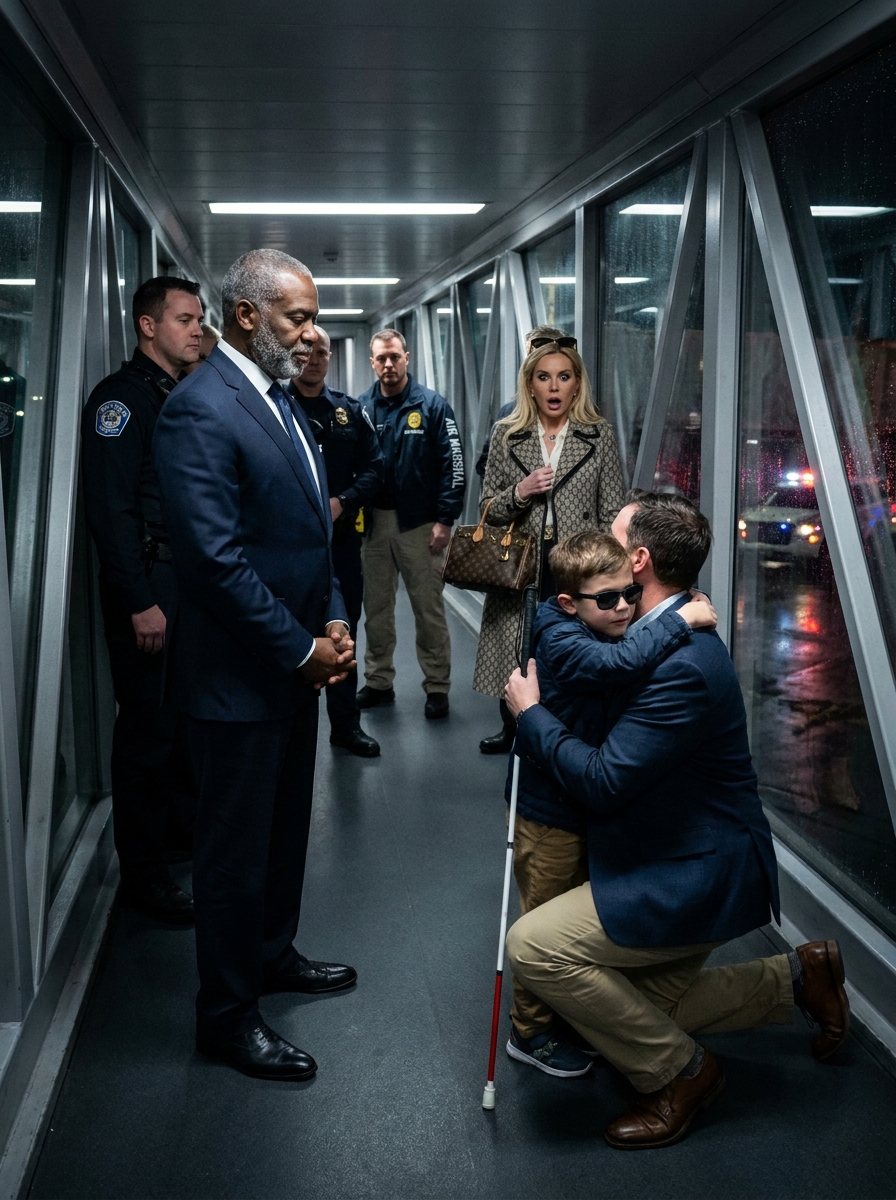
As Julian and I entered the jet bridge, the shift from the aircraft’s recycled air to Seattle’s cool, damp breeze hit us immediately. The jet bridge felt like a strange in-between space—a metal corridor where the rules of flight ended and the rules of the ground began.
And waiting at the far end, under the bright terminal lights, stood a towering man.
Arthur Holloway didn’t resemble a typical judge. He looked like a force contained in human form. A tall Black man in his late fifties, salt-and-pepper hair, wearing a suit that likely cost more than Eleanor’s entire wardrobe combined. He stood perfectly still, eyes locked on the aircraft door.
Behind him were two Port of Seattle police officers and a man in a plain suit I immediately recognized as the Special Agent in Charge of the local Air Marshal field office.
At first, Eleanor didn’t register the police presence. She only saw an expensive suit—and in her world, that meant influence she could appeal to.
She marched straight up to Judge Holloway, her expression shifting into exaggerated distress.
“Sir! Thank goodness,” she began, her voice taking on a dramatic, high-pitched urgency. “You wouldn’t believe the absolute nightmare I’ve endured on this flight. This airline—and this… this child—have been completely intolerable. And this man,” she pointed sharply back at me, “has been threatening me!”
Judge Holloway didn’t acknowledge her. His gaze remained fixed on Julian. I could see the tension in his jaw, the controlled storm behind his composed exterior.
Julian heard his father’s breathing before anything else. A blind child recognizes their world in ways others don’t understand. His entire expression changed instantly.
“Dad?” Julian called, small but filled with hope.
“I’m right here, son,” the Judge replied. His voice was deep and steady, like a cello string vibrating under immense pressure.
Eleanor froze. Her eyes moved between the Judge, Julian, and the white cane still tucked under her arm. The realization began forming—slow, then all at once—that this wasn’t just any child.
“Oh,” she stammered, her confidence cracking. “Is… is this your son? I was just… keeping this safe for him. He was being quite reckless with it during the flight, and—”
“Reckless?” Judge Holloway cut in.
He stepped forward. Eleanor instinctively stepped back. His presence filled the narrow space. “My son is blind, madam. That cane is not a toy. It is part of him. And I have been informed you tore it from his hands while the aircraft was in motion.”
“It was a misunderstanding!” she blurted, her voice rising as she tried to recover. She attempted to hand him the cane, but he didn’t take it. He didn’t even look at it.
“No,” the Judge said quietly. “A misunderstanding is taking the wrong luggage. What you did was assault on a disabled child. It is a violation of federal law. And it is an act of deliberate cruelty.”
His eyes shifted to me. “Special Agent Vance. Thank you for the report.”
The word Agent struck Eleanor like a physical impact. She turned toward me, eyes widening. “Agent? You… you’re actually—”
I didn’t respond. I simply opened my credential wallet, revealing the gold badge and federal ID. “Thomas Vance, Federal Air Marshal Service. Ma’am, I strongly suggest you stop speaking. Everything you’ve said since landing is being recorded on body cameras.”
One of the Port of Seattle officers stepped forward. “Ma’am, return the child’s property. Now.”
Eleanor’s hands trembled violently as she lowered the cane. She extended it toward Julian.
I stepped in. “No. Not you.”
I took it from her myself. The plastic felt cold in my hand, the weight suddenly meaningful. I unfolded it fully until it clicked into place, then placed it carefully into Julian’s grasp.
The moment his fingers wrapped around it, Julian exhaled—a long, shaking release. He tapped the ground once—click—and walked directly into his father’s arms.
Judge Holloway held him tightly, burying his face briefly against his son’s shoulder. It was a private moment of protection and love that stood in stark contrast to the woman only a few feet away.
When he finally looked up, the warmth was gone. Only authority remained.
“My husband is Richard Sterling!” Eleanor suddenly cried out. “He owns Sterling Development! He knows the Mayor! He knows—”
“He knows me,” the Judge interrupted calmly. “And his firm has a federal land-use case scheduled next month. Or rather, it did.”
Eleanor went visibly pale, her expression collapsing.
“I will recuse myself, of course,” he continued. “But I will also be filing a formal complaint with the Department of Justice and the FAA. And I understand Port Police have additional charges to discuss with you regarding theft and harassment of a minor.”
“I… I didn’t mean—”
“Officers,” he said, turning away from her completely, “do your duty.”
They moved in. “Ma’am, turn around and place your hands behind your back.”
“You can’t do this!” Eleanor screamed. “Over a stick? It’s just a stick!”
By now, the terminal had filled with arriving passengers. People from our flight had stopped to watch. They saw the woman in designer clothing being restrained, handcuffed, and escorted away.
They saw Julian standing steady beside his father, holding his white cane.
I watched it all with a quiet, heavy sense of closure. In nineteen years as an Air Marshal, I’d seen every kind of human behavior at cruising altitude—anger, entitlement, fear. Most people reveal who they are when they think no one is watching. First class just makes it easier to see.
But this time, the outcome was different.
“Mr. Thomas?” Julian’s voice called.
I stepped over. Judge Holloway extended his hand, and I shook it firmly. His grip was unyielding. “Thank you, Thomas. For not looking away.”
“I couldn’t,” I said simply. “Not on my watch.”
Julian reached out, and I returned a gentle high-five. “Did you see her face, Mr. Thomas?”
“I saw it,” I replied. “And I don’t think I’ll forget it.”
As officers led Eleanor away, still shouting about lawyers and money, I knew the situation wasn’t finished yet. There was still one final consequence waiting to unfold.
And it was already in motion.
Watching her being escorted through Sea-Tac was like witnessing a slow collapse of someone who never believed gravity applied to them. Her voice echoed through the terminal, drawing attention from travelers, staff, and families alike. Everyone turned—not out of curiosity anymore, but recognition of something irreversible.
I stood still as the silver handcuffs caught the overhead lights. Julian stayed close to his father, calmer now, his cane secure in his hand. He looked grounded in a way he hadn’t been all flight.
“Agent Vance,” Judge Holloway said, turning back to me. “I need your formal statement. My office will coordinate with you, but Port Police will handle initial documentation.”
“I’ll go directly to them,” I replied. “I’ve already secured cockpit and cabin footage. It’s all recorded.”
“Good,” he said quietly. “She’ll try to negotiate her way out of this. Her husband believes everything has a price. This time, it doesn’t.”
He looked down at Julian. “Ready to go home, son?”
Julian nodded. “Yeah. Mrs. Gable made pot roast.”
“That she did,” the Judge said softly.
I watched them leave—father and son moving forward with quiet strength. It was the kind of scene that makes years of anonymity, delays, and airport food feel justified.
Hours later, I sat in a windowless office at airport police headquarters, going through every detail. Every word. Every movement.
Halfway through my report, the door burst open.
A man in a charcoal suit rushed in—mid-fifties, disheveled, expensive briefcase, panic written across his face.
Richard Sterling.
“Where is she?” he demanded. “This is a misunderstanding. I’ve already spoken to people. We can resolve this with a donation—”
The officer didn’t look up. “Mr. Sterling, your wife is being processed for federal charges. Donations are not part of the legal process.”
He turned to me. “You were there. You saw it wasn’t serious. She was stressed. That’s all.”
I stood slowly. “Mr. Sterling, your wife assaulted a blind child. I watched her do it, and I watched her laugh.”
His confidence began to fracture.
“I can fix this,” he said quickly. “Whatever it takes—just tell me what to do.”
“You don’t understand,” I replied. “This isn’t a negotiation. It’s evidence.”
He sank into a chair.
But the real consequence wasn’t in that room.
It came later, when my phone lit up with alerts.
A passenger had posted a video.
Within hours, it spread everywhere.
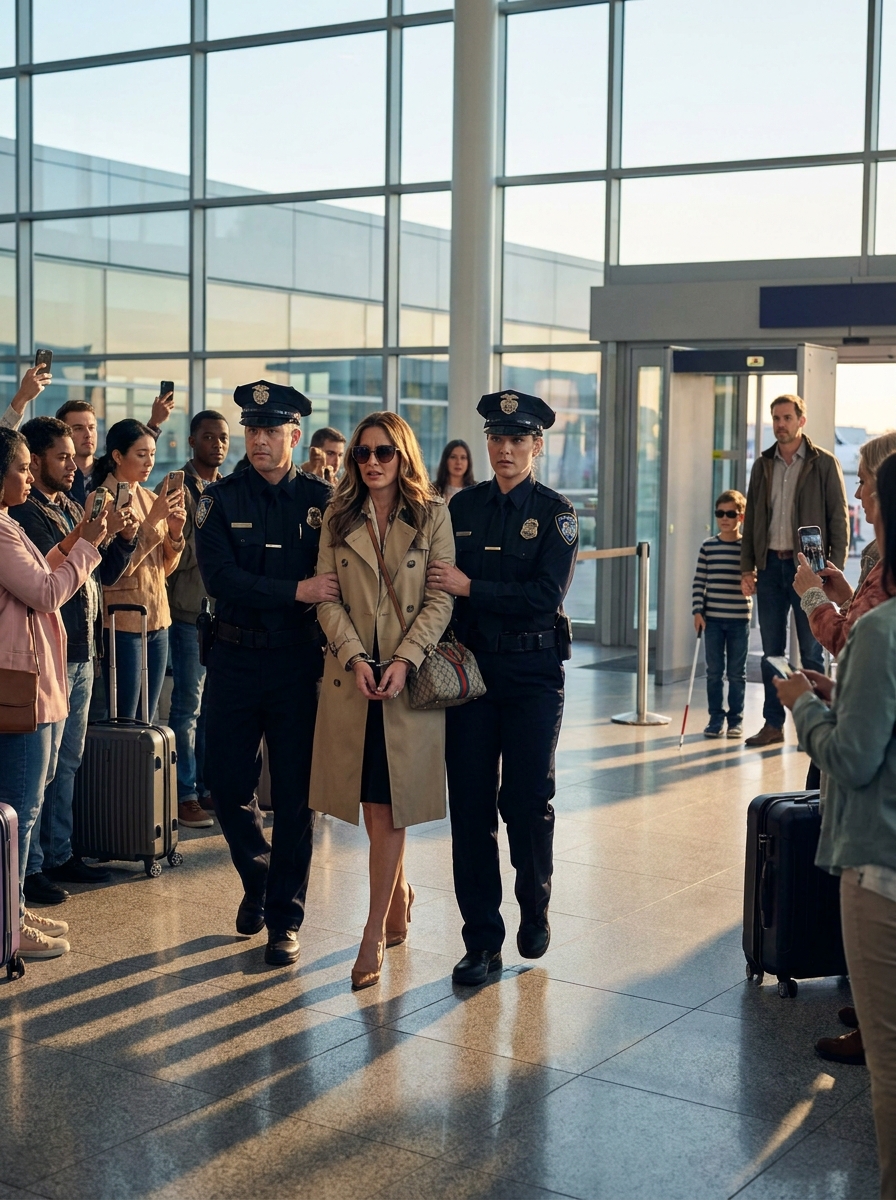
It showed Eleanor laughing with Julian’s cane. It showed her being restrained at the gate. It showed her shouting, “It’s just a stick!”
By morning, it had millions of views.
By afternoon, her world was already collapsing.
Weeks later, I saw Julian again.
He was at the airport with his father, this time by choice, not necessity. He spotted me before I reached them.
“Mr. Thomas!”
He looked different—more confident, steadier.
“We’re starting his orientation program,” Judge Holloway said. “He’ll learn to navigate the city independently.”
“That’s big,” I said.
Julian lifted his cane slightly. “I’m not scared anymore.”
I nodded. “Good.”
As I walked away toward my next assignment, I thought about what I had learned over the years. People reveal themselves at altitude. Some rise. Some fall.
And some believe the sky protects them from consequence.
But it never does.
I’m Thomas Vance. Nineteen years as a Federal Air Marshal. And I’ve learned that justice doesn’t need permission to arrive—it only needs time.
