

I had worked as a pediatric neurosurgeon for seventeen years, yet nothing in my life had prepared me for the terrifying and humiliating confrontation waiting for me in seat 2A—or for the heartbreaking consequences tied to the small medical cooler resting near my feet.
My name is Dr. Sarah Jenkins.
I am a Black woman, a mother, and the Chief of Pediatric Surgery at one of New York’s most respected hospitals.
But on that cold, rainy Tuesday morning, to the crew aboard Flight 408 headed to Los Angeles, I was simply a target.
I had been awake for thirty-six straight hours.
Every bone in my body hurt, my eyes burned from exhaustion, and my hands trembled faintly after the brutal marathon surgery I had completed the night before.
But I couldn’t rest.
Not yet.
Because inside the heavily reinforced medical cooler secured beneath the seat ahead of me was a fragile shipment of genetically matched stem cells capable of saving a life.
Those cells belonged to a six-year-old boy named Leo.
Leo was lying in an ICU bed in Los Angeles, surrounded by machines, struggling for every breath.
His parents sat beside him, holding his hands and praying desperately for a miracle.
I was carrying that miracle.
If those stem cells failed to reach his bloodstream within exactly twelve hours, his organs would shut down completely.
There would be no second chance. No backup option.
That was why I spent $3,500 of my own money on a first-class seat.
I needed to be the first passenger off the plane, and I needed that cooler to remain within my sight every second.
I boarded early and settled into my window seat in 2A.
I leaned back, closed my eyes, and inhaled deeply, hoping for a calm and uneventful six-hour flight.
But fate had something very different planned.
Everything began the moment she walked down the aisle.
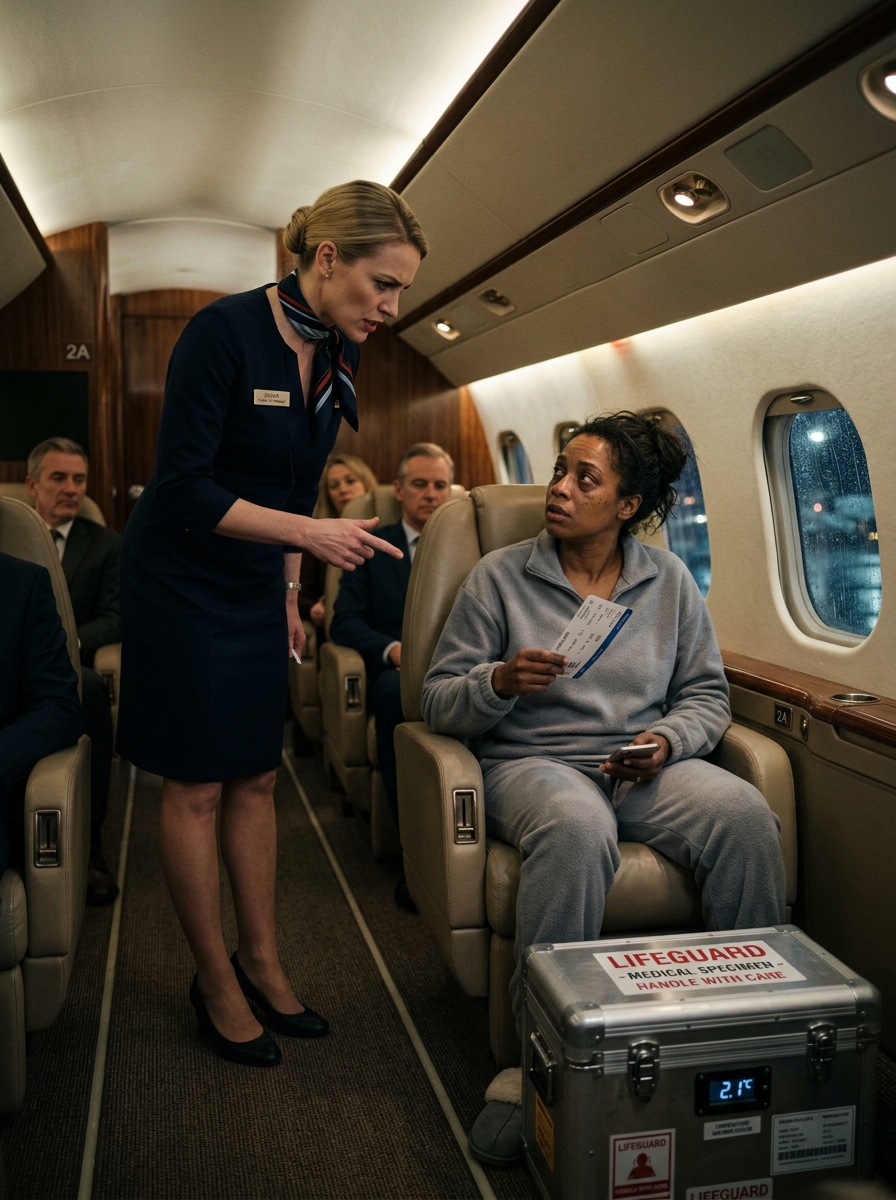
Her nametag read ‘Susan.’
She was the lead flight attendant—a sharply dressed woman with a tight blonde bun and a smile so cold it looked painted on.
As she moved through first class handing out champagne and warm towels to the passengers, I noticed her eyes fixed on me.
It wasn’t a welcoming look.
It was sharp. Calculating.
I was the only Black passenger sitting in first class.
And honestly, dressed in a plain gray tracksuit, I didn’t resemble a wealthy executive or famous celebrity.
I looked like an exhausted mother.
When Susan handed out the pre-flight drinks, she skipped my row entirely.
I didn’t care. I only wanted to reach Los Angeles.
Then she stopped beside my seat.
“Excuse me,” she said, her voice coated in sickly sweet condescension that instantly made the hairs on my arms rise.
I opened my eyes and looked up. “Yes?”
“I need to see your boarding pass,” she demanded.
She didn’t ask. She demanded.
I glanced around the cabin. She hadn’t questioned the white businessman in 1A. She hadn’t stopped the elderly couple in 3B.
Only me.
“I already scanned it at the gate,” I answered politely, keeping my voice calm. “Is there a problem?”
“We just need to make sure everyone is seated in the correct section,” Susan replied, her artificial smile widening even though her eyes stayed cold and lifeless. “Economy boarding is still happening toward the back.”
The implication hung in the air like a weight.
She was openly accusing me of sneaking into first class.
My chest tightened painfully.
I had dealt with microaggressions my entire life, but in that moment, I didn’t have the emotional strength or time for it.
I reached into my pocket, pulled out my phone, and opened the airline app.
I held the screen toward her.
Seat 2A. First Class. Paid in full.
Susan stared at the screen for an uncomfortably long moment.
I watched her jaw tighten. I saw the muscle in her cheek twitch.
But she never apologized.
She never smiled.
Instead, her eyes dropped toward the medical cooler tucked beneath my seat.
“What is that?” she snapped, pointing a manicured finger at the cooler.
“It’s a medical device,” I replied calmly. “It’s secured and meets the requirements for under-seat storage.”
“You can’t keep that up here,” Susan said, raising her voice just enough for nearby passengers to hear.
Several people turned to look. The businessman in 1A lowered his newspaper.
“It contains fragile medical materials,” I explained, trying hard to keep desperation out of my voice. “It’s completely legal, and I already cleared it with TSA and the gate agent.”
“I don’t care what the gate agent told you,” Susan shot back, folding her arms across her chest. “That’s a hard-sided cooler. It’s a tripping hazard. You need to check it.”
“If I check it, the temperature gauge will fail and the materials inside will be destroyed,” I said, my tone becoming firmer. “I am a doctor. This is life-saving medical transport. It stays with me.”
Susan’s face darkened into a dangerous shade of red.
She hated being challenged. She hated hearing the word ‘no.’ And she especially hated hearing it from me.
“Listen to me very carefully,” Susan hissed, leaning down until her face was inches from mine. “You are causing a disturbance. We have a VIP standby passenger who needs a first-class seat. Since you are refusing to comply with federal aviation safety regulations regarding your baggage, I am downgrading you to economy.”
I froze.
The blood drained from my face.
“You’re doing what?” I whispered.
“I am moving you to seat 32E. The middle seat at the back of the plane,” Susan said with a smug smile. “And that cooler is going into the cargo hold. If you refuse, you will be removed from this flight entirely.”
A wave of sharp panic tore through my chest.
If I missed this flight, little Leo would die.
If they placed the cooler in the freezing, unpressurized cargo hold, the stem cells would freeze and die.
I glanced at my watch. The plane was scheduled to leave the gate in exactly twelve minutes.
“I am not moving,” I said, my voice trembling but firm. “And this cooler is not moving.”
“Fine,” Susan sneered.
She straightened up and unclipped a radio from her belt.
Then she pressed the button and spoke loudly enough for the entire cabin to hear.
“Captain, this is Susan. I have a disruptive, non-compliant passenger in 2A refusing crew instructions. She is becoming hostile. I need airport security and police to board the aircraft immediately to remove her.”
The entire first-class cabin fell completely silent.
Passengers stared at me like I was dangerous.
I felt tears burning behind my eyes—a poisonous mixture of humiliation, fury, and absolute fear for the little boy waiting for me in California.
I inhaled slowly.
I wasn’t going to scream. I wasn’t going to cry.
I reached into my bag and pulled out my phone.
Because Susan had absolutely no idea who she was dealing with.
And she had no idea who I was about to call.
Four minutes later, the heavy sound of combat boots thundered through the jet bridge.
Two heavily armed airport police officers stepped onto the aircraft, their hands resting near their utility belts.
Directly behind them stood the Captain, looking furious.
They marched down the aisle and stopped beside my seat.
“Ma’am,” the larger officer barked while glaring down at me. “Grab your bags. You’re coming with us.”
I didn’t look at him.
Instead, I pressed the phone tighter against my ear, waiting for the person on the other end to answer.
CHAPTER 2
The silence inside first class felt thick and suffocating.
It was the kind of silence that comes moments before a crash, when everyone braces for impact but nobody dares to breathe.
I sat motionless in my window seat, my back pressed firmly into the leather cushion, staring at the three figures blocking the narrow aisle.
Two were armed airport police officers.
The third was the captain of Flight 408.
The lead officer, a tall and heavily built man with a buzz cut and a dark navy uniform, stared down at me with obvious irritation and exhaustion. His nametag read ‘Davis.’ I could smell rain on his jacket mixed with stale coffee.
His large hand rested against his utility belt beside his radio and a pair of heavy steel handcuffs.
“Ma’am,” Officer Davis repeated, his voice louder this time as it echoed through the cabin ceiling. “I need you to gather your belongings, stand up, and step into the aisle. You are coming with us.”
I didn’t move.
My hands shook uncontrollably, a fine tremor running from my wrists to my fingertips. It was adrenaline, fear, and the lingering exhaustion from thirty-six sleepless hours.
I tightened my grip on my phone and pressed it harder to my ear.
It kept ringing. One ring. Two rings.
“I am not leaving this seat,” I said.
My voice stayed low, but steady. It didn’t crack. I needed them to understand I was completely serious.
Officer Davis frowned, his thick brows pulling together as he leaned closer, his posture growing more aggressive.
“Ma’am, this is not a negotiation,” he said, the irritation in his voice turning colder and harder. “The flight crew has instructed you to leave the aircraft. You are now trespassing. If you refuse to stand voluntarily, I will physically remove you from this plane. Don’t make me do that.”
A cold bead of sweat slid down the back of my neck.
I knew exactly what he meant.
I had seen the viral videos. I knew what happened to passengers who refused to comply. I imagined them dragging me down the aisle while strangers watched, my dignity ripped apart in public.
But worse than the humiliation was the terror of what would happen to the cooler beside my ankle.
Inside that reinforced container were the stem cells.
They were stored inside a specialized thermal solution controlled by a fragile digital thermostat.
If they removed me from this aircraft, they would confiscate my belongings. They would toss the cooler into a police cruiser. They would leave it sitting in some airport evidence room while paperwork was processed.
The cells would die.
And if the cells died, a six-year-old boy named Leo would die too.
It was unavoidable. His body was already failing. His bone marrow was completely empty. He was lying in a sterile hospital room in Los Angeles surrounded by monitors, waiting for me to arrive and save his life.
I refused to let him die because a flight attendant judged me by the way I looked.
“Officer Davis,” I said, reading his nametag carefully. “Please listen to me. I am a pediatric neurosurgeon. There is a medical transport cooler under my seat containing life-saving biological material for a dying child. If I miss this flight, a little boy will die today. I paid for this seat. I am fully compliant with TSA and FAA regulations. I am not moving.”
Officer Davis hesitated.
For one brief moment, doubt flickered across his face. His eyes dropped toward the gray cooler beneath my seat.
He opened his mouth to respond, but before he could speak, Susan stepped forward.
Susan. The lead flight attendant. The woman responsible for this entire nightmare.
She pushed past the Captain and positioned herself behind the officer, her blonde bun flawless and her uniform perfectly neat.
“Do not listen to her,” Susan told the officers sharply. “She has been hostile and uncooperative since boarding. She is refusing to stow a large hard-sided container that poses a serious tripping hazard in first class. When I offered to check it, she became verbally aggressive. We have a VIP passenger waiting for this seat. She is delaying the entire flight.”
I stared at Susan in disbelief.
She was lying.
She lied effortlessly, weaponizing the police against me to hide her own prejudice.
I looked around the cabin.
The white businessman in seat 1A watched silently with wide eyes. The elderly couple whispered nervously while glancing at me suspiciously.
Nobody defended me. Nobody told the officers I had remained polite and calm the entire time.
To them, I was just another inconvenience delaying their flight to Los Angeles.
“Is this true?” the Captain asked quietly for the first time.
His nametag read Captain Miller. He looked to be in his late fifties with graying hair and piercing blue eyes. Stress was written all over his face.

“She is refusing crew instructions, Captain,” Susan replied firmly. “She is a security risk. I want her off my plane.”
Captain Miller sighed heavily and rubbed his forehead. He looked down at me with an expression that felt completely closed off. He didn’t want my explanation. He just wanted his aircraft airborne.
“Officer, remove her,” Captain Miller said while slightly turning away. “We’re already fourteen minutes behind schedule. Do whatever you have to do.”
Those words hit me like a punch.
Do whatever you have to do.
Officer Davis nodded and unclipped the heavy steel handcuffs from his belt. The metallic click rang loudly through the silent cabin.
“Last warning, ma’am,” Davis said, his voice dropping lower. “Stand up, or I’m putting hands on you.”
He stepped closer and grabbed my left shoulder.
His grip was painfully strong, his fingers digging through the thin fabric of my gray tracksuit into my collarbone.
“Don’t touch me!” I gasped, instinctively jerking backward.
The movement caused my phone to slip from my ear. I nearly dropped it, but caught it at the last second with both hands.
My thumb accidentally pressed the speaker button.
“Grab her other arm,” Davis ordered his partner.
The second officer moved toward me, reaching for my wrist. I leaned forward, throwing my body over the space beneath the seat, shielding the medical cooler with my arms and chest.
“Please!” I cried, tears finally spilling over and blurring my vision. “You are going to kill him! Please, just look at my hospital credentials!”
“Stop resisting!” Davis shouted.
He yanked hard on my shoulder, trying to pull me upright. Pain shot down my arm. I squeezed my eyes shut, bracing myself for the humiliation of being dragged onto the floor.
But then a voice suddenly filled the cabin.
Not from the officers.
Not from Susan.
It came from my phone speaker resting against my chest.
“Sarah? Sarah, what is happening? Are you on the plane?”
Nobody moved. Nobody even breathed.
Slowly, I lowered the phone from against my chest. My shoulder still throbbed from where the officer had grabbed me, and my hands continued to shake, but I forced myself to sit upright in my seat. I glanced down at the gray cooler near my feet, making sure it hadn’t shifted during the struggle. It remained perfectly secure.
Then I slowly raised my head and looked at Captain Miller.
The man looked shattered.
He straightened up, his face burning with deep embarrassment. For the first time since stepping onto the aircraft, he truly looked at me. He noticed the dark exhaustion beneath my eyes. He saw how drained my body looked. He noticed the protective way I had positioned myself around the life-saving cooler.
He had nearly destroyed everything because he blindly trusted a biased employee.
Captain Miller slowly turned his head.
His eyes locked onto Officer Davis.
“Officers,” Captain Miller said quietly, though his voice carried a dangerous, restrained fury. “Please leave the aircraft immediately.”
Officer Davis said nothing. He looked profoundly uncomfortable. He gave me a quick nod that almost resembled an apology, clipped the handcuffs back onto his belt, then turned away. He and his partner quickly walked down the aisle and disappeared into the jet bridge without another glance.
Then Captain Miller turned toward Susan.
Susan stood pressed tightly against the galley wall, trembling uncontrollably. She looked as if she wanted the airplane floor to split open and swallow her whole.
“Susan,” Captain Miller said, his voice tight with anger.
“Captain, I… I didn’t know,” Susan stammered, her voice shaking violently. “She didn’t look like a… I just thought she was…”
“You thought wrong,” Captain Miller cut in sharply. “You lied to me. You escalated this situation for no reason. You nearly cost a child his life today.”
“I was only following baggage policy,” Susan whispered, tears filling her eyes, though they looked more like fear for her career than genuine remorse.
“Get your things,” Captain Miller ordered, pointing toward the aircraft exit with a trembling hand.
“What?” Susan gasped, staring at him in disbelief.
“You are relieved of duty,” Captain Miller announced firmly, loud enough for the entire cabin to hear. “You are off this flight. Return to the terminal and wait for a call from Human Resources. You are finished here.”
“Captain, you can’t…” Susan began, stepping forward.
“I said get off my plane!” Captain Miller thundered, his sudden roar making several passengers flinch.
Susan burst into tears. This time she didn’t argue. She hurriedly grabbed her tote bag from the galley compartment, kept her head lowered, and practically ran off the aircraft before disappearing up the jet bridge.
A second later, the heavy cabin door slammed shut with a loud metallic thud.
Captain Miller inhaled deeply, his breath shaky. He adjusted his cap and smoothed down his uniform. In only a few minutes, he seemed years older.
Then he slowly walked back toward my seat.
He stopped beside me and looked down. The anger had disappeared from his face, replaced entirely by overwhelming shame.
“Dr. Jenkins,” Captain Miller said softly, genuine regret filling his voice. “I… I don’t even have the words to apologize for what just happened to you. It was unacceptable. And it was completely my fault for not listening to you first.”
I looked at him carefully. The horror in his eyes was real. He truly understood what he had almost done.
“I accept your apology, Captain,” I said quietly. “But right now, the only thing that matters is getting to Los Angeles. We’re losing time.”
Captain Miller nodded immediately, determination flashing across his face.
“I promise you, Doctor,” he said firmly. “I will get you there. We are pushing back right now.”
He turned quickly and headed back toward the cockpit, locking the reinforced door behind him.
Seconds later, the engines roared to life, sending a deep vibration through the cabin floor and into my feet. The aircraft slowly pushed away from the gate.
I leaned my head against the cool window glass and watched the rain streak across it.
Then I reached down and rested my hand gently on top of the medical cooler.
We’re coming, Leo, I thought as I closed my eyes, exhaustion finally threatening to overtake me. Just hold on a little longer.
But even as the plane rolled toward the runway, a heavy feeling remained lodged deep in my chest.
The confrontation might have ended, but the flight itself was only beginning. And deep down, I knew the problems weren’t over yet.
The climb out of New York was steep, slicing through layers of dark rain clouds before finally emerging into brilliant sunlight above them.
The ‘fasten seatbelt’ chime echoed softly through the cabin.
But nobody moved.
The atmosphere inside first class had completely changed. Earlier, the air had been thick with judgment, irritation, and quiet hostility.
Now it was filled with suffocating guilt.
I kept my gaze fixed outside the window, staring at the endless white clouds beneath us. My heart still pounded wildly against my ribs, and the adrenaline that had carried me through the confrontation was finally fading.
My hands shook so badly that I tucked them beneath my thighs to hide the tremors.
My right shoulder still hurt where Officer Davis had grabbed me. A dull ache spread from my shoulder down to my elbow, a painful reminder of how close I had come to losing everything.
But I hadn’t lost.
I glanced down beneath the seat ahead of me.
The gray medical cooler remained untouched. A tiny green light blinked steadily on the digital display, confirming the internal temperature was holding perfectly at thirty-eight degrees Fahrenheit.
Inside that cooler was a future.
Inside that cooler was a little boy’s chance to grow up, ride a bicycle, attend high school, and actually live.
I released a long, shaky breath and leaned back against the leather headrest. I closed my eyes, desperately searching for even a moment of peace.
“Excuse me.”
The voice was soft, hesitant, barely louder than a whisper.
I opened my eyes and turned.
It was the white businessman from seat 1A. The same man who had silently lowered his newspaper while Susan threatened me earlier. The same man who said nothing when the police boarded the plane.
He stood awkwardly in the aisle looking down at me. His expensive suit jacket was gone, and his tie hung loose around his neck. He looked deeply uncomfortable.
“Yes?” I asked flatly, without emotion.
“I, um… I just wanted to apologize,” he stammered, rubbing the back of his neck nervously. He couldn’t fully meet my eyes. “For earlier. For not speaking up when the flight attendant was harassing you. I saw everything. I knew she was wrong, and… I just sat there. I’m really sorry.”
I stared at him silently for several seconds.
Part of me wanted to scream at him. Part of me wanted to ask why my dignity and humanity alone weren’t enough for him to step in. Why it took discovering I carried the cure for a billionaire’s grandson before he suddenly found courage.
But I was too exhausted for anger.
“Thank you,” I said quietly.
It wasn’t forgiveness, but it was all I could give him.
He nodded quickly, obviously relieved, then retreated back to his seat.
A moment later, the curtain separating the galley from first class slid open, and another flight attendant stepped through.
Her nametag read ‘Clara.’ She looked young, probably in her mid-twenties, with warm brown eyes and a nervous smile. She had been moved up from economy to replace Susan as lead attendant for first class.
Clara walked directly toward me. She carried no drink cart. In one hand she held a warm towel, and in the other was a bottle of premium water.
“Dr. Jenkins?” Clara said softly, her voice incredibly kind. “Captain Miller asked me to check on you. Is there anything you need? Anything at all? Food, blankets, a charger…”
“Just the water, please,” I replied, giving her a tired but grateful smile. “Thank you, Clara.”
“Of course,” she said gently, handing me the bottle. She lingered for a moment, glancing down at the cooler near my feet. “My sister is a pediatric nurse. What you’re doing… it’s incredible. We’re going to get you to LA. I promise.”
“Thank you,” I whispered, suddenly feeling a painful lump rise in my throat.
Clara smiled warmly before walking back into the galley and pulling the curtain closed behind her.
For the next three hours, the flight remained completely smooth. The steady hum of the engines became soothing background noise.
Eventually, I drifted into a light and restless sleep.
My dreams came in broken fragments, replaying pieces of the last thirty-six hours.
I saw the bright surgical lights inside the operating room in New York. I felt the terrible ache in my lower back from leaning over the operating table for fourteen straight hours while carefully extracting donor stem cells from a brave young volunteer.
I remembered leaving the operating room, peeling off my bloodstained surgical gown, and looking up at the clock.
I remembered racing desperately toward the airport while rain hammered the highways and panic clawed at my chest, terrified I would miss the narrow time window.
Stem cells are unbelievably delicate.
They are living biological material. The moment they are extracted and placed into transport solution, the countdown begins.
You get exactly twelve hours.
Twelve hours to move them across the country, properly prepare them, and transfuse them into the patient’s bloodstream.
Miss that window, and the cells begin breaking down. They die. And they become worthless.
Leo’s twelve-hour deadline ended at precisely 2:00 PM Pacific Time.
Our flight was scheduled to touch down at LAX at 12:15 PM. That left me exactly one hour and forty-five minutes to get off the plane, climb into the waiting ambulance on the tarmac, and race to the hospital.
It was close. It was a logistical disaster waiting to happen. But it could still work.
Until the plane suddenly dropped.
It happened without warning and with such violent force that my body slammed hard against the seatbelt.
My eyes flew open as the overhead bins rattled violently above us. Across the aisle, the elderly woman let out a frightened scream.
The ‘fasten seatbelt’ sign lit up with an urgent double-ding.
“Ladies and gentlemen,” Captain Miller’s strained voice crackled over the intercom. “We’ve encountered unexpected severe clear-air turbulence over the Rockies. Please remain seated with your seatbelts securely fastened. Flight attendants, take your jump seats immediately.”
The aircraft shook violently again, a massive groan echoing through the cabin as we slammed into another air pocket. The plane dropped another hundred feet within seconds.
My stomach lurched into my throat.
But I wasn’t afraid of crashing.
I was terrified for the cooler.
I looked down instantly.
During the violent drop, the heavy medical cooler had shifted. It had slammed hard into the metal support beneath the seat in front of me.
“No,” I whispered.
Ignoring the Captain’s command entirely, I unbuckled my seatbelt and dropped onto my knees in the aisle.
The aircraft jolted again, throwing me sideways, but I scrambled back immediately and grabbed the thick plastic handle of the cooler, dragging it toward me.
Then I checked the digital display.
My blood turned to ice.
The solid green light—the one confirming the internal battery was functioning properly—was gone.
In its place, a small red warning light flashed rapidly.
And the temperature display, which had remained steady at 38 degrees for four straight hours, was climbing.
38.5…
39.0…
39.5…
“Oh my god,” I breathed, frantically running my hands along the side of the cooler searching for the battery pack.
I found the problem immediately.
When Officer Davis grabbed me earlier, during the struggle in the aisle, I had thrown myself over the cooler to protect it. Somewhere in that chaos, a heavy combat boot must have slammed into the side of the case.
The outer casing around the lithium-ion battery had cracked. The violent turbulence had finally shaken the damaged connection loose.
The cooling system had failed.
The temperature inside the cooler was rising.
Stem cells are extremely vulnerable to thermal fluctuations. Once the temperature reached 42 degrees Fahrenheit, the proteins would begin denaturing. At 45 degrees, irreversible cell death would begin.
The display climbed again.
40.1…
I had maybe twenty minutes before the cells died. We were flying at 35,000 feet somewhere above Colorado. There was no replacement battery. No hospital. No backup plan.
There was only me.
I slammed my palm against the flight attendant call button above my seat three times in rapid succession.
Ding. Ding. Ding.
The aircraft still shook violently as we pushed through the rough air.
A second later, Clara peeked through the galley curtain. She was strapped into her jump seat, pale and terrified.
“Clara!” I shouted over the roar of the engines and rattling cabin. “I need your help! Right now!”
Clara didn’t hesitate.
She unbuckled her harness, openly defying the Captain’s order, and stumbled down the aisle while gripping the overhead bins for balance.
She dropped to her knees beside me.
“Dr. Jenkins, what is it? Are you hurt?” she asked, panic filling her eyes.
“The battery is dead,” I said, my voice shaking with raw fear as I pointed toward the flashing red light. “The cooler is failing. The temperature is climbing. If it reaches 42 degrees, the boy dies. I need to cool it manually.”
Clara looked at the screen. It read 40.5.
“What do you need?” she asked, instantly shifting from frightened to laser-focused.
“Ice,” I ordered. “Every piece of ice on this aircraft. And plastic bags. Thick ones. Garbage bags, zip-locks, anything that won’t leak. I also need thermal blankets. Go!”
Clara scrambled to her feet and raced back toward the galley.
I pulled the cooler completely out from beneath the seat and positioned it between my legs on the cabin floor. Then I unlatched the heavy metal locks on either side.
I had to open it.
It was dangerous exposing the internal chamber to the cabin air, but I had no alternative. I needed to manually pack ice around the inner lining before the temperature became fatal.
I lifted the lid.
Inside, secured in custom-molded foam, sat the stainless steel bio-canister carrying Leo’s future.
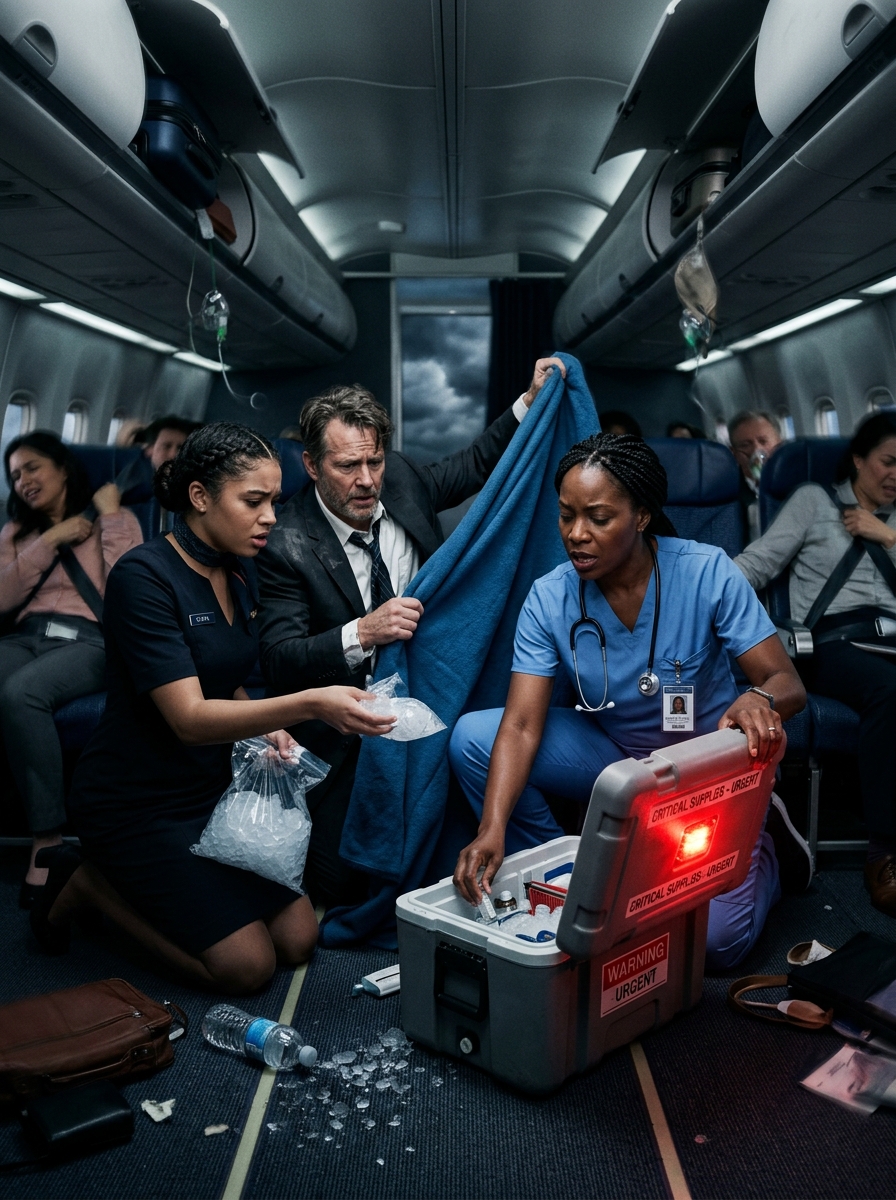
Clara returned less than thirty seconds later carrying two large plastic bags packed with crushed ice from the beverage carts, along with several blue fleece airline blankets draped over her arms.
The businessman from seat 1A had unbuckled his seatbelt and was now standing over us.
“How can I help?” he asked urgently.
“Take this blanket,” I instructed, tossing him one of the blue fleeces. “Hold it above the cooler like a tent. We need to block the warm air from the cabin vents.”
Without hesitation, he dropped to his knees in the aisle and held the blanket above us with both hands, creating a makeshift canopy.
“Clara, open the bags,” I ordered.
The temperature display now read 41.2.
We were seconds from disaster.
I grabbed the ice bags from Clara and carefully wedged them into the spaces between the foam lining and the outer shell of the cooler. I packed them tightly while making sure they never touched the stainless steel canister directly, because flash-freezing would destroy the cells just as quickly as heat.
“More ice,” I demanded, sweat pouring down my forehead.
“That’s all first class has,” Clara said breathlessly. “I’ll get more from the main cabin.”
“Run!” I shouted.
She sprinted down the aisle and vanished through the curtain into economy.
I stared at the digital display, my heartbeat pounding painfully against my chest.
41.5.
The temperature was still climbing. The trapped heat inside the container hadn’t dissipated yet.
“Come on,” I whispered brokenly. “Please. Not like this. Don’t die like this.”
I thought about John Sterling. I thought about the terrifying authority in his voice over the phone and the agony hidden beneath it. I thought about little Leo, a boy I had never met, lying in a hospital bed while his parents clung desperately to hope.
I pressed my palms against the cooler as if pure determination alone could force the temperature downward.
Then Clara came rushing back carrying two more bags of ice, completely breathless.
“Here,” she gasped, dropping beside me.
I packed the remaining ice around the inner lining. Then I shoved another fleece blanket tightly into the top of the cooler to create additional insulation before slamming the heavy lid shut and locking the metal latches.
At that exact moment, the aircraft finally broke free from the turbulence. The violent shaking eased instantly into a smooth and steady glide.
The three of us—me, Clara, and the businessman—remained kneeling on the cabin floor, staring silently at the tiny digital display.
41.8.
I stopped breathing.
41.9.
One more tenth of a degree. Just one more, and the proteins would start unraveling. Everything would be over.
I closed my eyes as a single hot tear slid down my cheek.
Then Clara gasped.
I opened my eyes immediately.
The display blinked.
41.7.
I stared at it in disbelief.
It blinked again.
41.4.
The ice was working. The manual insulation was holding. The temperature was finally dropping back into the safe range.
“It’s going down,” the businessman whispered emotionally. Slowly, he lowered the blanket he had been holding over the cooler. He looked at me with wet eyes full of relief. “You did it, Doc.”
I released a rough, exhausted breath and leaned heavily against the base of my seat.
“We did it,” I corrected softly, looking between him and Clara. “Thank you. Both of you.”
Clara smiled and wiped sweat from her forehead. “I’ll keep checking the galleys. I’ll bring you fresh ice every thirty minutes until we land.”
“Thank you, Clara,” I whispered.
I climbed back into my seat and fastened my seatbelt. Then I slid the cooler securely beneath the seat again, bracing it firmly with my feet.
The digital display continued dropping until it stabilized at a perfect and safe 38 degrees.
I rested my head against the window and stared out into the endless blue sky. The emergency had passed. The cells were safe. We were less than two hours from Los Angeles.
I closed my eyes, finally allowing myself to believe the worst was over.
But I was wrong.
Thirty minutes later, the intercom crackled alive.
It wasn’t the usual ‘fasten seatbelt’ tone. It was the sharp click of the pilot activating the microphone.
“Dr. Jenkins.”
Captain Miller wasn’t addressing the cabin. He didn’t say ‘Ladies and Gentlemen.’ He spoke directly to me through the aircraft speakers.
And his voice no longer sounded merely stressed.
It sounded defeated.
My eyes snapped open instantly. The cold dread from earlier returned all at once, heavier and darker than before.
“Dr. Jenkins, I need you to listen to me very carefully,” Captain Miller said, his voice echoing through the silent aircraft.
I sat upright immediately, staring at the speaker above my head.
“Air Traffic Control just contacted us,” Captain Miller continued, his voice trembling slightly. “There has been a major multi-vehicle crash on the 405 freeway near LAX. A fuel tanker exploded. The smoke is so dense it has blinded the radar systems and covered the runways. LAX is officially under a ground stop. The airspace has been closed.”
I stopped breathing.
“ATC is diverting all inbound flights,” Captain Miller said. “We have been ordered to turn around. They are rerouting us to McCarran International Airport in Las Vegas.”
Vegas.
I looked at my watch.
11:30 AM Pacific Time.
If we diverted to Vegas, we would have to land, refuel, and wait until Los Angeles airspace reopened. That process would take hours.
Leo’s deadline ended at 2:00 PM.
If this plane landed in Las Vegas, John Sterling’s grandson would die.
Las Vegas.
The words echoed through my head over and over until they stopped sounding real and became a death sentence instead.
I stared at the speaker above me, the small plastic panel that had just delivered the fatal blow to a six-year-old child I had never even met.
Around me, the first-class cabin erupted into irritated murmurs and frustrated sighs. Passengers pulled out phones and complained about missed connections, ruined vacations, and delayed schedules.
To them, this was an inconvenience.
To me, it was the end of everything.
I looked back down at my watch. The glowing digital numbers looked cruelly unforgiving.
11:32 AM.
The biological deadline for the stem cells inside the cooler beneath my feet was 2:00 PM.
If Captain Miller turned this massive Boeing aircraft around, crossed back over the Mojave Desert, entered a holding pattern above McCarran International Airport, landed, taxied, and waited for Los Angeles to reopen…
It would be nighttime before we reached California.
The cells would be useless.
Leo’s organs were already failing. His bone marrow was gone. He was surviving on machines and prayers. He didn’t have until tonight.
He barely had two and a half hours left.
I didn’t stop to think. I didn’t consider consequences. The exhaustion crushing me for the last forty-eight hours disappeared instantly beneath a blinding surge of adrenaline.
I unbuckled my seatbelt. The metal clasp snapped loudly in the quiet cabin.
Then I stood up and grabbed the heavy medical cooler by its reinforced handle.
“Ma’am?” the businessman from seat 1A asked nervously. “The Captain said to stay seated. We could hit more turbulence.”
I ignored him completely.
I stepped into the aisle and walked straight toward the front galley.
Clara sat strapped into her jump seat with her safety harness secured tightly across her shoulders. She looked up at me, alarm flashing across her warm brown eyes.
“Dr. Jenkins, you need to sit down,” Clara urged gently but firmly. “We’re changing course. The banking maneuver could knock you over.”
“Call the cockpit,” I demanded, stopping directly in front of her.
“I… I can’t do that,” Clara stammered nervously, glancing toward the reinforced cockpit door. “Sterile cockpit rules apply during major diversions. I can only interrupt them for an immediate flight safety emergency.”
“This is an emergency,” I said, my voice dropping into a low and dangerous tone. “If this plane goes to Las Vegas, a child is going to die. Call the Captain right now, Clara. Or I will start pounding on that cockpit door until he opens it.”
Clara stared at me silently.
She saw the desperation in my eyes. She saw the heavy cooler clenched tightly in my hand.
She remembered the ice. She remembered the panic of saving the cells manually.
Without another word, Clara unclipped her harness, stood up, grabbed the red intercom phone mounted beside the galley wall, and entered a four-digit code.
She raised the receiver to her ear. I heard ringing followed by a sharp click.
“Flight deck, this better be an emergency,” a harsh voice snapped through the line. It was the First Officer.
“It’s Dr. Jenkins,” Clara replied, her voice trembling slightly. “She needs to speak with Captain Miller immediately. It’s about the medical transport.”
A short pause followed. I heard muffled conversation in the background before Clara handed the receiver to me.
“Dr. Jenkins,” Captain Miller’s voice came through the phone. He sounded exhausted and overwhelmed by the chaos unfolding around him. “I am deeply sorry. Truly. But there is nothing I can do. The accident on the 405 is catastrophic. The smoke plume has completely blinded the control tower at LAX. All flights are grounded and the airspace is closed. Federal dispatch has directly ordered us to divert to Vegas.”
“Captain, you cannot take this plane to Nevada,” I pleaded, gripping the phone so tightly my knuckles turned white. “The stem cells expire at 2:00 PM. If we divert, we miss the window. The cells die. The boy dies. It is a mathematical certainty.”
“Doctor, I understand what’s at stake,” Miller replied, his voice heavy with regret. “But I cannot fly a commercial airliner into closed airspace with no visibility. That violates every federal aviation regulation imaginable. If I ignore ATC orders, I lose my license. I could face federal prosecution. I’m responsible for the lives of one hundred and forty passengers behind you. I cannot risk this aircraft.”
He was right.
Legally, logically, professionally… he was absolutely right.
But I refused to accept logic.
“Don’t turn the aircraft yet,” I begged. “Just maintain your heading for two minutes. Please. Just two minutes.”
“I’m entering the banking pattern now, Doctor. I have to go.”
“Captain, wait!” I shouted.
But the line went dead.
He had hung up.
I slammed the receiver back onto the wall mount. My chest heaved violently as I stared through the small galley porthole window.
The horizon was beginning to tilt.
The left wing was dipping.
He was already turning the aircraft.
We were heading to Vegas.
I dropped to my knees right there in the galley and pulled my cellphone from my pocket. My hands shook so violently that I dropped it twice before finally unlocking the screen.
I opened my recent calls, found the number, and pressed dial.
One ring.
“Sarah.”
John Sterling’s voice sounded completely different this time. Earlier it had thundered with authority. Now it was hollow and breathless. It sounded like a man listening helplessly as the clock ticked down on someone he loved.
“John,” I said immediately, skipping all pleasantries. “They’re diverting the flight. There’s a fire near LAX. The airspace is closed. Captain Miller is turning toward Las Vegas. We are not going to make the 2:00 PM deadline.”
A horrifying silence filled the line.
In the background, I could hear the steady beeping of hospital monitors. I pictured him standing in the pediatric ICU hallway staring through glass at little Leo.
“Vegas,” John whispered at last. The word sounded poisoned.
“He said he has no choice,” I continued rapidly. “ATC ordered the diversion. He said he can’t risk the passengers. John, I tried to stop him. I tried.”
“Hold on,” John said.
Suddenly, his voice changed. The despair vanished instantly, replaced by something razor-sharp and cold as steel.
“Do not hang up.”
I heard a door swing open on his end, followed by his rapid footsteps pounding down a hospital hallway.
“I am the Chief Vice President of Flight Operations,” John muttered darkly, almost to himself. “Nobody turns my airplane around without my permission.”
I heard another line ringing through his speakerphone. He had placed me on speaker while dialing from another phone.
“Dispatch, this is Sterling,” John barked. “Get me LAX tower. Priority override. Now.”
There was a pause, several clicks, and then another voice entered the call.
“LAX Tower, supervisor Reynolds speaking.”
“Reynolds, this is John Sterling. Flight 408 inbound from JFK was just ordered to divert to McCarran. I am overriding that order.”
“Sir,” the ATC supervisor answered tensely but respectfully. “With all due respect, visibility on the primary runways is zero. Smoke from the tanker explosion is moving directly across the approach path. The ground stop is mandatory for all commercial aircraft.”
“I don’t care if the runway itself is burning, Reynolds,” John roared. “My grandson is dying in a hospital three miles from your tower, and the cure is sitting in seat 2A aboard that aircraft. You are going to find a way to get that plane on the ground.”
“Sir, it’s a Boeing 767,” Reynolds argued. “I cannot authorize a blind landing for a heavy aircraft. The risk is unacceptable.”
“Then don’t land them at LAX!” John shouted. “What about Long Beach? Burbank? The military base at Los Alamitos?”
“Burbank is too far north. Traffic on the 5 freeway is completely deadlocked, the ambulance would never make it,” Reynolds replied quickly. “Long Beach is clear of smoke. They have sufficient runway length.”
“Then divert them to Long Beach!” John ordered.
“I can’t do that, Mr. Sterling,” Reynolds said, genuine regret filling his voice. “ATC policy requires diversion to the primary alternate airport, which is McCarran. Unless the Pilot in Command declares a critical emergency, I legally cannot override the diversion procedures. My hands are tied.”
I closed my eyes.
Rules. Policies. Bureaucracy.
They were going to kill Leo.
“Patch me through to the cockpit of Flight 408,” John said quietly, his voice suddenly terrifyingly calm. “Connect me right now.”
Here’s the rephrased version with all quoted speech and emotions preserved, no added details, and the overall length maintained:
A few seconds later, a sharp beep sounded through the phone.
“Flight deck, Captain Miller speaking,” the familiar, strained voice answered.
“Tom,” John said.
Captain Miller didn’t reply right away. I could practically hear his stomach drop.
“Sir,” Miller finally said.
“Tom, I’m standing outside my grandson’s hospital room,” John said. Every trace of anger had disappeared from his voice. What replaced it was far more powerful—raw, desperate pleading. “His mother is on the floor crying. His doctors have run out of options. The only thing keeping him alive is the cooler sitting in your galley.”
I glanced up. Clara was staring at me, tears streaming down her cheeks.
“Sir, the airspace is closed,” Miller replied, his voice cracking. “If I ignore ATC instructions, I’m committing a federal violation. I’ll lose my wings.”
“Tom, listen to me,” John begged. “If you go to Vegas, you keep your wings. But I’ll bury my grandson. I’m asking you, father to father, man to man… please. Don’t take that plane to Nevada.”
The silence afterward was unbearable.
I looked through the galley window. The aircraft was still banking. Its nose kept turning east, away from the coastline, away from hope.
I held my breath.
Then suddenly, a deep vibration shook through the floor beneath us.
The left wing straightened. The right wing dipped.
The plane was turning back.
“LAX Tower, this is Flight 408,” Captain Miller’s voice rang over the radio, suddenly steady, clear, and absolutely determined.
“Go ahead, 408,” the dispatcher answered.
“Tower, Flight 408 is officially declaring a medical emergency,” Captain Miller announced. “We have a critical, time-sensitive biological transport onboard intended for a dying patient. We are approaching the biological expiration window. We require immediate priority routing to Long Beach Airport.”
The radio crackled.
“408, declaring a medical emergency grants you priority clearance,” the dispatcher replied, his voice no longer stiff with bureaucracy. “Turn right heading one-eight-zero. Descend and maintain ten thousand feet. You are cleared direct approach to Long Beach runway three-zero.”
“Copy that, Tower,” Miller replied. “Heading one-eight-zero. Have ground crews at Long Beach place an ambulance directly on the tarmac. We are not going to a gate. We’re coming in hot.”
“Ambulance is scrambled, 408. Good luck.”
The line clicked off.
“Thank you, Tom,” John whispered, his voice breaking apart completely. “Thank you.”
“Get ready, Doctor,” Miller’s voice came through my phone. “It’s going to be a fast ride down.”
I ended the call and shoved my phone into my pocket.
Grabbing the heavy medical cooler, I hurried back toward seat 2A.
The ‘fasten seatbelt’ sign was already flashing aggressively overhead.
I shoved the cooler beneath the seat, securing it tightly between my feet, then pulled the thick nylon seatbelt firmly across my waist.
The descent was terrifying.
Captain Miller wasn’t performing a smooth commercial approach. He was dropping the massive Boeing 767 toward the ground as fast as the aircraft could safely handle.
My ears popped painfully. The cabin pressure shifted violently. Several passengers farther back began shouting in fear.
I looked out the window.
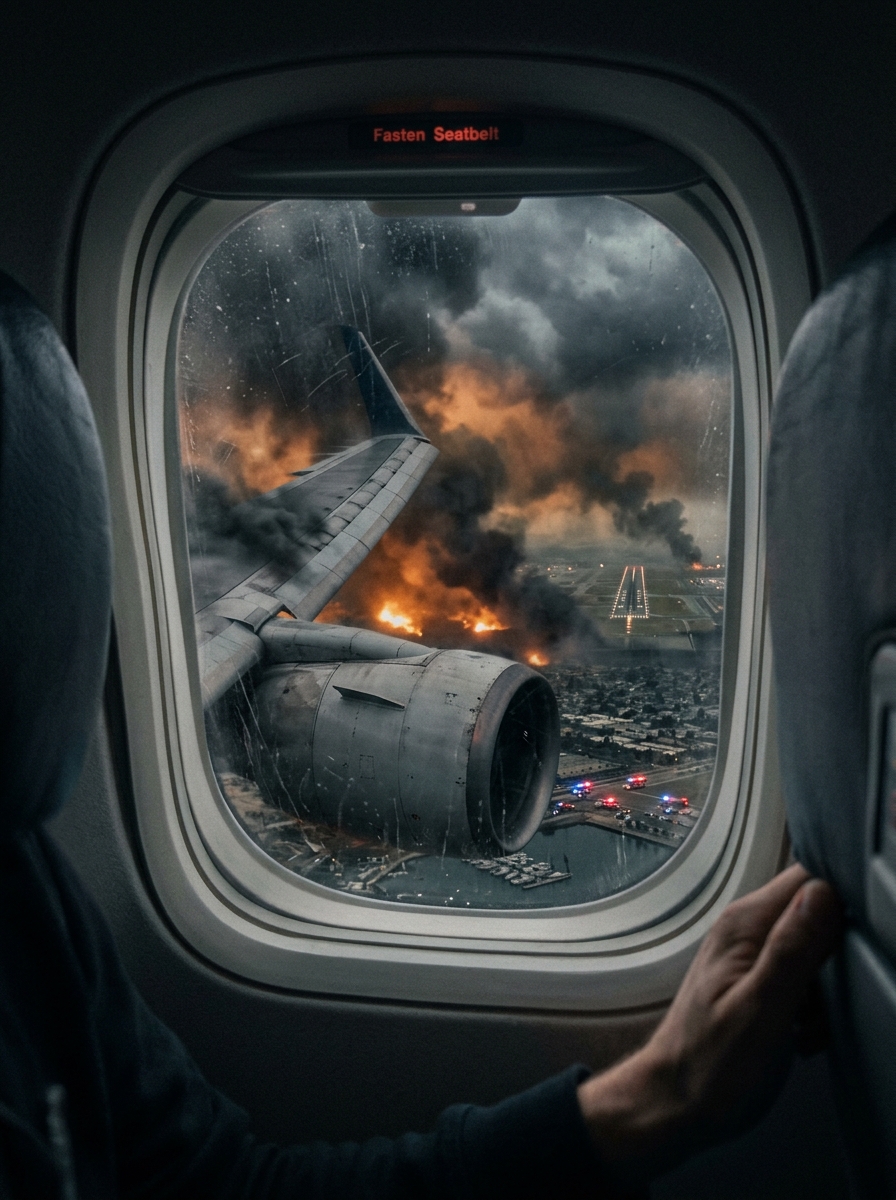
Below us, Los Angeles was buried beneath an enormous blanket of black and gray smoke. The tanker explosion on the 405 was pumping toxic ash into the sky by the thousands of tons.
We punched directly into the smoke layer.
The cabin instantly darkened, swallowed by an eerie twilight glow. The aircraft shook violently as it passed through thermal currents rising from the inferno below.
“Hold on,” I whispered to the cooler at my feet.
Then suddenly, we burst beneath the smoke.
The ground rushed upward toward us. We were unbelievably low. I could see rooftops in the Long Beach suburbs, cars crawling through side streets, palm trees bending in the wind.
The landing gear deployed with a loud mechanical grind that rattled the floor beneath us.
I braced myself against the seat ahead, planting my feet tightly around the cooler.
The plane slammed onto the runway.
It wasn’t gentle. It was a hard, aggressive impact that bounced the entire aircraft.
The reverse thrusters roared to life with a deafening scream of metal and jet fuel. The brakes shrieked as Captain Miller fought to slow the enormous aircraft.
Everyone lurched violently forward against their seatbelts.
Finally, the plane slowed to a crawl before sharply turning off the runway toward a remote stretch of tarmac.
We didn’t taxi to the terminal. We didn’t approach a jet bridge.
The aircraft shuddered to a complete stop in the middle of the concrete apron.
Outside my window, red and blue emergency lights flashed wildly.
A massive Los Angeles Fire Department ambulance sat fifty feet away with its engine running and two paramedics waiting beside the open rear doors. Parked nearby was a sleek black SUV with government plates.
“Cabin crew, doors to manual. Deploy the forward stairs,” Captain Miller announced over the intercom.
I didn’t wait for the chime.
I unbuckled my seatbelt, grabbed the cooler, and jumped into the aisle.
Clara pushed open the heavy forward door while ground crews rolled a mobile staircase into place.
“Go,” Clara said, tears shining in her eyes. “Go save him.”
I never looked back.
I ran.
I flew down the metal stairs, the cooler slamming painfully against my leg with every step. The hot California air hit my face, thick with the smell of jet fuel and smoke.
I sprinted across the tarmac toward the ambulance.
“Dr. Jenkins?” the lead paramedic shouted above the roaring jet engines.
“Yes!” I yelled, breathless.
“Get in!”
He grabbed my arm and practically shoved me into the back of the ambulance.
The metal doors slammed shut behind us.
“Go! Go! Go!” he shouted to the driver, pounding twice against the partition.
The ambulance lurched forward immediately, sirens screaming into the heavy afternoon air.
I collapsed onto the narrow bench seat, clutching the cooler tightly against my chest. My eyes darted to the digital clock mounted on the wall.
1:14 PM.
We had forty-six minutes left.
The drive from Long Beach to the pediatric hospital in Los Angeles blurred into flashing lights, screaming sirens, and violent swerves. The driver pushed the ambulance like a madman through the gridlocked traffic, running lights, driving along shoulders, doing absolutely anything to keep us moving.
My eyes stayed locked on the cooler’s digital display.
38.0 degrees.
The emergency ice packs we had jammed into the casing mid-flight were still holding. The temperature remained perfect.
“How far?” I shouted over the sirens.
“Three miles!” the paramedic yelled back. “Almost there!”
Ten minutes later, the ambulance screeched through a hard left turn before slamming to a stop at the hospital’s ambulance bay.
The rear doors burst open.
I grabbed the cooler and jumped out before the paramedic could even offer help.
A group of nurses and a security guard waited at the trauma entrance.
“Dr. Jenkins?” a young nurse called urgently.
“Yes. Where is he?” I demanded.
“ICU, fourth floor. Follow me.”
I ran.
My legs burned. My lungs felt like they were on fire. The exhaustion from thirty-six sleepless hours crashed into me like a wall, but adrenaline forced my body forward.
We rushed through the crowded lobby, pushed past startled physicians, and sprinted into the priority elevator.
The nurse swiped her badge and the doors slid shut.
“How is he?” I asked between heavy breaths.
The nurse stared down at her shoes. “He coded ten minutes ago. They revived him, but his pressure is crashing. We’re completely out of time.”
The elevator dinged.
Fourth floor.
The doors opened, and I bolted into the brightly lit hallway of the Pediatric Intensive Care Unit.
I saw him immediately.
At the far end of the corridor stood a tall, broad-shouldered man wearing a wrinkled custom suit. His graying hair was disheveled, deep exhaustion lined his face, and his eyes were swollen red.
John Sterling.
The man who commanded thousands of pilots and moved fleets of aircraft across the world suddenly looked small and fragile.
Beside him sat a woman collapsed on the floor, sobbing into her hands.
Leo’s mother.
John looked up as I sprinted toward him.
He didn’t speak. He didn’t introduce himself.
His eyes went straight to the gray cooler in my hands.
I reached him completely breathless, my tracksuit soaked with sweat and stained with airplane coffee.
“I have them,” I gasped, holding out the heavy box.
John reached for it. His large trembling hands wrapped around the handle like he was holding something sacred.
Then he looked at me. A single tear slipped down his weathered cheek.
“Thank you,” he whispered. The sound carried pure gratitude.
The ICU door suddenly burst open. A surgeon in full scrubs rushed out, looking frantically between John and me.
“Is that the donor material?” the surgeon demanded.
“Yes,” I answered, handing over the cooler. “Temperature stable at 38 degrees. It’s viable. Go.”
The surgeon grabbed the box and disappeared back into the room, kicking the door shut behind him.
I stood there in the hallway, staring through the glass.
I saw the tiny, fragile body of a six-year-old boy lying in the hospital bed surrounded by tubes, wires, and machines breathing for him.
I watched the medical team unfasten the cooler. I watched them carefully remove the stainless steel canister. I watched them connect the IV tubing.
Then I watched the thick red fluid—the stem cells, the future, the life—flow down the line and into little Leo’s arm.
I looked at the clock on the wall.
1:48 PM.
We made it.
Twelve minutes to spare.
The relief hit me so hard my knees gave out beneath me. I stumbled backward into the hallway wall before slowly sliding down to the floor.
I pulled my knees against my chest and buried my face in my arms.
And finally, I let myself cry.
I cried from the terror of the flight. I cried from the humiliation and rage of Susan trying to throw me off that plane. I cried because Captain Miller chose humanity over regulations.
Then I felt a heavy hand rest gently on my shoulder.
I looked up.
John Sterling sat beside me on the hospital floor. The billionaire aviation executive, the legendary Chief Vice President of Flight Operations, sat there on the cold linoleum beside an exhausted Black doctor wearing a stained tracksuit.
“He’s stabilizing,” John said quietly, staring through the glass. “His blood pressure is rising. The doctors say… they think it’s going to work.”
“He’s a fighter,” I whispered, wiping tears from my eyes.
John turned toward me, his expression filled with deep and unwavering respect.
“Captain Miller called me from the tarmac,” John said softly. “He told me everything. About Susan. About the police.”
I lowered my eyes to my hands.
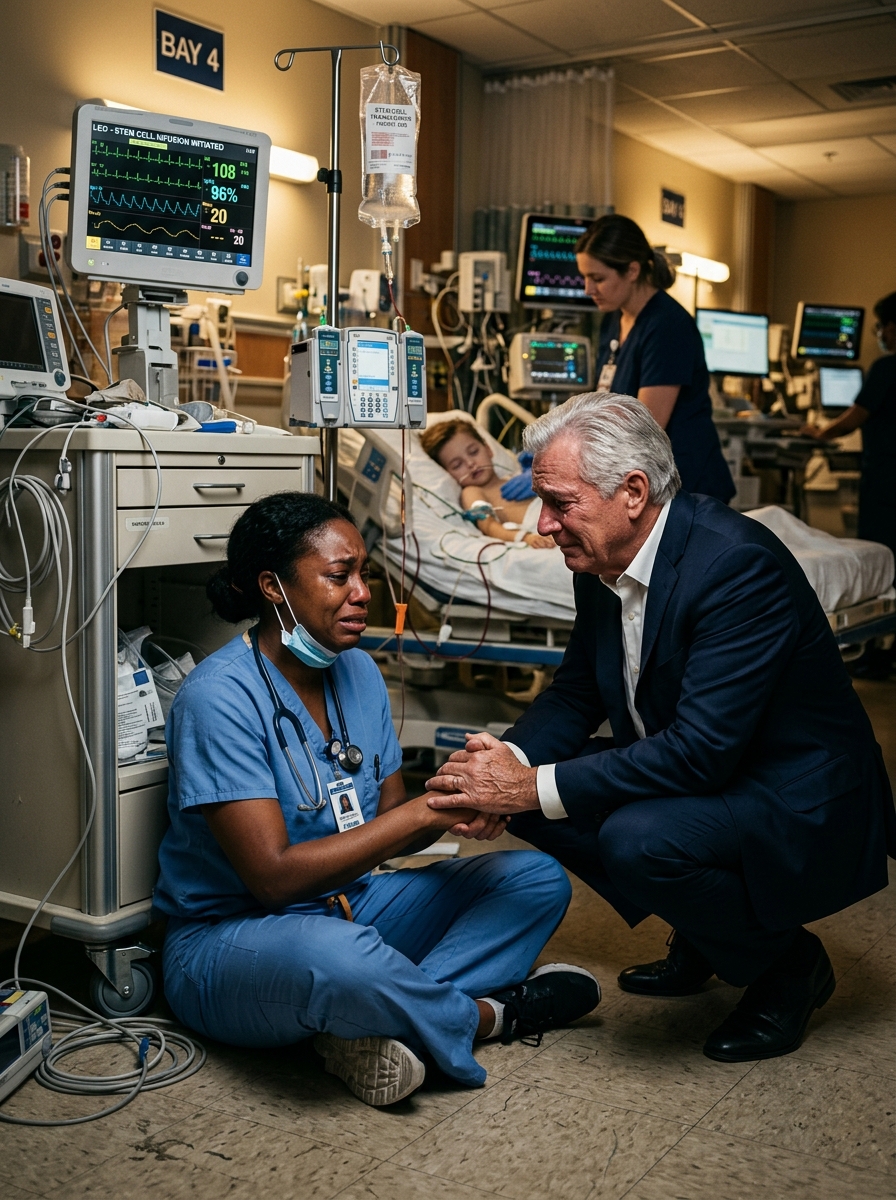
“Dr. Jenkins… Sarah,” John continued, his voice hardening slightly. “I promise you, the woman who did this to you will never work in commercial aviation again. And this airline will issue a public formal apology. But right now, from one grandfather to the woman who just saved his entire world…”
He reached over and gripped my hand tightly.
“You are a hero.”
I looked through the glass again, watching little Leo’s chest rise and fall in the steady rhythm of a life that would continue.
“No,” I said softly, giving him a small exhausted smile. “I’m just a doctor. And I had a seat in first class.”
