

The scanner beeped. It wasn’t the pleasant, melodic chime that welcomes you to First Class. It was a harsh, angry red buzz.
I didn’t flinch. I knew exactly why it was beeping. I had engineered it to beep.
“Sir,” the gate agent sighed, her voice dripping with the kind of practiced exhaustion reserved specifically for people she deemed beneath her. Her name tag read Evelyn – Senior Gate Supervisor. She didn’t look up from her monitor. “This lane is for Priority and First Class passengers only. Economy boarding hasn’t started yet. You need to step aside.”
“My boarding pass says Seat 2A,” I said, my voice steady, my hands resting loosely on the counter.

Evelyn finally stopped typing. She looked up. Her eyes performed that familiar, lightning-fast calculation I’ve experienced my entire life as a Black man in America. She took in my dark skin, my overgrown beard, my faded Baltimore Ravens hoodie, and the worn Nike duffel bag slung over my shoulder. In a fraction of a second, she ran my physical data through her internal algorithm and assigned me a worth, a background, and a right to occupy her space. The result was zero.
“I don’t care what your phone screen says, sir,” Evelyn said, leaning closer and lowering her voice into a condescending whisper. “The system says there’s a flag on your ticket. An unverified payment method. Now, I can call security to escort you to the main ticketing desk, or you can step out of the way on your own. We have important clients waiting.”
Right on cue, the man behind me scoffed loudly. I glanced back. He was in his mid-fifties, white, wearing a tailored charcoal suit that screamed Wall Street, his face flushing an impatient shade of pink.
“Excuse me, buddy,” the man snapped, checking his Rolex. “Some of us have actual business to conduct. If your card declined, just go back to the lobby and figure it out. Stop holding up the line.”
Ten years ago, that comment would have made my blood boil. Ten years ago, I would have squared up, raised my voice, and given them exactly the “angry Black man” stereotype they were already projecting onto me.
But I wasn’t that man anymore. I was Marcus Vance. Thirty-eight years old. Founder and CEO of Vance Logistics—a $400 million aviation management firm. Exactly forty-eight hours earlier, my company had quietly completed a hostile takeover of the primary management contract for this very terminal at Chicago O’Hare. Every person working this gate, including Evelyn, technically worked for me now. The ink on the merger was still fresh. Even my board didn’t know I had done it.
I had deliberately flagged my own ticket with a minor system error. A standard Level-1 issue. Any competent gate agent could clear it in seconds by verifying my ID. I wanted to see how frontline staff handled it.
Evelyn wasn’t trying to handle it. She was trying to remove it.
“Could you just check my ID?” I asked, pulling my driver’s license from my pocket and placing it on the counter. “It’s a simple glitch. It should take two seconds to clear.”
Evelyn stared at it as though it were contaminated. She didn’t touch it.
“I am not going to argue with you,” Evelyn said, her voice now loud enough for the entire terminal to hear. She wanted an audience. She wanted humiliation. “You are holding up my First Class queue. I am voiding this boarding pass. You need to leave the carpeted area immediately, or I will have airport police remove you.”
The businessman behind me exhaled loudly, theatrical and dismissive. “Unbelievable,” he muttered. “They just let anyone wander into this terminal nowadays.”
The anger burned quietly in my chest—a familiar heat. The sting of being seen not as a person, but as a problem. A trespasser. It was a specific exhaustion: knowing that no matter your success, no matter the millions you’ve built, to people like Evelyn you would always be a threat in a hoodie trying to cheat the system.
I met her eyes and memorized the smug satisfaction in her expression.
“Alright,” I said softly, picking up my ID. “I’ll step aside.”
Evelyn’s smirk widened into a victorious smile. “Next in line, please!” she called out brightly, her tone instantly softening as the man in the charcoal suit stepped forward. “Welcome back, Mr. Sterling. So sorry about the delay. Let’s get you right onto the plane.”
I stepped off the blue First Class carpet, gripping my duffel strap so tightly my knuckles ached. I didn’t leave the gate. I moved to a row of cheap plastic chairs near the window and sat down, pulling out my phone.
I wasn’t calling my security team. I wasn’t calling my assistant.
I wanted to watch. I wanted to see whether anyone in this multimillion-dollar operation had the basic decency to treat a Black man in sweatpants like a paying customer.
I sat for twenty minutes as boarding continued. No one looked at me. Evelyn avoided my gaze entirely, occasionally whispering to coworkers and gesturing in my direction.
I was about to make the call that would effectively end the employment of everyone at Gate C4 when I felt a tap on my shoulder.
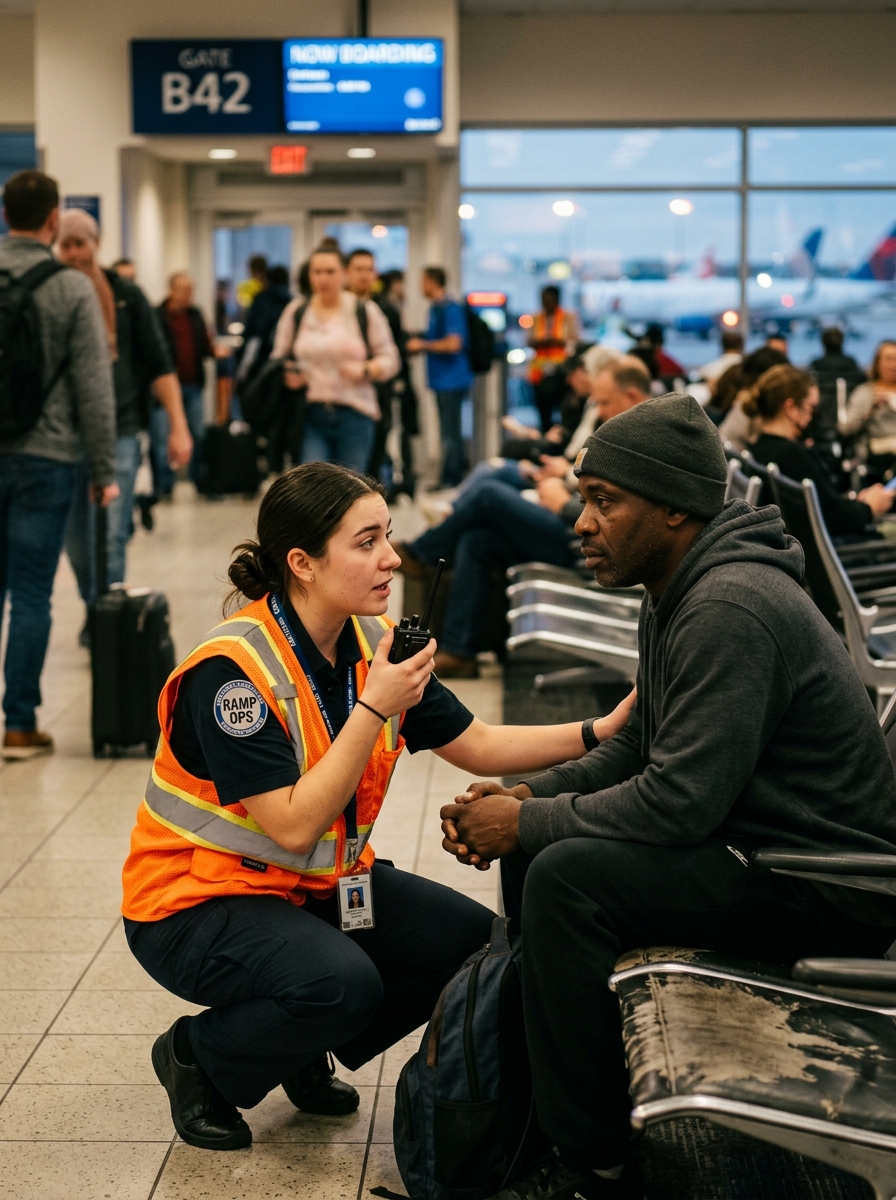
I looked up. A young kid, barely in his twenties, stood there in a high-vis ramp agent vest. He was sweating, holding a handheld radio, glancing nervously back toward Evelyn.
“Hey, man,” the kid whispered, his voice shaky. “I saw what happened up there. I know I’m just a baggage guy, but… give me your confirmation number. Let me see if I can override the system through the back terminal before they close the doors.”
I looked at him. Really looked at him.
The trap had just caught something I didn’t expect.
Chapter 2
His name tag hung crooked from his bright orange vest, held on by a fraying thread, the plastic scratched with tarmac grime. Julian. He looked barely twenty-one. He carried the nervous energy of someone still learning how unforgiving systems could be. Sweat clung to his temples despite the cold air-conditioning, and his grip tightened around his Motorola radio.
He kept glancing back toward the boarding desk. Evelyn was currently occupied with a silver-haired couple and their oversized bag, but her attention never fully left her surroundings.
“I’m serious, man,” Julian said quickly, keeping his voice low over the hum of rolling luggage and distant announcements. He crouched beside my seat, making himself smaller. “I saw her screen. It was a Code 42. Just a mismatch between the billing ZIP and the profile address. Happens all the time with corporate cards. She could’ve cleared it in one keystroke.”
I studied him without expression. “If she could clear it in one keystroke, why didn’t she?”
Julian swallowed. His eyes flicked to my hoodie, my beard, the duffel bag—reading the same assumptions I’d seen all my life. He didn’t answer, but he didn’t need to.
“Look,” he said, shifting uncomfortably but not leaving. “My supervisor has a backdoor terminal in baggage. Give me your confirmation number. I can send it over, force-clear the flag, and print you a new pass before they seal the gate. We’ve got maybe ten minutes.”
I watched him for a long moment.
In boardrooms, I dealt in numbers, leverage, acquisitions—cold, structured decisions. But here, there were no spreadsheets that measured this kind of choice.
Julian had nothing to gain. If anything, he risked everything. Evelyn could end his job with a single call.
And still, he stayed.
“Why are you doing this, Julian?” I asked quietly.
He blinked, surprised I knew his name. “Because it ain’t right, man. My dad used to travel for construction. Got treated like dirt because he’d show up straight from the site. People see clothes, see skin, and stop seeing people. I hate that. Just… give me the number.”
Something in my chest loosened.
I had spent decades building Vance Logistics from nothing into a $400 million empire. I owned a penthouse on Lake Michigan. I sat on charity boards. I had lawyers who billed more in an hour than Evelyn made in a month.
But without the suit, without the card, without the title—I was still just a Black man in a hoodie to her. A problem.
I unlocked my phone.
“It’s X7B9…” I began.
“Excuse me! What exactly do you think you are doing?”
The voice cut through the air like a blade.
Julian jerked upright. I looked up. Evelyn was striding toward us, having left the desk entirely. Her face was flushed, posture rigid with authority she believed was being challenged. Her heels struck the floor sharply, each step controlled and deliberate.
“Julian, is it?” Evelyn snapped, stopping in front of him with crossed arms. She looked down at him, then at me with open contempt. “You are a below-wing employee. You are supposed to be loading the rear cargo hold of flight 1442. Why are you loitering in my boarding area fraternizing with a rejected passenger?”
Julian rose to his feet. His knees were visibly shaking, but he forced his shoulders back. “Ma’am, I was just… I noticed his ticket had a Code 42. It’s a simple fix. I was going to have dispatch clear it so he could make his flight.”
Evelyn’s eyes widened. For a brief moment, she looked genuinely stunned that a baggage handler had the nerve to talk back to her. Then that shock hardened into anger.
“A simple fix?” she hissed, her voice trembling with rage. “Do you have any idea how airport security protocols work, you idiot? This individual’s payment method was flagged. He was belligerent at my counter. He refused to follow instructions. And you, a glorified mule, think you can override my authority?”
“He wasn’t belligerent,” Julian said, his voice cracking, but he didn’t step back. “He just asked you to check his ID.”
“I do not need a lecture on customer service from someone whose job is to throw Samsonite bags onto a conveyor belt!” Evelyn snapped, her voice rising and pulling the attention of nearby passengers. “This man is a security risk. He doesn’t belong in First Class, he doesn’t belong on this flight, and frankly, he doesn’t belong in this terminal.”
The words hung there. He doesn’t belong. The unspoken part was now spoken aloud. No more hiding behind “system errors” or “payment issues.” It was a declaration of who, in her mind, was allowed to exist here.
Before I could step in, the situation escalated again. The jet bridge door swung open, and Mr. Sterling—the Wall Street executive in the charcoal suit who had been behind me in line—strode out looking furious, a sleek leather briefcase in one hand and a half-empty plastic cup in the other.
“Evelyn!” Sterling barked, not acknowledging me or Julian. “What is the hold-up? I’ve been sitting in 1A for twenty minutes and the captain just announced a delay regarding baggage loading. I have a merger meeting in Manhattan at three o’clock. If we don’t push back in five minutes, I’m missing my connection.”
Evelyn’s entire demeanor changed instantly. The sharp gatekeeper vanished, replaced by an overly eager, apologetic subordinate.
“Oh, Mr. Sterling, I am so incredibly sorry,” she cooed, lowering her posture into servility. “The delay is entirely my fault. We are having a slight personnel issue.” She turned and shot a lethal glare at Julian. “Our ramp agent here decided to abandon his post to harass passengers instead of loading your luggage. But I am handling it right now.”
Sterling finally looked at us. His eyes flicked over Julian’s grease-stained vest, then my faded hoodie. His lip curled.
“Well, tell the kid to get back to work,” Sterling scoffed. He gestured at me with his cup. “And why is this guy still here? I thought you told him to leave. Jesus, you pay three thousand dollars for a ticket to avoid exactly this kind of riff-raff.”
“I completely agree, Mr. Sterling. It’s unacceptable,” Evelyn said quickly, nodding. She turned back to Julian, her tone turning sharp and venomous again. “Give me your employee badge, Julian. Right now. You are suspended pending immediate termination. I am calling the station manager, and you will never work at O’Hare again.”
Julian went pale. The color drained from his face. He looked down at his badge, then back at Evelyn. His hands shook so badly he couldn’t unclip the lanyard. “Please, ma’am,” he whispered, his earlier defiance collapsing into panic. “My mom relies on my health insurance. I was just trying to help. Please.”
“Hand it over!” Evelyn demanded, her hand still extended.
I had seen enough.
I had measured the temperature of the room. I had mapped Evelyn’s certainty, Sterling’s entitlement, and—more importantly—the quiet integrity standing in front of me named Julian.
The audit was over.
It was time to close the trap.
I rose slowly from the plastic chair. No rush. No noise. I simply stood to my full six-foot-two height. The worn duffel slid off my shoulder and hit the terrazzo floor with a heavy thud.
“Julian,” I said, my voice steady and carrying cleanly through the space. The kind of voice used to quiet entire boardrooms. “Keep your badge. You’re not fired. In fact, you’re about to receive a very substantial promotion.”
Evelyn snapped her head toward me, her face twisting in outrage. “Excuse me? Who the hell do you think you are? I already told you I am calling airport police!”
“Call them,” I said calmly, reaching into my hoodie pocket. I pulled out my phone—but not for a boarding pass. I opened my contacts. “Call the police, Evelyn. And while you’re at it, call David Chen. He’s the Director of Operations for Terminal 3. He’s probably in his office down the hall. Tell him his new boss is out at Gate C4, and he needs to get down here immediately.”
Mr. Sterling let out a loud, mocking laugh. “His new boss? What is this guy talking about, Evelyn? Is he on drugs?”
Evelyn glared at me, but for the first time, something flickered—uncertainty. Her eyes dropped to my phone: plain on the outside, but unmistakably expensive in a way that didn’t match my hoodie.
“I don’t know what kind of scam you’re trying to pull,” Evelyn sneered, forcing confidence back into her voice. “But Mr. Chen doesn’t take meetings with crazy people wandering the terminal.”
I didn’t respond. I simply pressed one button on my speed dial and put the call on speaker, holding it out.
It rang twice.
Then a frantic voice exploded through the speaker for everyone to hear.
“Mr. Vance? Sir? This is David Chen. Is everything alright? We’ve been tracking your phone’s location… the board told us you were doing a surprise walk-through of the newly acquired gates, but we didn’t know which one. Are you at C4?”
The silence that followed was total. Heavy. Suffocating. The kind that comes right before impact.
Evelyn stopped breathing. Her hand dropped mid-motion. The color drained from her face, leaving her frozen.
Mr. Sterling’s smirk locked in place, his eyes flicking rapidly between my phone and my face.
Julian just stared at me, stunned.
“Yes, David, I’m at C4,” I said into the phone, my gaze locked on Evelyn. “And we have a massive, systemic failure regarding customer service and personnel management here. Get down here right now. And bring HR. We’re about to do some restructuring.”
Chapter 3
“Yes, sir. Right away, sir. I’m on my way,” David Chen’s voice crackled through the speaker, tight with the specific panic of middle management realizing the executioner was already inside the building.
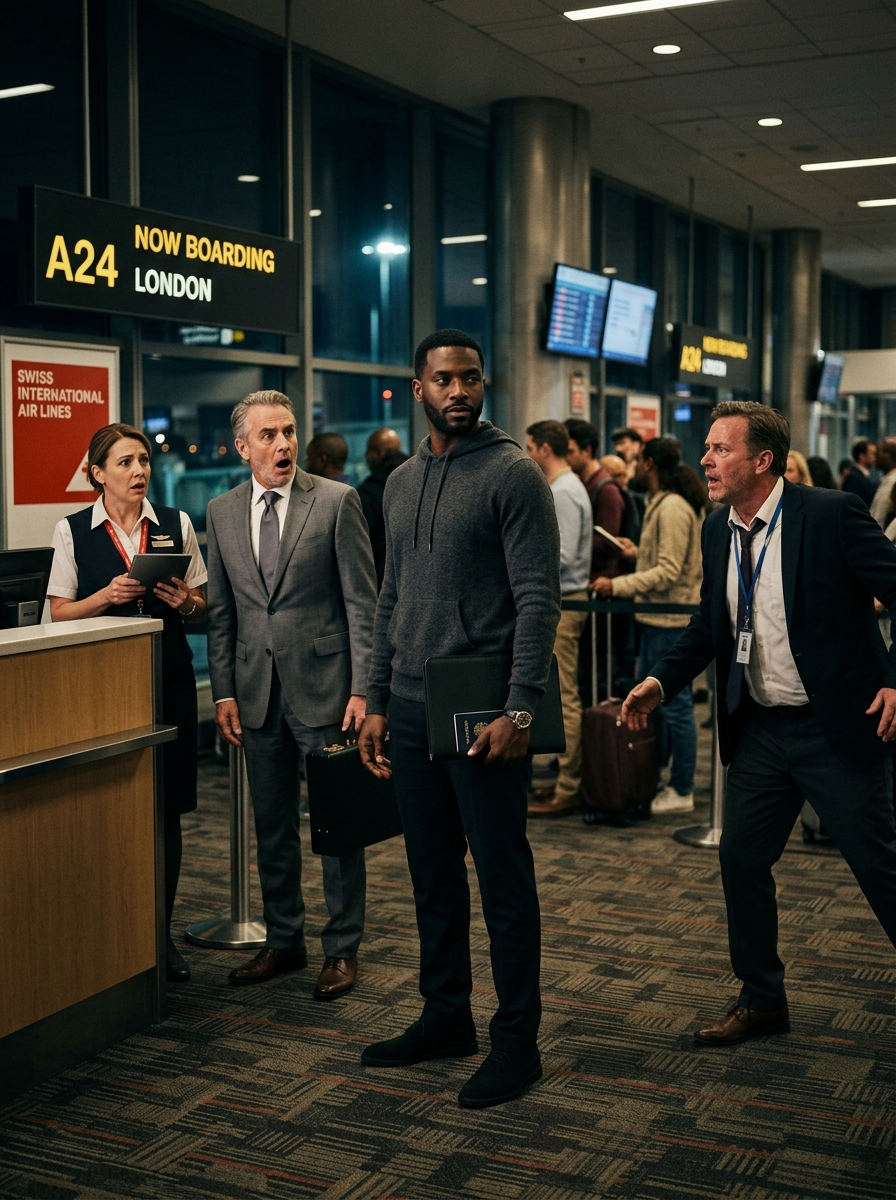
I ended the call and slid the phone back into the pocket of my faded Ravens hoodie.
The silence at Gate C4 was total. It was thick enough to carve. Evelyn looked as if the air had been pulled straight out of the terminal. Her mouth opened and closed without sound, eyes locked on me with a rising horror that bordered on disbelief. The smug, authoritative gatekeeper was gone. In her place stood someone realizing she had just ignited her own career and sealed the exit behind her.
“You’re… you’re…” Evelyn stammered, the words snagging in her throat. She stared at my overgrown beard, my sweatpants, my dark skin, trying desperately to reconcile her assumptions with the reality in front of her.
“I’m Marcus Vance,” I said, my voice steady and stripped of earlier anger. Anger no longer mattered. This was business. “Founder and CEO of Vance Logistics. As of 8:00 AM yesterday, my firm assumed full operational control of this terminal’s management contracts. You work for me, Evelyn.”
Mr. Sterling, the Wall Street executive who had called me “riff-raff” moments earlier, suddenly became very interested in his shoes. He cleared his throat, shifting his leather briefcase with uneasy hands. The smug confidence had evaporated, leaving only a thin layer of nervous sweat.
“Look, Mr. Vance,” Sterling interjected, forcing a false warmth into his voice. “There’s clearly been a misunderstanding here. A system error. If I had known who you were—”
“If you had known who I was, you would have treated me with basic human dignity,” I cut in, my voice sharp enough to draw blood. I didn’t look at him. My focus stayed on Evelyn. “But because you thought I was nothing, you treated me like nothing. Both of you did.”
Sterling opened his mouth again, but heavy, fast footsteps echoed down the concourse and cut him off.
David Chen, Director of Operations, came rushing around the corner, suit jacket flaring, tie loose. Behind him, the regional HR director followed closely, gripping an iPad like a shield. They stopped abruptly at the edge of the blue First Class carpet, both breathing hard.
Chen’s eyes scanned the scene—Evelyn frozen pale, Sterling shifting uncomfortably, Julian holding his radio like a lifeline, and me standing calm in worn clothes.
“Mr. Vance,” Chen gasped, trying to steady his breath. He extended a hand, then quickly pulled it back, noticing how badly it shook. “Welcome to O’Hare. I am deeply sorry we weren’t prepared for your arrival. If you had just given us a heads-up…”
“If I had given you a heads-up, David, I would’ve gotten a rehearsed version of this terminal,” I said. “I didn’t want a performance. I wanted to see how frontline staff treat passengers when management isn’t watching. And I saw exactly what I needed to see.”
I pointed at Evelyn. She flinched as though struck.
“David, this is Evelyn. Senior Gate Supervisor,” I continued, my voice carrying cleanly across the gate. “Twenty minutes ago, she refused to clear a Level-1 payment flag on my ticket. She refused to look at my ID. She publicly humiliated me, threatened airport police, and removed me from the boarding area, labeling me a ‘security risk’.”
Chen turned toward Evelyn, his face darkening. “Evelyn… what did you do?” he hissed.
“I… the system… his clothes… the payment flag…” Evelyn stammered, her authority collapsing in real time. Her voice broke into fragments. “I was following security protocols for unverified passengers, Mr. Chen! He looked… he didn’t look like a First Class passenger!”
“He didn’t look like a First Class passenger,” I repeated slowly. “Let’s be honest, Evelyn. You looked at my skin. You looked at my hoodie. And you decided I didn’t belong. You used your authority to humiliate a paying customer.”
I turned back to Chen, who was now visibly sweating.
“David, Evelyn is fired. Effective immediately,” I said, each word precise and final. “Not suspended. Not reviewed. Fired. Revoke her security clearance, have security escort her to her locker, and remove her from my terminal.”
Evelyn let out a broken sob, covering her mouth. “Mr. Vance, please! I have a mortgage. I’ve been here twelve years!”
“And in those twelve years,” I asked quietly, “how many people have you treated like this? People without a $400 million company behind them? People who had no choice but to accept it?”
She had no answer. Only tears, as the HR director stepped forward and began processing the termination with quiet, mechanical focus.
I shifted my attention to Julian. The young ramp agent stood near the plastic chairs, eyes wide, as though he had just witnessed something impossible.
“Julian,” I said gently.
He flinched slightly. “Yes, sir?”
“Come here.”
He hesitated, then stepped forward, boots soft against the polished floor.
“David,” I said, gesturing to him. “This is Julian. Ramp agent. When Evelyn removed me, he was the only person in this concourse who tried to help. He risked his job to fix my ticket through the back system because he thought it was the right thing to do.”
Chen nodded quickly, looking at Julian with sudden respect.
“Julian,” I asked, meeting his eyes. “Are you in school?”
He swallowed. “Yes, sir. Night classes at DePaul. Business administration. I work the ramp to pay tuition and help my mom with bills.”
I nodded once. It was exactly what I expected—drive, discipline, intent.
“David, Julian is no longer a ramp agent,” I said. “Transfer him to the downtown corporate office by Monday. Junior Operations Analyst. Double his salary, fully cover his remaining tuition at DePaul, and place him in the management pipeline.”
Julian staggered slightly. “Sir… I don’t… I don’t know what to say. Are you serious?”
“I am completely serious, Julian,” I said, a small genuine smile breaking through. “You showed more leadership in five minutes than most people show in years. We need that in decision rooms, not on the tarmac.”
Julian looked overwhelmed, nodding repeatedly, wiping his eyes with the back of his glove.
The PA system crackled overhead.
“Final boarding call for Flight 1442 to New York. All remaining passengers must board immediately or the doors will close.”
Mr. Sterling, who had been frozen during the exchange, suddenly snapped back to attention. His eyes flicked toward the jet bridge, then back to me.
“Well,” Sterling said, forcing a strained smile. “I suppose that’s our cue, Mr. Vance. Maybe we can discuss your acquisition in First Class—perhaps I can offer some insight on wealth management for—”
“Mr. Sterling,” I interrupted evenly. “Did you forget what Evelyn said?”
Sterling frowned. “Forget what?”
I looked at him, a quiet certainty settling in.
“She said I was a security risk,” I said softly. “And I take security risks very seriously.”
I turned to David Chen.
“David, cancel Mr. Sterling’s boarding pass,” I ordered. “And permanently ban him from flying through any terminal managed by Vance Logistics.”
Chapter 4
Mr. Sterling laughed. It wasn’t a confident laugh. It came out dry, hollow, and rattling—scraping against the walls of the concourse. He glanced around the gate area, searching the remaining passengers, desperately trying to find an ally in a room that had suddenly tilted off its axis. He found none. The few people still lingering were watching him now with a mix of shock and uneasy fascination.
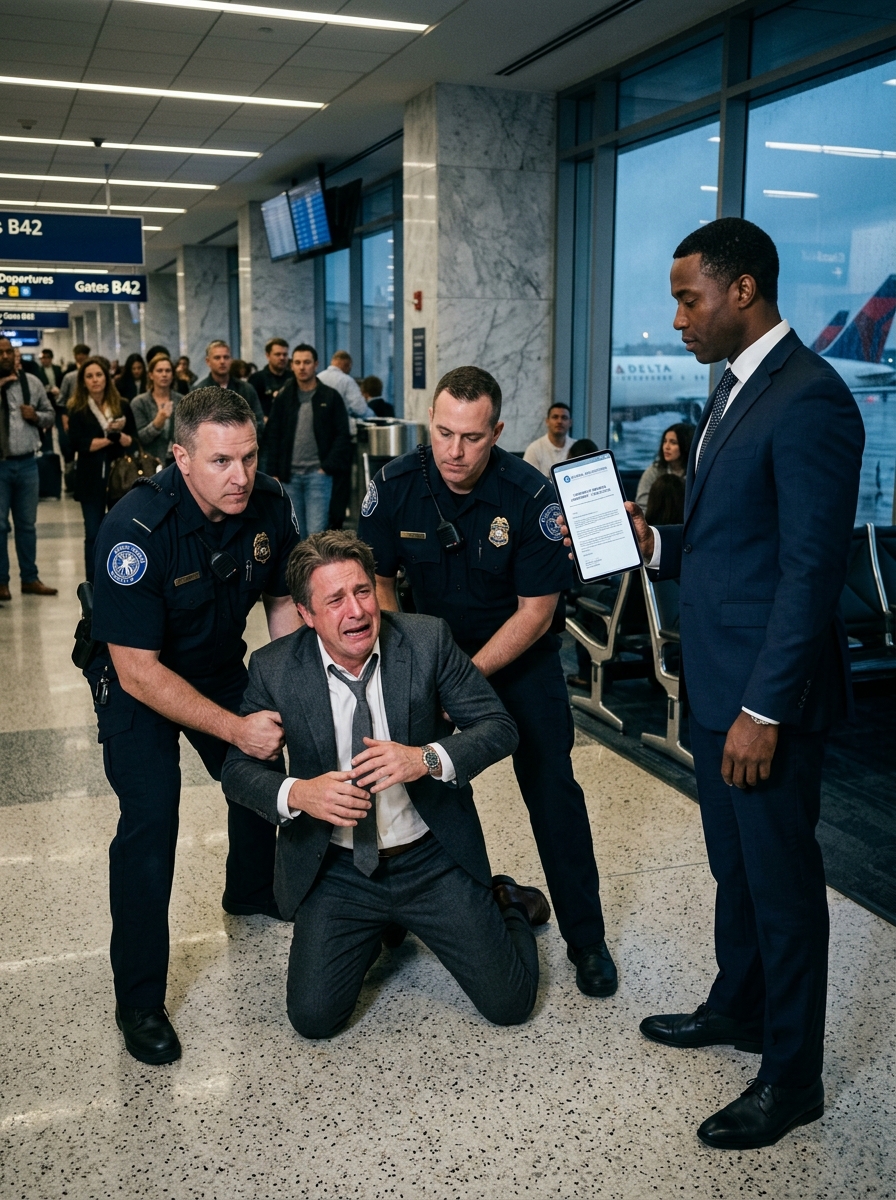
“Cancel my ticket?” Sterling repeated, the faux-collegial warmth draining out of his voice and replaced by brittle panic. He stepped toward me, his expensive leather shoes squeaking on the terrazzo floor. “Are you out of your mind? You can’t do that. I am a Platinum Medallion member. I fly two hundred thousand miles a year with this carrier. You do not have the authority to ban me from a commercial flight because your feelings got hurt.”
I didn’t move. I just observed him. The change was almost clinical. Stripped of the structure he believed protected him, Sterling was coming apart in real time, falling back into the raw entitlement that had carried him his entire life.
“David,” I said, my voice barely above a whisper, yet it cut through the terminal noise like a blade. I didn’t look away from Sterling’s flushed face. “Is there any ambiguity in my order?”
David Chen, still processing the shock of firing his Senior Gate Supervisor, snapped upright. He had seen the shift in power. He knew exactly whose authority now controlled his position, and he wasn’t about to land on the wrong side of Vance Logistics.
“None at all, Mr. Vance,” Chen said quickly. He turned to the HR director, who was already typing rapidly on her iPad. “Flag Mr. Sterling’s profile. Code Red restriction. Terminal-wide ban across all Vance-managed properties. Call the gate agent at the jet bridge and have his luggage pulled from the hold immediately.”
“Now wait just a damn minute!” Sterling roared, whatever composure he had left finally breaking. He slammed his briefcase onto the counter with a sharp crack that echoed through the gate. “This is illegal! This is a breach of contract! Do you know who I am? Do you have any idea how much money I manage? I have a three o’clock meeting in Manhattan that is going to finalize a nine-figure merger! If I am not in that boardroom, heads are going to roll, and I promise you, Vance, yours will be the first one on the block! My lawyers will strip you down to the studs!”
I let him shout. I let the anger burn itself out in the air. It was the same reaction I had seen a hundred times—men who believed the world was built to obey them if they raised their voices enough.
I stepped closer, slow and deliberate, closing the gap until we were less than two feet apart. Sterling instinctively leaned back, chest rising sharply beneath his tailored suit. Up close, his confidence didn’t hold. I was taller. Broader. And completely unaffected by his panic.
“You’re right about one thing, Mr. Sterling,” I said calmly, my voice stripped of emotion. “You do have a very important meeting in Manhattan at three o’clock.”
Sterling blinked, thrown off. “What?”
“You’re the Senior Managing Partner at Vanguard Capital, aren’t you?” I asked, glancing briefly at the monogrammed ‘VC’ on his briefcase. “You’re flying into JFK. From there, a black car to Midtown. You’re pitching a portfolio acquisition to a parent company. A merger you’ve spent eighteen months building. One that, if successful, will secure your retirement and a very large payout.”
Sterling’s expression went blank. His mouth parted slightly. The color drained from his face, leaving a sickly gray pallor. “How… how do you know that?” he stammered, voice dropping into something almost frightened. “That deal is under NDA. It’s completely confidential. How the hell do you know where I’m going?”
I reached into my faded Ravens hoodie and pulled out my phone again. This time, I didn’t call anyone. I opened an email and held the screen up in front of him.
It was a calendar invite.
3:00 PM EST – Vanguard Capital Acquisition Pitch. Location: Vance Logistics East Coast Headquarters, Manhattan. Lead Executive: Marcus Vance, CEO.
I watched his eyes move across the screen. I watched the exact moment understanding hit him. I watched his entire sense of control collapse inward.
“You’re going to pitch your firm to my board of directors, Mr. Sterling,” I said quietly. “Vance Logistics is the parent company acquiring you. I’m the one who decides whether your life’s work is worth nine figures—or nothing at all.”
Sterling visibly faltered. His hand caught the counter to steady himself. His eyes dropped—my hoodie, my shoes, my beard—everything he had dismissed minutes earlier as beneath him.
“Mr. Vance… I… Marcus… please,” he stammered, all arrogance gone, replaced by a desperate, humiliating plea. “I didn’t know. I swear I didn’t know. It was a high-stress morning. I misspoke. I was out of line. Please, you can’t tank this deal over a misunderstanding at an airport. It’s business.”
“You’re right,” I said, stepping back and lifting my duffel bag onto my shoulder. “It is business. And I deal in people who have integrity under pressure. People who don’t adjust their morality based on who they think they’re standing next to. If this is how you treat a stranger in an airport, I want no part of how you treat my employees, my clients, or my capital.”
I turned away from him.
“David,” I called over my shoulder. “Keep him out of my terminal. And cancel the three o’clock meeting in New York. Tell the board Vanguard Capital is no longer under consideration.”
“Understood, sir,” Chen replied immediately.
“No! Wait! You can’t!” Sterling shouted, lunging forward—but two airport security officers stepped in instantly, hands firm on his chest.
“Sir, you need to step back and come with us,” one of them said.
I didn’t look back. I didn’t need to.
What I felt wasn’t satisfaction. It was something heavier. A quiet exhaustion that came from recognizing the same pattern again and again—different faces, same assumptions. The only thing that had changed was that now I could end the pattern instead of absorbing it.
I walked toward Julian.
He was still standing near the windows, gripping his radio, staring at me like the world had shifted beneath his feet.
“Julian,” I said, my voice softening.
“Yes, Mr. Vance,” he answered quickly, standing straight.
“I wasn’t joking about the job,” I said, extending my hand. “Report to the downtown office Monday. Ask for Sarah in HR. She’ll handle your onboarding. Bring your DePaul transcripts. We’ll sort your tuition, and you’re getting out of those boots.”
Julian looked at my hand for a moment, then took it. His grip was firm, rough, real. “I won’t let you down, sir. I swear. I’m going to work harder than anyone you’ve ever seen.”
“I know,” I said. “Because you already did.”
I released his hand and turned toward the jet bridge. Above the door, the display read: FLIGHT 1442 – DEPARTING.
As I walked into the sloping, fluorescent-lit tunnel, the silence deepened. The adrenaline faded, leaving something quieter behind.
I thought about the hoodie on my shoulders. Fifteen years old. From a time when Vance Logistics was just me, a rented truck, and a phone I could barely afford to keep on. I remembered sleeping in that truck through Chicago winters because I couldn’t afford both heat and rent. I remembered walking into corporate lobbies in my best thrift-store suit, only to be met with the same look Evelyn had given me—one I knew well. The look that said: you don’t belong here.
They had made me feel small. They had made me feel ashamed of where I came from, of what I had endured, of my skin. For years, I chased wealth not only for comfort, but as protection. I believed that if I bought enough bespoke suits, accumulated enough private equity, and flew high enough, the world would finally stop seeing me as a threat and start seeing me as a man.
But today confirmed what I had long suspected in the quietest, darkest corners of my mind. The protection was an illusion. Money didn’t change how they saw me; it only changed how they behaved once they realized I held the power. Without the armor of wealth, I was still just a target.
I reached the end of the jet bridge and stepped onto the plane.
The lead flight attendant, a polished woman with perfect posture, waited at the door. Her eyes widened slightly as I boarded. She had clearly already received a panicked call from David Chen at the gate. She knew exactly who I was.
“Mr. Vance,” she said, her voice almost trembling with deference, bowing her head slightly. “Welcome aboard. We are so incredibly honored to have you flying with us today. Your seat is 1A. May I take your bag? Can I get you a pre-departure beverage? Champagne? Water?”
I looked at her. Then past her into the First Class cabin. The wide leather seats. The soft lighting. The quiet atmosphere of privilege.
I found seat 1A. Behind it, in 2A, Sterling’s seat sat empty—pristine leather, untouched. A ghost of a man who had built his life on assumed superiority, only to lose it in a moment because he couldn’t extend basic humanity to someone in a hoodie.
I looked down at my faded clothes. I ran a hand over my rough, untrimmed beard.
I didn’t feel like a CEO. I didn’t feel like a titan of industry.
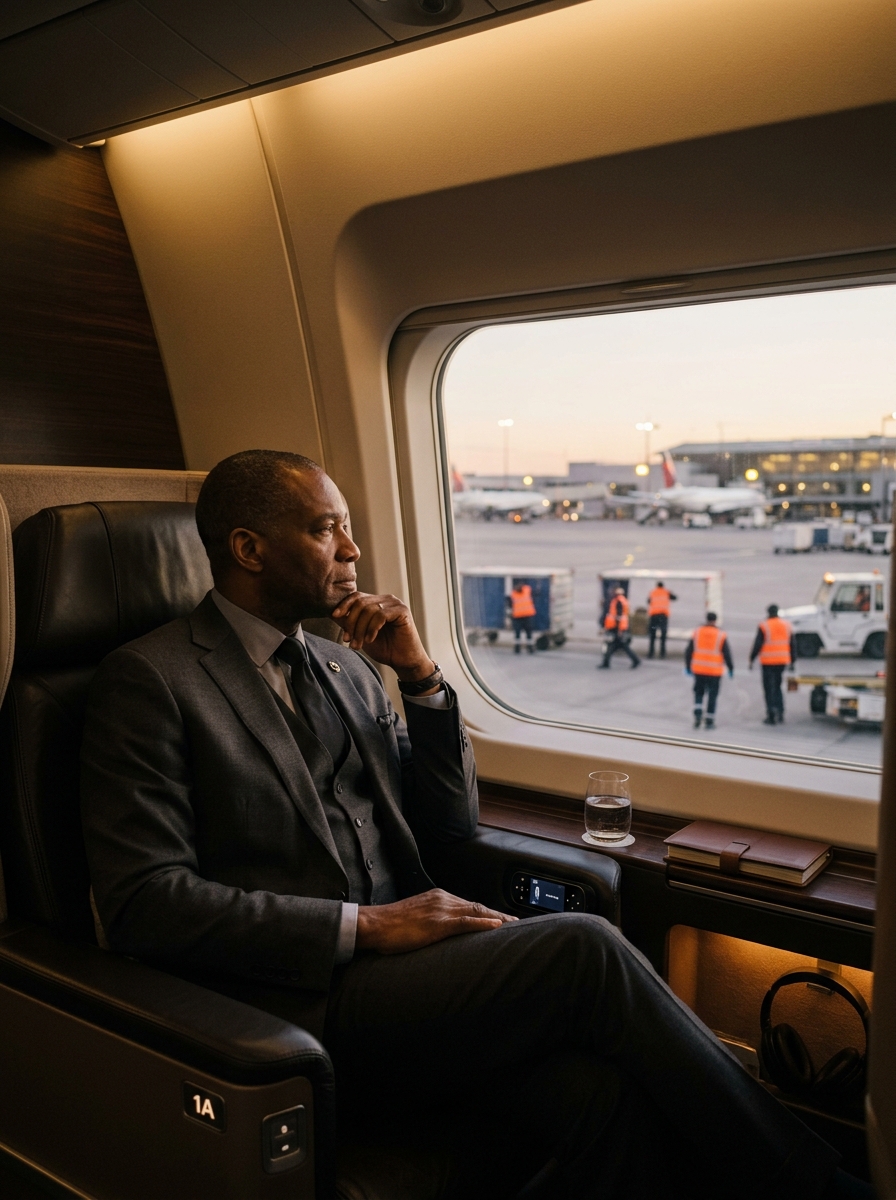
I just felt like Marcus.
“I’ll keep the bag, thank you,” I said softly to the flight attendant, offering a polite, tired smile. “Just a glass of ice water would be great.”
“Right away, sir,” she said quickly, hurrying toward the galley as if urgency itself could protect her.
I settled into the window seat and fastened my belt. I rested my head against the cool glass and watched the baggage handlers moving below in their orange vests. I thought of Julian, lifting heavy bags in the heat, holding onto his integrity in a system that rarely rewarded it.
The engines began to rise, a deep vibration rolling through the cabin. The plane pushed back from the gate.
I took out my phone one last time, opened my notes app, and typed a single line—something to carry with me into boardrooms full of men in charcoal suits, where decisions were made over the futures of thousands.
They look at the clothes. They look at the skin. But they never look at the man. Remember who you are when the suit comes off.
I locked the screen, closed my eyes, and let the sound of the engines carry me home.
[END OF FULL STORY]
