

CHAPTER 1: The Incident
The cabin of Global Atlantic Flight 217 carried the scent of expensive bourbon mixed with the sterile, metallic chill of thirty thousand feet. In first class, sound is usually softened—crystal clinking gently, engines humming steadily. It is a space of carefully maintained courtesy.
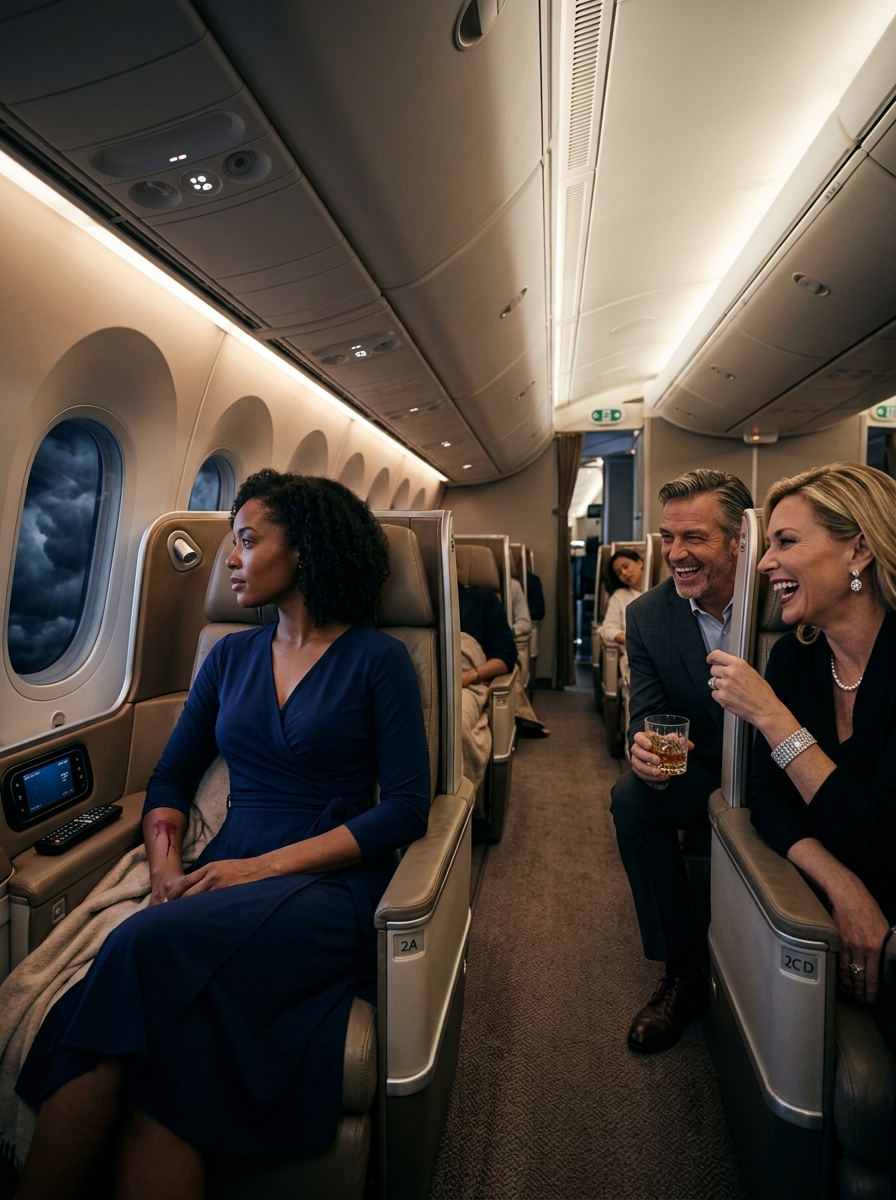
Until Bradley Whitcomb decided otherwise.
“Does it come with subtitles?” Bradley asked, his voice slicing through the calm like a blunt knife. He was facing his wife, Meredith, but his gaze was locked on me.
I had just thanked the flight attendant, Elise, for a warm towel. My “thank you” carried the soft, rhythmic cadence of my father’s Trinidad—a melody I had spent twenty years refining into a professional asset, yet never abandoned.
Meredith laughed, a sharp, tinkling sound like shattering glass. She adjusted her diamond tennis bracelet and leaned closer. “Maybe it’s an ‘island’ thing, Brad. You know, relaxed. Unstructured.”
I didn’t turn. My eyes stayed on the clouds beyond the oval window, dark and bruised under the North Atlantic night. Heat crept up my neck—that familiar sting I first felt in 1998, watching two police officers laugh at my father’s accent while he tried to prove he owned his own car.
Silence is not surrender, he had told me that night. Sometimes, Lenora, silence is evidence.
I reached into my leather satchel and took out a pen. On the corner of a white cocktail napkin, I wrote a single word in clean, block letters: OBSERVE.
“Look at that,” Bradley murmured, loud enough for the businessman in 3D to let out a muffled laugh. “She’s taking notes. Maybe she’s writing a travel blog about getting upgraded by mistake.”
“Oh, darling,” Meredith crooned, leaning across the aisle. Before I could move away, her pale, manicured fingers brushed one of my locs. “Is it heavy? It looks so… heavy. I’ve always wondered how you wash it.”
A jolt shot through me—an invasion of space, of body, of dignity. Elise, the senior flight attendant, froze a few feet away, her tray of appetizers trembling slightly. She glanced at me, her eyes asking for permission to step in, but I gave the smallest shake of my head.
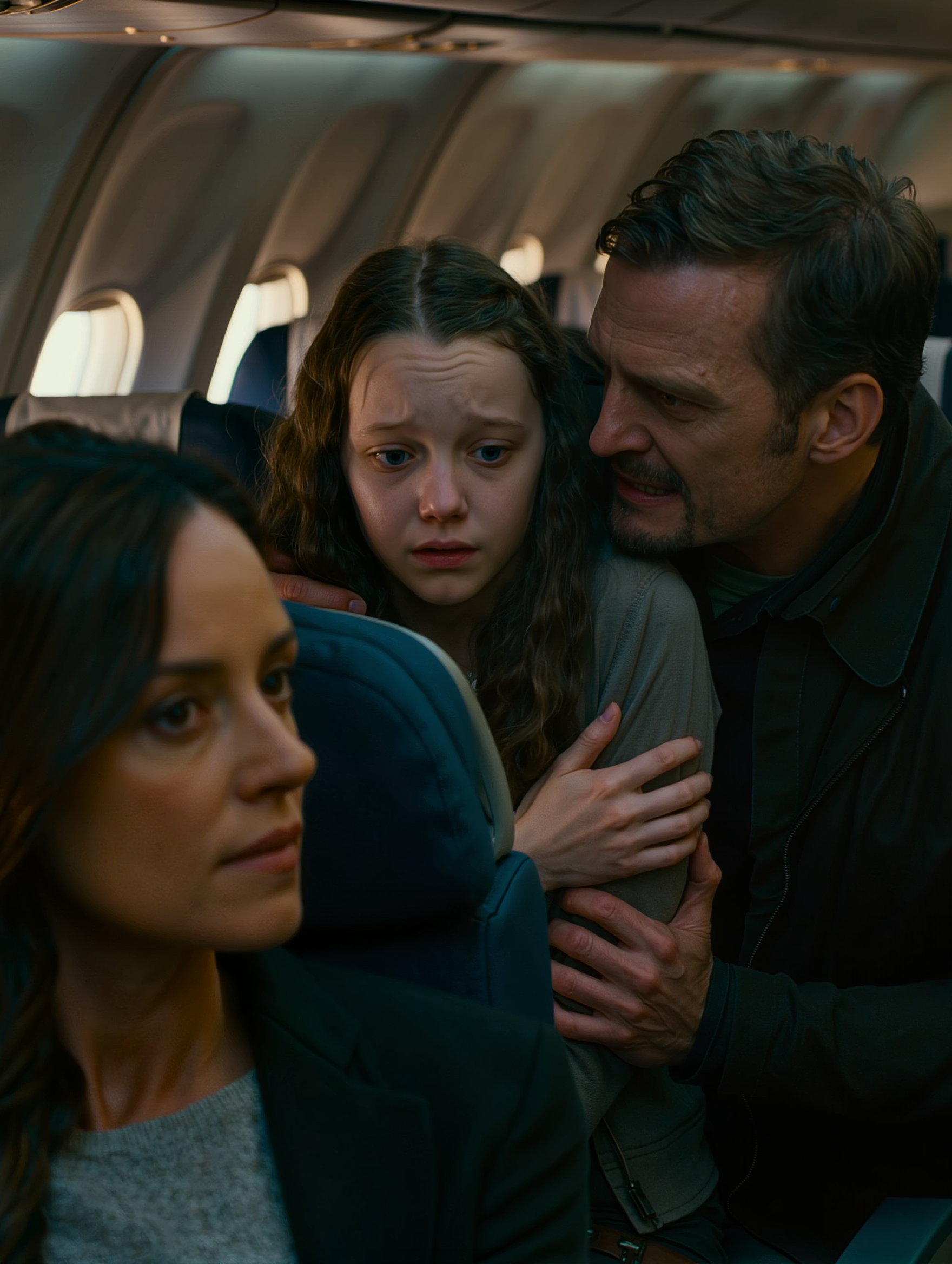
Not yet. Because two rows behind the Whitcombs, in seat 4F, a seventeen-year-old girl named Asha was staring at the back of Bradley’s head with pure, unfiltered fear.
I had noticed her during boarding. She was traveling with a man who called himself Victor, but she never met his gaze. Each time a crew member spoke to her, she repeated the same line: “I am visiting my auntie in Georgia for spring shopping.”
She spoke with a forced Jamaican lilt—awkward, borrowed, fragile. To most, she was just a shy girl. To a federal forensic linguist with fifteen years of training task forces to detect coercion, she was an alarm blaring in the dark.
“Excuse me,” Meredith said, her voice dripping with false concern. She tilted her glass of Cabernet Sauvignon. A single dark drop landed on the navy silk of my sleeve. “Oh! How clumsy of me. Though, on your skin, I suppose it’s barely visible anyway.”
Bradley let out a harsh laugh and signaled Elise for another bourbon. “Don’t worry about it, Mere. I’m sure she’s used to stains.”
I lowered my gaze to the dark mark on my arm. It felt cold. I didn’t wipe it away. Instead, I folded the stained napkin carefully and placed it inside my passport case, beside my Customs Declaration card.
For the next five hours, the Whitcombs turned the cabin into their private stage. They mocked my “peasant” dress. They speculated aloud about whether I had “won the lottery” to afford seat 2A. Bradley even performed a crude imitation of a Caribbean accent, mangling the vowels, while Asha Coleman flinched in seat 4F as if struck.
He thought it was humor. He thought he was reinforcing the natural order of things—the wealthy, the loud, and the white above the quiet and the dark.
He didn’t realize that every insult was being recorded. Each disruption of the cabin’s peace became another line in a federal report he couldn’t begin to imagine.
As the pre-landing lights flickered on, the cabin fell quiet. Most passengers slept. I remained awake. I took my Customs Declaration card and turned it over.
I didn’t write about the wine. I didn’t write about the hair. I wrote a priority code—a sequence of numbers and letters unused on a commercial flight for three years. Beneath it, I added four precise words.
I caught Elise’s eye as she passed and handed her the card, folded twice.
“Give this to the Captain,” I whispered. My voice was steady, stripped of the emotion Bradley had tried so hard to provoke. “Tell her it’s a LSB-Level 4 assessment. She’ll know the frequency.”
Elise accepted it, her brow tightening. She glanced at the Whitcombs, then back at me—taking in the stain on my sleeve and the absolute, unsettling calm in my eyes.
She didn’t question it. She walked straight to the cockpit.
Ten minutes later, the Captain’s voice came over the intercom. It wasn’t the usual “prepare for descent” announcement. It was shorter. Tighter.
“Flight attendants, prepare the cabin for arrival. We have been cleared for a priority approach into Atlanta. All passengers are to remain seated until the aircraft is met by ground authorities.”
Bradley stretched, his gold watch catching the first light of the Georgia sunrise. “Hear that, Mere? Priority. Probably because I complained about the service earlier. They’re finally rolling out the red carpet.”
I looked at him then—truly looked at him. A small, thin smile crossed my face.
“You have no idea what’s waiting for you at the gate, Mr. Whitcomb,” I said.
It was the first time I had spoken to him in six hours. His smile flickered, just for a moment, his brow tightening at the authority in my tone.
Then Lenora wrote four words beneath her customs declaration, and thirty minutes before landing, the cockpit went quiet.
CHAPTER 2 — The Pressure Builds
The cabin lights dimmed as we crossed that invisible line where the Atlantic swallows the last trace of the European coastline. There’s something surreal about sitting in a first-class pod at thirty-five thousand feet. The world below disappears; all that remains is the steady hum of air recyclers and the faint, rhythmic clink of ice in glasses.
Across the aisle, Bradley Whitcomb was working through his fourth bourbon. He wasn’t loud enough to wake the sleeping passengers behind us, but he made sure I couldn’t tune him out.
“She’s still awake,” he murmured to Meredith, though his eyes stayed fixed on the side of my head. “Look at her. Just sitting there like a statue. It’s unnatural. You’d think someone who managed to sneak into first class would be enjoying the amenities. Instead, she’s staring at a dark window like she’s waiting for a sign from the ancestors.”
Meredith let out a soft, cutting giggle. “Maybe she’s just overwhelmed, Brad. It’s a lot of buttons for one person to figure out.”
I didn’t blink. I didn’t move. My gaze stayed locked on the black emptiness outside. My father’s voice—an echo from 1998—filled the pressurized silence in my mind. “Silence is not surrender, Lenora. Sometimes silence is evidence.”
He had been a mechanic, a man who understood machines by the sounds they made. He could detect a hairline crack in a manifold before any computer could. When the police pulled him over that night, accusing him of stealing the very Mercedes he had spent weeks restoring, they didn’t see a master craftsman. They saw a Black man with a thick Trinidadian accent who “didn’t belong” in that neighborhood.
They mocked his vowels. They mimicked his rhythm. They laughed when he tried to explain the registration was in the glove box. I was sixteen, sitting in the passenger seat, watching the dignity drain from my hero’s face. I wanted to scream. I wanted to burn everything down. But he looked at me, squeezed my hand, and chose silence. He let them document their own cruelty. He let silence hold their bias.
That night reshaped my life. I didn’t just want to speak; I wanted to understand the power of speech—and how it could be weaponized.
I closed my eyes briefly, letting the memory settle. I wasn’t that frightened girl anymore. I was Dr. Lenora Baptiste. I had spent the past decade consulting for federal agencies, teaching uniformed officers that a person’s voice is a fingerprint of their soul—and their trauma.
My focus shifted from the Whitcombs when I heard something two rows back.
A cough. Small, dry, uneven.
I leaned my head slightly, listening—not to words, but to rhythm. I heard the girl, Asha, speak to the man traveling with her.
“I need a water, please,” she said.
The man, Victor, muttered something I couldn’t make out.
“I am visiting my auntie in Georgia for spring shopping,” she repeated.
My heart skipped. She hadn’t been asked anything. She simply delivered the sentence, like a shield. And the accent… Jamaican, but wrong. The glottal stops were misplaced. The lilt felt forced, slipping into flat Midwestern vowels when she said “shopping.”
It was a “borrowed phrase.” In my field, we call it linguistic shielding. Someone had coached her. Someone had told her that sounding like an island girl would make customs officers in Atlanta see her as a harmless tourist rather than a runaway—or worse, a victim.
“Is there a problem, Dr. Baptiste?”
I opened my eyes. Elise stood over me. She had noticed the tension in my posture. A fresh bottle of water was in her hand, her grip tight. She glanced past me at Bradley, who was pretending to “groom” his eyebrows using his tablet’s reflection, making faces at me through the screen.
“I’m fine, Elise,” I said quietly.
“I can move you,” she whispered, leaning closer. “There’s a crew rest seat. It’s not first class, but it’s quiet. You shouldn’t have to listen to… this.”
“No,” I replied, my voice sharpening. “I need to stay right here.”
Elise hesitated, then nodded. She understood this wasn’t about pride—it was about placement.
Bradley suddenly straightened, his bourbon-fed bravado peaking. “Hey! Miss!” he called to Elise. “Are we going to get some real service, or are you too busy consoling the ‘doctor’ over here? I think my wife’s champagne has gone flat. Much like the atmosphere in this cabin.”
Meredith sighed theatrically. “It really is uncomfortable, isn’t it? The energy is just so… aggressive. Even when people don’t say anything, you can feel the resentment. It’s like they think they’re entitled to be here just to make us feel guilty for succeeding.”
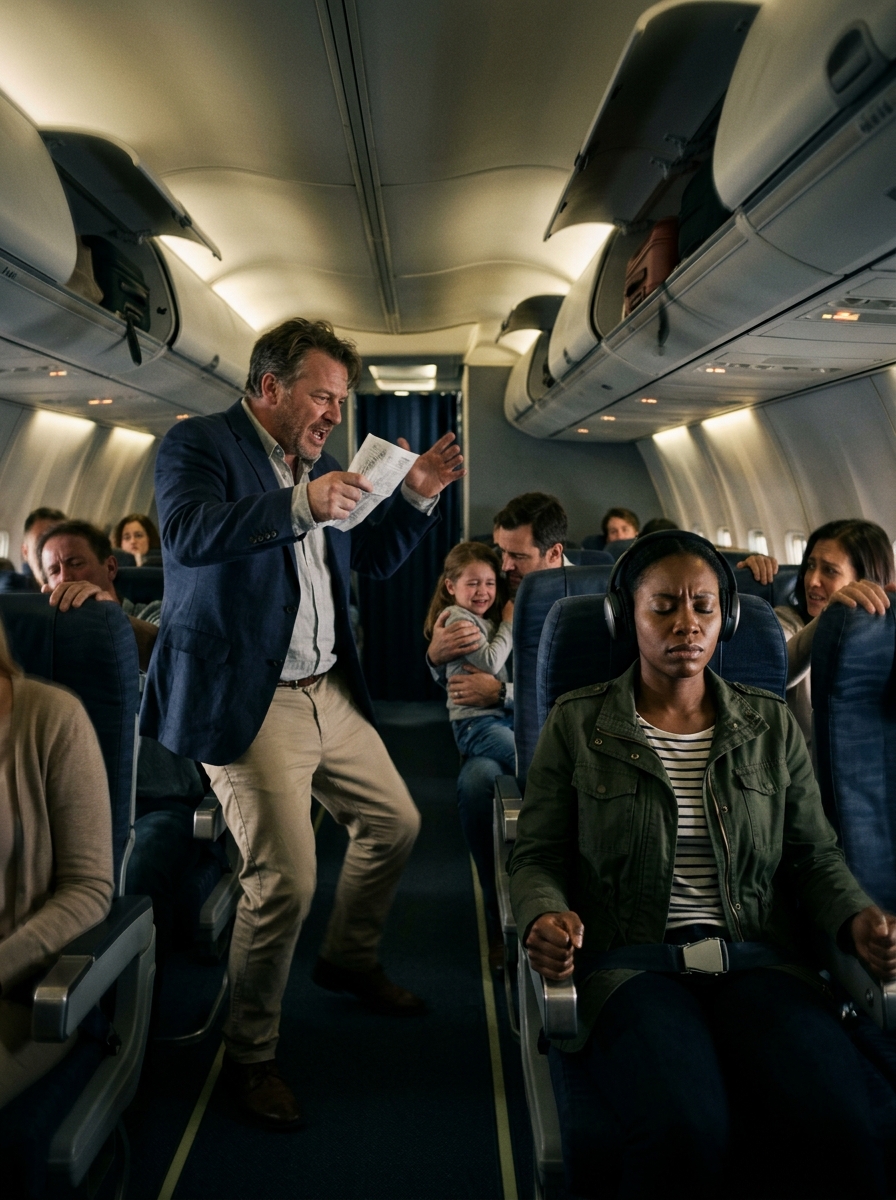
Bradley looked straight at me, his face flushed. “You hear that? You’re making my wife uncomfortable with all that… brooding. If you’re going to sit up here, at least try to act like you’ve been in a civilized environment before. Maybe smile? Or is that not part of the ‘island’ package?”
I slowly turned my head. For the first time, I met Bradley Whitcomb’s eyes. I didn’t smile. I didn’t frown. I looked at him the way a biologist studies a specimen—cold, clinical, detached.
“My father once told me,” I said softly, my voice barely above a whisper yet carrying across the row, “that some people build their entire identities out of the things they hate, because they are too hollow to love anything. It must be very exhausting for you, Mr. Whitcomb. To be so afraid of a woman who hasn’t even looked at you.”
Bradley’s mouth dropped open. His face shifted from pink to a deep, angry purple. “Afraid? You think I’m afraid of you? I’ve bought and sold companies bigger than your entire family tree. I pay for the air you’re breathing right now!”
“Brad, don’t,” Meredith snapped, though her glare stayed fixed on me. “She’s trying to provoke you. She wants a scene so she can play the victim. It’s what they do.”
I didn’t respond. I had already turned back to the window. I had what I needed. I had seen him crack. He wasn’t powerful—just a fragile ego wrapped in expensive cashmere and cheap liquor.
More importantly, while he was shouting, I had heard Asha Coleman cry.
The sound was muffled but unmistakable. Victor had gripped her arm—I caught the movement between the seats. He leaned in and whispered something sharply.
I grabbed my bag and stood.
“Where do you think you’re going?” Bradley sneered. “Going to cry in the bathroom?”
I ignored him and walked toward the lavatories. As I passed seat 4F, I “stumbled” slightly when the plane hit a patch of light turbulence. My hand brushed the seatback.
Asha looked up. Her eyes were red, her face drained of color. A blue passport rested on her tray table. The name on it read “Kayla Price.”
As I steadied myself, I caught a glimpse of the photo inside. The girl in the image had the same eyes, but different hair—shorter, straightened. And there was a birthmark on her neck that Asha Coleman didn’t have.
My heart pounded. This wasn’t just a forced accent. It was a stolen identity.
I reached the lavatory and locked the door. My hands trembled—not from Bradley’s insults, but from what I now understood was happening thousands of feet above the ocean. I pulled out the cocktail napkin where I had written OBSERVE.
I flipped it over and began writing in shorthand.
Target: 4F. Name: ‘Kayla Price’ (Incongruent). Linguistic markers: Coerced Jamaican pidgeon. Frequent repetition of ‘shopping’ script. Physical distress high. Companion: Male, 40s, controlling behavior.
I inhaled deeply, splashed cold water on my face, and stared at myself in the mirror. The red wine stain on my sleeve looked like a bruise under the harsh fluorescent light.
I wasn’t just a passenger. I was the one who knew.
When I returned to the cabin, the lights were dimmer still. Silence pressed in. Bradley slumped in his seat, snoring softly, a half-empty bourbon glass tilting dangerously on his armrest. Meredith scrolled through her phone, its glow casting ghostly light across her face.
I sat back down in 2A. A strange calm settled over me. The insults, the mockery, the touch—it had all become fuel. Bradley Whitcomb thought he was the predator here. He believed he held the power.
He didn’t realize I was drafting the legal cage about to close around him—and the man in 4F.
I pulled out my Customs Declaration card. My hands were steady now. I didn’t fill out the front. I flipped it to the blank space on the back.
I wrote the priority code for a Level 4 Human Trafficking Interdiction. I added my federal ID number.
Then I wrote the four words that would ensure that when we landed, no one—not Bradley, not Victor, and certainly not Meredith—would be walking away.
I waited for Elise to pass. When she did, I didn’t just hand her a note. I handed her a mission.
“Take this to the Captain,” I said. “Tell her to look at the ID number. Tell her that Dr. Baptiste is on board, and the flight is compromised.”
As Elise disappeared toward the cockpit, I felt the aircraft make a subtle, sharp bank. We were shifting course—not much, just a few degrees. But I knew what it meant.
The ground was starting to listen.
I glanced at Bradley, still snoring, his mouth slightly open. He looked small. Pitiful. He had spent six hours trying to make me feel invisible.
He was about to learn that being seen by me was the most dangerous thing that could ever happen to him.
I leaned back and closed my eyes, waiting for the first light of the Georgia sunrise to touch the wing. The real storm was only thirty minutes away.
CHAPTER 3 — The Darkest Point
The middle of the Atlantic is an isolating place, even inside a pressurized cabin full of people. As the flight crossed an invisible meridian near the Azores, the sky outside deepened into a harsh, bruised purple. Then the shaking began.
At first, it was just “oceanic chop”—a steady tremor that made the ice in Bradley’s fifth bourbon tap against the glass. But within minutes, the aircraft groaned and dropped fifty feet in a gut-twisting plunge. The seatbelt sign chimed sharply, authoritative and urgent.
“Ladies and gentlemen, please return to your seats and fasten your seatbelts immediately,” the Captain’s voice crackled. It wasn’t her “customer service” tone anymore. It was tight. Focused.
Bradley barked a laugh, though his hand clutched the armrest hard enough to whiten his knuckles. “Even the damn plane wants her back in coach!” he shouted over the roar of wind striking the fuselage. He gestured at me with his free hand. “Hear that? The earth itself is shaking because it can’t stand you being up here with the civilized folk!”
Meredith laughed, but the sound was brittle. She clutched her cashmere shawl, her eyes flicking nervously around the shaking cabin. “It’s the energy, Brad. I told you. It’s heavy.”
I didn’t respond. I couldn’t. My focus was fixed beyond them, toward row four. Each time the plane dropped, Asha Coleman let out a small, choked whimper. But it wasn’t the turbulence scaring her. It was Victor. Every time she made a sound, he leaned in and gripped her jaw, his thumb pressing into her cheek, forcing her to meet his eyes.
He was terrified she’d draw attention. Terrified she’d break.

A surge of hot, liquid anger rushed through me—the kind that narrows your vision to a single point. It was the same heat I felt at sixteen, watching those officers mock my father. For a split second, the discipline I had spent twenty years building—the academic distance, the federal restraint—cracked.
I started to unbuckle my seatbelt. I wanted to go back there, grab Victor by the throat, and show him exactly what a “civilized” woman could do when a child was in danger.
“Stay seated, ma’am!” Bradley shouted, noticing my movement. “Don’t you understand English? Sit your ass down!”
Suddenly, Elise was there. She moved through the cabin with the balance of someone used to shifting ground. She placed a firm hand on my shoulder and leaned close.
“Doctor, please,” she whispered. Her face looked pale under the emergency floor lighting. “The Captain got your message. She’s already contacted Atlanta. But we have to be careful. If you move now, Victor will notice. He’ll panic. We’re over the ocean—there’s nowhere to go.”
I met Elise’s eyes. I saw fear—but also trust. Slowly, I lowered myself back into my seat and fastened my belt. My hands trembled.
“I’ve spent my life teaching people how to hear distress,” I whispered, my voice thick. “And yet, when I hear it myself… I still feel like that little girl in the passenger seat, watching my father get humiliated because of how he spoke. I feel powerless.”
Elise squeezed my hand. “You are the furthest thing from powerless, Lenora. Look at them.”
She nodded toward the Whitcombs. They were busy mocking the way I was breathing, mocking the “intensity” of my silence. They thought they were in control. They didn’t realize they were acting as a distraction, keeping Victor’s attention away from the crew.
Elise reached into her apron and pulled out a fresh Customs Declaration card. “The Captain wants you to keep documenting. She’s diverted us into a high-speed corridor. We’re landing forty minutes early.”
She stepped away just as the plane dropped again, violently. Bradley’s bourbon finally flew from his hand, splashing amber liquid across the carpet and his salmon-colored sweater.
“Dammit!” he roared. He looked around for someone to blame, and his eyes landed on my leather satchel. In the chaos, it had slid into the aisle.
Before I could react, Bradley unbuckled his belt and lunged for it.
“Brad, no!” Meredith screamed as the plane jolted again.
He ignored her. He grabbed my bag and yanked it into his lap. “Let’s see what the ‘Doctor’ is hiding in here. Probably some Voodoo charms or a fake passport.”
“Put that down, Mr. Whitcomb,” I said, my voice low and steady, almost vibrating.
He laughed, eyes wild with alcohol and arrogance. He flipped open the bag and pulled out the white cocktail napkin—the one where I had written my notes about Asha and Victor.
“What’s this?” he sneered. He stood, bracing himself against the overhead bin as the plane shuddered. He cleared his throat and began reading aloud in a high-pitched, mocking imitation of my father’s accent.
“Target: Four-F… Linguistic markers: Coerced…” He paused, frowning at the shorthand he couldn’t understand, then improvised. “‘I am a big, scary doctor who hates rich white people because they have nice sweaters!’”
Meredith burst into laughter. Behind them, Trevor Sloan in seat 3D had his phone out again. I saw the red “Recording” dot. He was filming everything.
Bradley was literally reading evidence of a federal crime into a camera, convinced it was entertainment. He was reciting the very red flags that would later prove Victor Hale was a trafficker. He was documenting the “coerced accent” I had identified.
“‘Subject shows signs of distress,’” Bradley continued in that mocking sing-song tone. “Oh, I’ll show you distress! You’re the one who’s going to be in distress when I call the board of Global Atlantic and have your ‘doctor’ title stripped for harassing passengers!”
He tossed the napkin at me. It drifted down, landing on my wine-stained sleeve.
I picked it up. I didn’t look at him. I looked at the word written there.
Distress.
That was when I understood—Bradley wasn’t just a racist. He was an asset. His loud, obnoxious behavior was making Victor feel invisible. Victor was so focused on the spectacle in first class that he was loosening his hold on Asha. He believed authorities would be too busy dealing with the “drunk in First Class” to notice a quiet girl in 4F.
I took the new customs card Elise had given me. My pen moved with sharp precision.
Priority Code: 10-Alpha-Niner. Subject: Asha Coleman (Confirmed ID mismatch). Status: Active transport of a minor. Recommendation: Immediate sealed jet-bridge boarding. Detain companion Victor Hale. Separate victim immediately.
I added one final line:
Secondary Concern: Interference with a federal consultant by Bradley Pierce Whitcomb. Evidence recorded by passenger in 3D.
I stood. The turbulence had settled into a low, ominous vibration. I walked past Bradley, who was now trying to blot bourbon from his sweater with a silk handkerchief.
“You’re going to pay for this sweater,” he muttered as I passed.
I didn’t stop. I continued straight to the galley. Elise stood there, headset on. Her eyes widened when she saw me.
“He read the notes, Elise,” I said. “It’s on video. The man in 3D captured everything. Bradley just handed us the corroboration we needed.”
I gave her the card. “This is a Level 4 alert. Tell the Captain to transmit the manifest for row 4 immediately. And tell her… tell her I want Supervisory Officer Daniel Reyes at the gate.”
Elise’s hand shook as she took it. “Reyes? You know him?”
“I trained him,” I said. “And he owes me.”
I returned to my seat. The cabin had quieted. The sun was beginning to rise, a sharp, cold gold illuminating frost along the windows.
Thirty minutes to Atlanta.
Bradley glanced at me, his lip curling. “Back so soon? Couldn’t find a way to jump out the emergency exit?”
“Mr. Whitcomb,” I said, settling into my seat and smoothing my dress. I could feel my father’s silence transforming into something heavier—something inevitable. “I want you to enjoy these last thirty minutes. Truly. Have another drink. Tell another joke. Because very soon, the world is going to become a very quiet place for you.”
Meredith rolled her eyes. “God, she’s so dramatic. It’s just a flight, Brad.”
But it wasn’t.
Inside the cockpit, radios crackled with urgency. In Atlanta, lights were flicking on in a secure room at Hartsfield-Jackson. And out on the tarmac, black SUVs were already starting their engines.
The “silence” was about to break—and when it did, it would land with the force of a hammer.
CHAPTER 4 — The Reckoning
The descent into Hartsfield-Jackson felt unlike any landing I had experienced in my twenty-year career. Usually, tension eases, and a shared breath passes through the cabin as passengers realize they’ve once again defied gravity. But as Flight 217 dropped beneath the thick Georgia humidity, the air inside felt pulled tight, like a wire ready to snap.
I remained perfectly still, my hands folded over the leather satchel in my lap. The dried red wine on my sleeve—Meredith’s “clumsiness”—had hardened into a rough stain, but it no longer bothered me. It felt like war paint.
Across the aisle, Bradley was grooming himself. For the past ten minutes, he had been checking his reflection in his darkened tablet screen, smoothing his silver hair and adjusting the collar of his stained salmon sweater. He looked like a man preparing for recognition, not one about to face consequences.
“You ready, Mere?” he asked, his voice carrying through the quiet cabin. “I’ve already got the corporate legal line on speed dial. By noon, this airline is going to be issuing a public apology. And as for our silent friend in 2A… well, I hope she likes the taste of a defamation suit.”
Meredith reached over and patted his hand, her diamond bracelet catching the morning light. “Don’t be too hard on her, Brad. I’m sure the authorities will deal with her ‘attitude’ before we even need to call the lawyers.”
I looked out the window. The runway rushed toward us. Normally, a flight from London would taxi endlessly at ATL, weaving through the sprawling terminal complex. But today, the pilot exited the runway quickly and moved with clear intent toward a remote gate at the far end of Terminal F.
I noticed the flashing lights first.
They weren’t the red and blue of local police. They were amber and white—federal airport authority vehicles—accompanied by three black SUVs with government plates. They waited at Gate F12, which had been cleared of all other activity.
The aircraft stopped with a sharp hiss of brakes. The “Fasten Seatbelt” sign didn’t chime—it simply went dark.
“Ladies and gentlemen, please remain seated with your seatbelts fastened,” Elise announced. Her voice trembled slightly, but for a brief second, she met my eyes. She understood.
“What is this?” Bradley demanded, unbuckling his seatbelt anyway and rising to his feet. “Why aren’t we moving? I have a 9:00 AM meeting!”
“Sit down, sir,” a voice commanded from the front.
The forward cabin door opened with a hiss. The jet bridge had been secured. The first person to step aboard wasn’t a gate agent—it was a man in a tactical vest marked “CUSTOMS AND BORDER PROTECTION” in bold lettering. Behind him came four more officers and two plainclothes investigators.
The cabin fell completely silent. Even Bradley froze, his hand hovering near the overhead bin.
The lead officer—a man with sharp features and a buzz cut—scanned the first-class cabin. His eyes found mine. Recognition flickered there, followed by a subtle straightening of his posture. This was Daniel Reyes. Ten years earlier, he had been a trainee in my linguistics lab, nearly failing because he couldn’t distinguish fear from deception. I had rebuilt that skill in him.
“Officer Reyes,” I said calmly.
“Dr. Baptiste,” he replied. No smile—he was working. He glanced at the manifest in his hand. “We received your Level 4 transmission. The jet bridge is secured. The cockpit is locked. We are taking control of the aircraft.”
Bradley finally spoke again, stepping into the aisle with his chest puffed out. “Finally! Officer, I’m Bradley Whitcomb. I’m the one who made the complaint. This woman in 2A has been harassing my wife and me for six hours. She’s been taking strange notes, acting erratically, and—honestly—I think she’s a security risk. I want her removed and charged immediately.”
Reyes looked at him with complete, clinical detachment.
“Mr. Whitcomb, you are currently interfering with a federal investigation,” Reyes said. “Sit down and remain quiet, or you will be boarded in flex-cuffs.”
Bradley blinked, his face draining of color. “I… you don’t understand. I’m a donor to the—”
“Sit. Down.”
Bradley dropped into his seat as if his legs had given out. Meredith clutched her throat, looking on the verge of collapse.
Reyes turned back to me. “Doctor, where is the primary target?”
I stood and pointed toward row four. “Seat 4F. Traveling under the name Kayla Price. Companion in 4D, Victor Hale. I’ve documented six hours of coerced linguistic patterns, rehearsed shielding scripts, and physical intimidation markers. The girl is in severe distress.”
The officers moved past the Whitcombs as though they didn’t exist. They surrounded row four. I heard Victor Hale shout—a desperate, trapped sound—followed by the unmistakable metallic snap of handcuffs.
“Asha,” I called, my voice softening as I stepped forward.
The girl in 4F looked up, shaking so badly she couldn’t stand. Victor was being forced from his seat, his face pressed against the headrest.
“Asha Coleman,” I said, using her real name for the first time. “My name is Lenora. You don’t have to say the shopping script anymore. You don’t have to pretend. These men are here to take you home.”
Asha broke into a sob—a raw, unfiltered release that filled the cabin. She collapsed into the arms of a female officer, who wrapped her in a heavy blanket.
As Victor Hale was escorted toward the front, he passed Bradley Whitcomb. Bradley tried to shrink into his seat, but Reyes stopped directly in front of him.
“Officer,” Bradley stammered, his voice thin. “I had no idea… I mean, she looked so suspicious, I thought she was the one…”
“Mr. Whitcomb,” Reyes said, leaning closer, “the woman you spent six hours mocking is the leading expert in human trafficking linguistics in the United States. She wrote the manual my team uses to rescue girls like the one you just saw.”
I stepped beside Reyes. I glanced at the wine stain on my sleeve, then at Bradley’s ruined sweater.
“You spent six hours mistaking my restraint for permission, Bradley,” I said quietly. “You believed my silence meant weakness. It didn’t. It was an interrogation.”
I turned toward Trevor Sloan in 3D, who still held his phone, his hands trembling. “And since Mr. Sloan here recorded your ‘performance,’ the Department of Justice now has the evidence it needs regarding your harassment of a federal consultant and your interference with an active investigation.”
“I’ll lose everything,” Bradley whispered as reality settled in. “My deals… my reputation…”
“You lost your humanity somewhere over the Atlantic, Mr. Whitcomb,” I said. “The rest is just paperwork.”
Reyes gestured to his team. “Escort Mr. and Mrs. Whitcomb to secondary screening. I want a full statement, and I want the video from seat 3D copied to our server before they leave this gate.”
As they were led away, Meredith sobbed, her bracelet clinking against the handrail. Bradley didn’t look back. He looked like a man realizing the world was far bigger—and far less impressed by him—than he had ever believed.
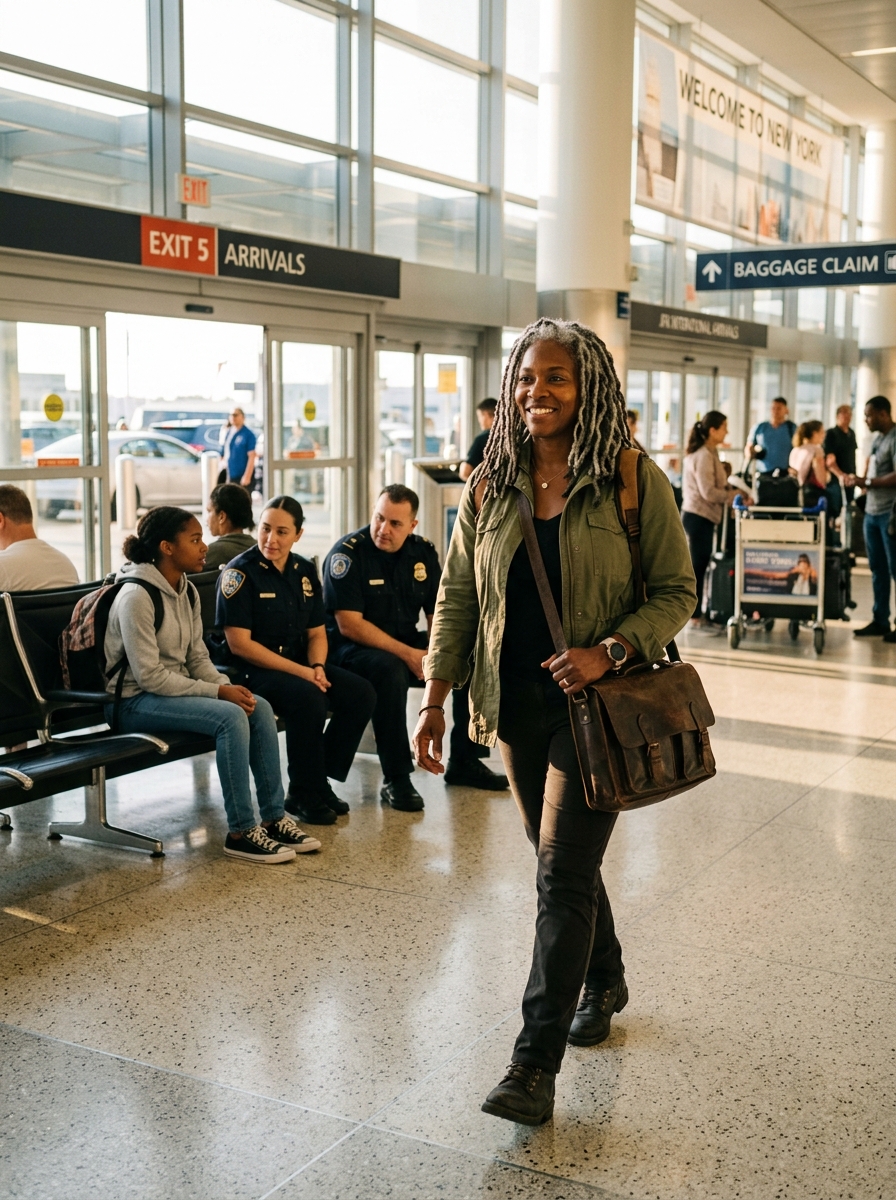
I exited the plane behind Asha. The Georgia sun was bright and unforgiving, cutting through the sterile air of the jet bridge.
Two hours later, in a private room within the Customs wing, Asha sat on a couch holding a cup of tea. Her eyes were finally clear.
“How did you know?” she asked softly. Her voice had changed—no forced accent now, just a quiet, trembling American tone. “How did you know it wasn’t me talking?”
I sat across from her and gave a small smile. “Because I know what it’s like to hide your real voice just to survive. But I also know that once you reclaim it, no one can ever take it from you again.”
An hour later, I walked out of the terminal, my father’s old leather satchel slung over my shoulder. The air smelled of pine and jet fuel.
I pulled out my phone and called my sister, Mara.
“Hey,” I said when she answered. “I’m home. And Mara? Silence isn’t the only evidence anymore. Today, the truth had a voice.”
I walked toward my car, the silver in my locs catching the morning light. For six hours, I had been the victim in Bradley Whitcomb’s story. But as the sun rose over Atlanta, I stood exactly as I was meant to be.
The woman who heard the scream inside the silence.
THE END.
