


Chapter 1
The sound didn’t come from a crash or a shout—it came from a single snap of fingers that cut through the room like an order no one dared defy. Conversations didn’t merely pause, they ceased, glasses suspended mid-air, forks halted halfway to mouths, because everyone at the table understood exactly what that gesture signaled.
Not respect—never that—but fear, the kind born from watching a man who took pleasure in breaking others for sport. Garrett Whitmore III didn’t just possess wealth; he wielded control, the kind that reduced people to background noise in his presence.
When the server stepped forward quietly with a tray, her voice calm and courteous—“Sir, your champagne is ready”—he didn’t turn, didn’t even acknowledge her as if she were worthy of notice in his world.
“Did I ask you to speak?” he said, his tone light but sharpened with something that could cut. His hand rose lazily, a dismissive flick that silenced her more completely than any shout.
The table erupted in laughter, not because it was amusing, but because it was expected, because in Garrett’s world, cruelty passed for entertainment. He leaned back, slowly swirling his champagne, watching the bubbles rise as though even they existed for his amusement, while his billionaire companions leaned closer, eager for what would follow.
“Since this black girl is so good at carrying plates,” he drawled, his voice thick with disdain, “maybe she can give me financial advice,” and at last his gaze settled on her, cold, assessing, calculating just how far he could go before anyone might object—though no one ever did.
“I’ve got fifty million dollars, sweetheart,” he continued, letting the number linger like a challenge, like a weapon, like something far beyond her reach. A pause followed, deliberate and cruel, stretching the humiliation just long enough to take hold.
“What should I do? Open a savings account at the welfare office?” The laughter that followed was louder, harsher, echoing off marble and glass like something alive.
Someone clapped. Another lifted their glass in mock approval.
Garrett slipped a crisp hundred-dollar bill from his jacket and waved it before her face as though tossing scraps to something beneath him. “Here’s your tip in advance,” he smirked, leaning forward slightly. “Teach a billionaire how money works.”

For illustrative purposes only
A woman draped in pearls leaned toward her companion, her voice lowered but still laced with venom. “These people don’t know their place,” she whispered, her lips curling with quiet contempt.
And still, no one stepped in. No one protested. No one even shifted enough to matter.
Felicia Turner stood there in her plain uniform, alone in a room filled with power, surrounded by people who believed silence was safer than decency. She didn’t move. She didn’t blink. She didn’t flinch. That was their first mistake.
Because what they saw was a waitress. What they saw was someone invisible. What they saw was someone who would absorb the insult, lower her gaze, and retreat into the shadows where they believed she belonged.
But what they didn’t see—what none of them could imagine—was that in just fifteen minutes, everything in that room, everything they believed was stable, untouchable, permanent… would begin to fall apart. And Garrett Whitmore, the man who considered himself inevitable, would discover just how fragile inevitability truly was.
The Meridian Club wasn’t merely a restaurant—it was a fortress cloaked in elegance. Set high above Manhattan on the forty-second floor, entry required more than wealth; it demanded approval, status, and the kind of connections that shielded men like Garrett from consequences.
Every Saturday morning, the same ritual played out: power brunch, they called it. Three hours of champagne, lobster omelets, and deals murmured over linen so white it looked unreal.
Silverware gleamed beneath soft, calculated lighting—real silver, of course—and the staff moved like shadows, visible only when necessary, invisible the rest of the time.
On the far wall, a massive screen streamed live market updates, stock tickers scrolling endlessly, fortunes rising and falling in real time. Even as they ate, their money worked harder than most people ever would.
This wasn’t just a meal—it was a battlefield where numbers replaced bullets and signatures replaced bloodshed. And at its center sat Garrett Whitmore, ruler of a system he had spent decades perfecting.
At fifty-eight, he had transformed Whitmore Capital into a twelve-billion-dollar force, a hedge fund capable of dismantling companies as easily as others ordered coffee. Forbes called him brilliant. CNBC called him unstoppable.
But those left in the wake of his deals had other names for him—predator, executioner, thief wrapped in tailored perfection.
He specialized in destruction disguised as opportunity. Acquire struggling companies, load them with debt, extract millions in fees, and walk away just as everything collapsed behind him.
Pension funds emptied. Businesses erased. Thousands of lives undone overnight.
All of it legal. All of it profitable. All of it carried out without hesitation or remorse.
And now, that same man sat there laughing, ridiculing a woman he believed was beneath him, unaware that the balance of power in the room had already begun to shift.
Felicia reached for the champagne bottle with unhurried precision, her movements controlled, almost delicate against the noise surrounding her. Her hands remained steady. Her breathing stayed even. Her expression was calm, unreadable.
But her eyes—her eyes held something that didn’t belong in that room, something no one at the table recognized because they had never been forced to see it before. It wasn’t fear. It wasn’t shame.
It was something colder. Something patient. Something that had already calculated the outcome long before they realized they were part of it.
Garrett took another sip, still smiling, still certain he controlled every variable in the room. “Come on,” he said, leaning forward slightly, his voice thick with amusement. “Don’t be shy.”
Felicia set the glass before him gently, the soft clink against the table sounding louder than it should have in the silence that followed. Then she spoke, her voice quiet, clear, slicing through the noise without rising above it.
“Sir… if I had fifty million dollars like you…”
For the first time, the laughter didn’t come. It stalled, lingering in the air, uncertain.
Garrett looked at her properly now—not as an object, not as background, but as something… unexpected. Something in her tone disrupted the rhythm of the room in a way no one could explain.
“I wouldn’t worry about where to put it,” she continued, her gaze steady and unflinching, her words delivered with surgical precision.
There was a pause.
A long one.
The kind that unsettles people without them understanding why.
“I’d worry about where it’s about to disappear.”
The room went still.
Not quiet—still.
Garrett’s smile flickered, just for a split second, but it was enough. Enough for the shift to begin, enough for something unseen to tighten around the edges of the moment, enough for the first crack in his certainty to form.
And then—
Chapter 2
Garrett laughed first, because men like Garrett always laugh when fear arrives disguised as confusion. It was brief, brittle, and far too loud.
“Did everyone hear that?” he said, turning to his table as if inviting them back into the safety of mockery. “The waitress is threatening my portfolio now.”
A few people chuckled, but the sound was thinner this time. Felicia hadn’t moved, and that stillness had become impossible to ignore.
Garrett leaned forward, the hundred-dollar bill still held between two fingers. “Sweetheart, do you even know what fifty million looks like?”
Felicia glanced at the bill, then back at him. “I know what stolen money looks like.”
The table went rigid.
The woman in pearls stopped smiling. A man with a red pocket square lowered his champagne glass so slowly it felt choreographed by dread.
Garrett’s eyes narrowed. “Excuse me?”
Felicia lifted the bottle and poured with effortless grace. “You heard me.”
The bubbles rose in Garrett’s glass, bright and delicate, completely out of place in a room that had begun to darken without any change in the lighting.
Garrett set his glass down. “You have ten seconds to explain yourself before I have you fired.”
Felicia glanced toward the staff entrance, where the general manager stood pale and unmoving. “He can’t fire me.”
Garrett sneered. “Everyone here can be fired.”
“Not me,” Felicia replied.
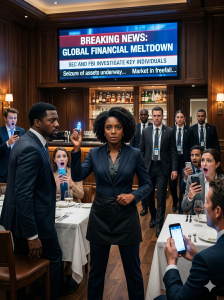
A low murmur spread through nearby tables. On the CNBC screen, a breaking banner slid beneath the stock tickers, but no one had noticed yet.
Garrett noticed only her face. Calm. Measured. Almost bored.
That offended him more than the words themselves.
“You people get one uniform and suddenly you think you own the place.”
Felicia’s eyes flickered—not with hurt, but with recognition.
The phrase had traveled across generations to reach her. Different voices, same poison.
She reached into her apron pocket and pulled out a small black phone. Not cheap. Not staff-issued.
Garrett glanced at it and scoffed. “Calling your supervisor?”
“No,” Felicia said. “Confirming execution.”
That was when the first phone at the table vibrated.
Then another.
Then three more.
The man with the red pocket square looked down first. His expression shifted so quickly it resembled illness.
“Garrett,” he whispered.
Garrett ignored him. “I’m speaking.”
“Garrett,” the man repeated, louder now. “Whitmore Capital just froze redemptions.”
The room shifted.
A second man checked his phone and stood abruptly. “That’s impossible.”
The CNBC screen behind them finally drew the room’s attention.
BREAKING: WHITMORE CAPITAL UNDER EMERGENCY LIQUIDITY REVIEW.
For illustrative purposes only
Garrett turned slowly toward the screen.
For the first time that morning, he looked smaller.
Felicia set the champagne bottle down with quiet care.
“Fifteen minutes was generous,” she said. “It started in seven.”
Chapter 3
Garrett sprang to his feet so quickly his chair slammed into the marble behind him.
“What did you do?” he demanded.
Felicia met his gaze with the patience one might give a child holding a match in a room filled with gasoline. “I told the truth.”
His palm struck the table. Silverware jolted. Champagne quivered in every glass.
“You don’t know anything about my fund.”
“I know about Halcyon Steel,” Felicia replied.
The name rang through the room like a hidden bell.
One of Garrett’s friends muttered, “Don’t.”
Felicia turned toward him. “You remember it too?”
Garrett’s expression hardened. “Halcyon was a lawful acquisition.”
“No,” Felicia said. “Halcyon was a murder with paperwork.”
The surrounding tables had gone completely still. Staff lingered at the edges, afraid to make even the slightest sound.
Felicia continued, her voice steady. “You acquired a struggling steel company, buried it in debt, drained its pension fund through consulting fees, and sold off the scrap rights before shutting the plant down.”
Garrett’s jaw tightened. “That is business.”
“My father worked there for twenty-nine years.”
The words shifted the air.
Felicia’s calm didn’t break, but something human stirred beneath it—something old, something wounded.
“His pension vanished three weeks before his cancer treatment was denied,” she said. “My mother sold our house. I left college. He died believing he had failed us.”
Garrett stared at her. Then a flicker of recognition crossed his face.
“Turner,” he said.
Felicia gave a smile devoid of warmth. “There it is.”
He leaned in slightly. “I don’t remember every sob story tied to a balance sheet.”
A gasp rose from the woman in pearls.
Felicia’s eyes turned cold.
“No,” she said. “But I remembered every signature on the documents that destroyed him.”
Garrett’s phone rang. He grabbed it instantly.
“What?” he snapped.
The voice on the other end was faint but urgent. “SEC inquiry opened. Prime brokers are demanding collateral. Investors are calling. Someone leaked the Black Ledger.”
Garrett went pale.
Felicia tilted her head.
“Black Ledger?” she echoed softly, as if testing the words. “That sounds serious.”
He lowered the phone slowly. “Who are you?”
Felicia untied the white apron from around her waist.
The motion was small, yet every person watched it as if a curtain were lifting.
“My name is Felicia Turner.”
She folded the apron once.
“Founder of Turner Forensic Recovery.”
Then she set it on the table beside Garrett’s untouched champagne.
“And today, your largest creditor.”
Chapter 4
The room erupted into whispers.
Garrett stared at the apron, then back at her, as if the fabric itself had betrayed him.
“That’s impossible,” he said.
Felicia’s smile remained, but it never reached her eyes. “You keep using that word for things you failed to anticipate.”
A man near the window whispered, “Turner Recovery? They bought distressed debt from three collapsed Whitmore companies last quarter.”
Felicia looked at him. “Seven.”
His mouth shut immediately.
Garrett grabbed his phone again, scrolling rapidly. His fingers trembled despite his attempt to steady them.
“You think owning scraps makes you powerful?” he snapped. “I own the structure.”
“You owned the structure,” Felicia corrected.
Another headline flashed across CNBC.
TURNER FORENSIC RECOVERY FILES EMERGENCY CLAIMS AGAINST WHITMORE-LINKED SHELL ENTITIES.
The woman in pearls stood. “Garrett, what shell entities?”
Garrett turned sharply toward her. “Sit down.”
She didn’t sit.
That was the second crack.
Felicia reached into the ice bucket and retrieved a sealed envelope wrapped in plastic. It had been hidden beneath the ice, waiting.
Garrett stared at it.
“Where did you get that?”
Felicia raised it slightly. “From your former accountant.”
“He’s dead.”
“Yes,” she said. “That made him very motivated to be prepared.”
Garrett’s eyes widened.
Felicia opened the envelope and pulled out a flash drive.
“Before Mr. Alder died, he sent copies to my firm, the SEC, two federal prosecutors, and one journalist who happens to enjoy brunch.”
At the mention of journalist, heads turned.
A quiet woman at a corner table lowered her coffee cup. Her recorder was already running.
Garrett’s voice dropped. “You came here to ambush me.”
Felicia glanced around the Meridian Club. “No. I came here to serve champagne.”
She leaned in slightly.
“You chose the ambush.”
His nostrils flared. “Do you know what happens to people who threaten me?”
Felicia’s gaze didn’t shift.
“Yes,” she said softly. “They become evidence.”
The elevator doors opened behind them.
Two federal agents stepped into the restaurant.
The room drew a sharp breath.
Garrett didn’t turn at first.
He kept his eyes on Felicia, because for the first time in decades, he understood that the person standing across from him was not afraid.
Chapter 5
The agents approached at an unhurried pace, their badges visible, their expressions unreadable.
“Garrett Whitmore,” one said, “we need you to remain where you are.”
Garrett offered a thin smile. “I have attorneys.”
Felicia said, “You’ll need better ones.”
The agent continued. “We have warrants for financial records related to Whitmore Capital, Whitmore Strategic Advisors, and affiliated pension recovery vehicles.”
The woman in pearls dropped back into her seat.
“Pension recovery?” she whispered.
Felicia turned toward her. “That’s what he called the fund that took money from retirees before the companies collapsed.”
Garrett’s hand curled into a fist. “You don’t understand finance.”
Felicia stepped closer. “I understand hunger.”
The room stilled again.
“I understand watching my mother choose between medicine and heat. I understand collection calls. I understand funeral flowers paid for with borrowed money.”
Her voice trembled now, but only slightly.
“And I understand that men like you call suffering inefficient when it happens to other people.”
Garrett’s face twitched.
The agent reached toward him. “Sir.”
Garrett pulled back. “This is theater.”
Felicia nodded. “You would know. You performed wealth for thirty years while stealing from people who built real things.”
His phone rang again.
This time, he didn’t answer.
On the wall, CNBC switched to live coverage outside Whitmore Capital’s headquarters. Cameras showed employees leaving in clusters, reporters gathering, police cars lining the curb.
Garrett looked at the screen.
His empire was unraveling in public.
Then the journalist in the corner stood.
“Mr. Whitmore,” she called, “is it true the Black Ledger contains payments to federal pension auditors?”
The agents exchanged a glance.
Garrett’s mouth opened, then closed.
Felicia’s expression shifted.
That question had not been part of her plan.
“Payments to auditors?” she asked quietly.
The journalist looked at her, surprised. “You didn’t know?”
Felicia turned slowly back to Garrett.
He began to smile.
It wasn’t a victorious smile.
It was desperate. Harsh.
“You think I built this alone?” he whispered.
Felicia felt the moment drop out from under her.
Garrett leaned closer, his eyes gleaming with ruin.
“Ask who signed the first Halcyon clearance.”
Chapter 6
Felicia stared at him.
“What did you say?”
Garrett let out a low laugh, the sound fractured but sharp. “You built your entire revenge story around me.”
The agents stepped in, but Felicia raised a hand.
“Let him speak.”
Garrett looked almost pleased with the damage he was about to inflict.
“Halcyon’s pension transfer required government approval,” he said. “An auditor signed off. A respected one. A Black woman, actually.”
Felicia’s chest tightened.
“No.”
Garrett’s smile widened. “Oh, yes.”
He glanced toward the screen as if calling up a ghost.
“Evelyn Turner.”
Felicia stopped breathing.
Her mother’s name drifted through the restaurant like smoke.
The room blurred.
“My mother was a school secretary,” Felicia whispered.
Garrett shook his head. “Your mother was a federal pension auditor before she disappeared into that small life she gave you.”
Felicia’s hands turned cold.
“That’s a lie.”
“Is it?”
He nodded toward the flash drive.
“Open the folder marked clearance.”
One agent inserted the drive into a secure tablet.
Felicia watched as the screen loaded.
A document appeared.
HALCYON STEEL PENSION TRANSFER CLEARANCE.
At the bottom was a signature.
Evelyn M. Turner.

Felicia felt something inside her fracture.
All those years, her mother had blamed Garrett. Despised Garrett. Wept because of Garrett.
But it was her signature that had unlocked the door.
Felicia’s voice came out hollow. “Why?”
Garrett’s smile faded. “Because she was trying to save you.”
The words struck harder than the signature.
He continued, more quietly now. “Your father uncovered the pension theft before the collapse. He threatened to expose everyone.”
Felicia gripped the edge of the table.
“Everyone?”
Garrett glanced at the agents. Then at the journalist. Then back at Felicia.
“The pension theft wasn’t mine to begin with.”
Felicia shook her head.
Garrett said, “It was Halcyon management. Union leadership. Federal auditors. Your mother found out too late.”
The tablet chimed.
Another file opened on its own.
A video.
Felicia’s mother appeared on screen—young, tearful, alive.
A sound escaped Felicia, small and broken.
“Mom?”
Evelyn Turner looked directly into the camera.
“Felicia, if you’re seeing this, then I failed to stop him from telling you first.”
Garrett lowered his head.
Evelyn continued. “I signed the clearance because they threatened your father. I thought I could collect evidence from the inside.”
Tears slid down Felicia’s face.
“But when your father found out, he confronted them. Garrett was involved, yes. But he wasn’t the only one.”
The video flickered.
Evelyn whispered, “The day your father died, he gave me a ledger. The real ledger.”
Felicia’s eyes moved to the flash drive.
Evelyn shook her head on the screen. “Not the Black Ledger.”
A pause.
“The Red Ledger.”
Garrett’s head snapped up.
For the first time, he looked afraid.
Evelyn’s voice dropped. “It names the people above Whitmore. Judges. senators. regulators. the men who used him as a blade and planned to discard him once he took the blame.”
Garrett whispered, “No.”
Felicia stared at him.
The predator had been a predator.
But also a shield for something far larger.
Evelyn’s video went on. “Felicia, the Red Ledger is hidden where your father kept his work boots. Under the floorboard beneath the left heel.”
Felicia could barely remain standing.
Evelyn leaned closer to the camera.
“And baby, listen carefully.”
The restaurant held its breath.
“Garrett Whitmore is not your final enemy.”
The light seemed to dim around Felicia.
Evelyn’s next words shattered every certainty she had carried into that room.
“He is your father’s half-brother.”
Garrett closed his eyes.
Felicia staggered back.
“What?”
Evelyn wept silently on the screen. “Your grandfather had two sons. One he acknowledged. One he left in poverty.”
Felicia looked at Garrett.
Garrett met her gaze, stripped of arrogance now—only old and broken.
Evelyn said, “Your father died trying to expose his own brother.”
The video ended.
No one spoke.
Felicia stood in the Meridian Club, surrounded by billionaires, agents, cameras, champagne, and the wreckage of a revenge she thought she understood.
Garrett whispered, “He was better than me.”
Felicia’s tears fell freely now.
“Yes,” she said.
Then the journalist’s phone buzzed.
Her expression shifted.
“Felicia,” she said. “A source just leaked the Red Ledger location online.”
Garrett went pale.
The agents moved.
Felicia picked up the hundred-dollar bill Garrett had waved in her face and folded it slowly.
Then she looked at the room full of powerful people who had laughed at her.
“My father lost everything because men in rooms like this believed money made them untouchable.”
Her voice broke, then steadied.
“So here’s my financial advice.”
She set the folded bill on Garrett’s plate.
“Run.”
Outside, sirens rose beneath Manhattan.
And for the first time in his life, Garrett Whitmore looked like a man who understood he couldn’t.
