


The baby kicked the exact moment the gate agent’s gaze fixed on mine.
It wasn’t a soft flutter. It was a sudden, desperate jab against my lower ribs, as if my unborn daughter could feel the shift in pressure before I even registered it.
I was at Gate D14 in Seattle-Tacoma International Airport. My feet were swollen inside my loafers, and my lower back ached with a steady, grinding pain only a woman in her third trimester truly knows. In my shaking hand was a First Class boarding pass for Flight 408 to Chicago. Seat 2A.
I needed that seat. I wasn’t flying for leisure. I was flying to bury my father.
He had died thirty-six hours earlier from a sudden heart attack. Grief pressed against my chest like a physical force, matching the weight of the life growing inside me. All I wanted—all I needed—was to collapse into that wide leather seat, close my eyes, and cry until we landed in Illinois.
The boarding line crept forward. The gate area was tightly packed, the air heavy with stale coffee, perfume, and the restless tension of delayed passengers. It was the Friday before a holiday weekend, and Flight 408 was heavily overbooked. The airline had been pleading over the intercom for volunteers for an hour, increasing vouchers from $300 to $800, but no one was taking the offer.
In front of me stood a middle-aged white couple. The man in a stretched pastel polo laughed loudly about a golf tournament, while his wife leaned comfortably at the podium, chatting with the gate agent.
The gate agent’s name tag read Claire.
Claire looked mid-forties. Her blonde hair was stiffly lacquered into place, and her navy airline blazer was tailored sharply to her frame. But beneath the surface—something I always notice—were cracks. Dark under-eye circles masked by expensive concealer. Her knuckles pale as she gripped the scanner. Later, I would learn she was in the middle of a brutal custody battle, losing her son to a husband who outspent her in court. Claire had lost control of her personal life, and so she tightened her grip on her professional one. At Gate D14, Claire was God.
“Have a wonderful flight, Mr. and Mrs. Henderson,” Claire beamed, handing back their scanned passes. Her voice was pure corporate sweetness. “Enjoy the extra legroom in row three.”
“Thanks, Claire! You’re a peach!” the man boomed, patting his wife as they walked onto the jet bridge.
I stepped forward next, offering a tired, respectful smile as I slid my phone under the scanner.
The scanner beeped. A harsh red flash lit the screen.
Claire’s smile disappeared instantly. Not fading—erased. She looked at the display, then slowly up at me. She took in my hair pulled neatly into a bun. My black maternity dress. My dark skin. Then, deliberately, my swollen belly.
“Step aside, please,” Claire said. Her voice had turned to ice.
“Excuse me?” I blinked, confused. “Is there a problem with my ticket? It’s Seat 2A.”
“I said, step out of the line, ma’am. You’re blocking the other passengers.”
I glanced back. A long line of irritated travelers stretched behind me. A well-dressed white woman directly behind—Eleanor, as I would later learn—sighed loudly, adjusting her Louis Vuitton tote.
“I don’t understand,” I kept my voice steady and controlled. As a Black woman, I’d been taught early that volume is dangerous—panic becomes aggression, confusion becomes threat. “I paid for this ticket three months ago. I have my ID right here.”
“Your boarding pass has been flagged for a random security check,” Claire said, louder than necessary. She wanted witnesses. “I cannot let you board this aircraft.”
“A random check? I already went through TSA. I went through the full-body scanner. They even patted down my hair.” My voice shook as grief surged again. “Please, miss. My father just passed away. I have to be on this flight to make his funeral tomorrow morning.”
Claire didn’t react. No blink. No softness. Only control. “Your personal issues are not my concern, ma’am. Federal regulations require me to hold you here. If you continue to argue and cause a disturbance, I will call security.”
Cause a disturbance. The phrase landed like a threat.
“I’m not causing a disturbance,” I whispered, heart pounding. “I just want to get on the plane.”
“Security,” Claire snapped into her radio. “I need an officer at Gate D14 for a non-compliant passenger.”
“Non-compliant?” I gasped, stepping back as if struck.
Behind me, voices rose in uneasy murmurs.
“Just do what she says, honey,” Eleanor leaned in, whispering. Her tone was falsely gentle, almost maternal. “You don’t want to make things worse for yourself. Think of the baby. You people always make things so difficult.”
You people. The words hit like impact. To her, it was advice. To me, it was erasure. A reminder of how quickly I had been reduced.
Within ninety seconds, two security officers arrived. The lead officer, Thomas Vance, stepped into my space.
He was tall, broad, late thirties, with a military buzz cut and a jaw locked tight. But his left hand on his belt trembled slightly.
Vance wasn’t cruel by nature. He was a veteran drowning in medical debt, working endless hours to keep his wife Sarah’s MS treatments covered, terrified of losing stability, terrified of error. He didn’t want this assignment. But Claire had called, and Claire meant authority.
“Ma’am, grab your bags. You need to come with us,” Vance said, voice deep and heavy.
“Officer, please,” I said, tears spilling fast now, one hand covering my belly. “I have a First Class ticket. I haven’t done anything wrong. She won’t even tell me why I’m flagged.”
Vance shot a glance toward Claire. “What’s the issue here, Claire?” he asked in a low voice.
“System flag. Suspected fraudulent ticket purchase,” Claire replied instantly without hesitation. “And she’s acting erratically. I smell alcohol on her breath.”
My mouth fell open. “Alcohol? I’m seven months pregnant! That is a lie! You are lying!”
“See?” Claire pointed a perfectly manicured finger at me. “Hostile. Remove her from the gate area, Officer. Now. Before I call the Port Authority.”
Vance’s jaw tightened. He looked at me—really looked. He saw the tears, the exhaustion, the unmistakable weight of pregnancy. He understood Claire was lying. The faint scent around me was cocoa butter, not alcohol. But then his thoughts flickered to hospital bills, to pressure from above, to consequences he couldn’t afford. He swallowed that awareness, choosing obligation over what he knew was right.
“Let’s go, ma’am,” Vance said, his voice hardening as he forced down his hesitation. He grabbed my upper arm.
His grip was firm. Too firm. Pain shot up through my shoulder like lightning.
“Don’t touch me!” I cried out, instinctively yanking my arm back.
That was the moment.
In the eyes of protocol, and in the eyes of the anxious crowd watching, a Black woman pulling away from an officer is not read as fear or defense. It is read as defiance.
Vance moved on instinct. He seized my wrist, twisted my arm behind my back, and forced my chest down against the cold metal edge of the boarding podium.
Air tore from my lungs. A sharp, burning pain surged through my abdomen. The baby stopped moving.
“Stop! She’s pregnant!” someone shouted from the crowd, but it felt distant, unreal.
I couldn’t breathe. Cold metal pressed into my collarbone. My cheek was crushed against the podium as I turned my head slightly. From that angle, I saw Claire’s computer screen.
It wasn’t a security alert flashing red. It was a standard administrative override panel.
Right beneath my name, Maya Harrison, Seat 2A, was the note she had entered just before I approached.
Passenger removed to accommodate deadheading flight crew. Reason: Intoxicated/Disruptive.
She hadn’t flagged me for safety. The flight was overbooked, and she needed my First Class seat for an off-duty pilot. And she chose me—the exhausted, pregnant Black woman traveling alone—because she assumed I would be the easiest to push aside.
“You’re hurting my baby,” I gasped, vision darkening at the edges.
Claire leaned closer over the podium, her face inches from mine. The customer-service mask was completely gone.
“I told you to step aside,” she whispered, her voice sharp and poisoned. “You should have learned your place.”
As Officer Vance snapped heavy zip-ties around my wrists, pulling them painfully tight, one thought cut through the pain in my abdomen and the crushing grief of my father’s death.
I am going to burn this entire airline to the ground.
Chapter 2
The holding room deep in Concourse D smelled of disinfectant, stale sweat, and electrical ozone. It was a small, windowless concrete box behind an unmarked door, designed to erase any sense of time or presence. The fluorescent light above buzzed constantly, a high-pitched hum that rattled in my teeth.
I sat on a bolted metal bench, my wrists still bound tightly behind my back with industrial zip-ties. The plastic dug cruelly into my skin, cutting off circulation so completely my fingers had gone numb. But the pain in my wrists was secondary to the sharp, rhythmic tightening in my abdomen.
Every few minutes, my stomach seized into a hard, punishing contraction. It wasn’t movement. It was my body reacting to trauma. I was twenty-nine weeks pregnant, and what had happened at the gate had triggered something deeply wrong.
Officer Thomas Vance stood near the steel door, arms folded over his vest. He hadn’t spoken since escorting me down the service elevator. His eyes stayed fixed on the floor, avoiding mine entirely.
“Officer,” I rasped. My throat was raw, my voice barely carrying. The room felt suffocating, yet I was shaking. “Officer Vance.”
He shifted slightly but still didn’t look at me. “Medical is on the way, ma’am. Just stay seated.”
“They’re too tight,” I said, twisting my shoulders weakly against the restraints. “I can’t feel my hands. Please, you have to cut them off. I’m not a threat. I’m pregnant. I’m having contractions.”
Vance’s jaw flexed. He finally looked at me, and I saw it again—that flash of guilt buried under procedure. He was trapped in something he couldn’t openly defy. I didn’t know about his wife, about the medical debt, about the fear that shaped every decision he made. All I knew was that he had chosen force over doubt.
“Protocol says I can’t remove restraints until the shift supervisor arrives,” Vance said, as if repeating it made it unchangeable. “You were flagged as hostile.”
“You know she lied!” I shouted, my voice cracking. The pain in my stomach spiked instantly, forcing me to bend forward as far as the restraints allowed. “Claire lied. You smelled my breath. There’s no alcohol. I was just trying to get to my father’s funeral.”
Vance closed his eyes briefly, like the sound itself weighed on him. “I don’t make the calls, ma’am. I just respond to the gate.”
“Do you have children, Officer Vance?” I whispered, tears sliding down my face, hot and humiliating. “If this was your wife sitting here, bleeding… what would you do?”
His eyes snapped open, a flicker of real anguish breaking through his expression. He took a hesitant step toward me, his hand instinctively drifting toward the trauma shears clipped at his belt. For a brief moment, it looked like instinct and conscience might override everything else—the internal struggle visible in his stare, where doing what was right collided with the fear of losing his livelihood.
Before he could reach the shears, the heavy steel door clicked and swung open.
Two paramedics hurried inside with a jump bag and portable oxygen tank. The first through the door was a young white man, maybe twenty-five, with tousled brown hair and deep, exhausted shadows under his eyes. His name tag read B. Carter.
Ben Carter had been an EMT for three years, and the job had already worn him down. He worked the airport rotation, which mostly meant panic attacks, fainting spells, and the occasional cardiac scare near a fast-food counter. He was underpaid, sleep-deprived, and quietly bitter toward authority that abused its reach.
Ben froze the moment he saw me—bent over in pain, visibly pregnant, zip-tied like a criminal.
“What the hell is this?” Ben demanded, his voice booming in the cramped room. He dropped his bag and moved straight toward me. “Why is she restrained?”
“She’s a detainee, Carter,” Vance replied, his tone tightening as he tried to reassert control. “Disorderly conduct at the gate. Resisting.”
“She’s in her third trimester and hyperventilating,” Ben shot back, ignoring him completely as he dropped to one knee beside me. He pulled a penlight from his pocket and shined it into my eyes, his touch careful and steady. “Hey, ma’am. I’m Ben. Paramedic. What’s your name?”
“Maya,” I gasped. “Maya Harrison.”
“Alright, Maya. Talk to me. Where’s the pain?”
“My stomach,” I cried. “I was slammed into a counter. The baby… the baby stopped moving. I’m cramping. Sharp pains. Every few minutes.”
Ben’s expression shifted immediately into clinical urgency. “How far along?”
“Twenty-nine weeks.”
He stood and turned to Vance. This time it wasn’t a request. It was an order. “Cut those ties off her. Right now.”
“I can’t do that until my supervisor—”
“Cut the damn ties, Vance!” Ben shouted, stepping closer. “She’s in preterm distress. If she loses this baby in this concrete room because you’re waiting for permission from someone who isn’t even here, I will personally testify against you at a manslaughter trial. Cut them off. Now.”
The weight of that threat landed hard. Vance went pale. After a tense beat, he pulled the shears from his belt, stepped behind me, and slid the blade under the thick plastic.
SNAP.
The zip-ties gave way.
I pulled my arms forward. My wrists were raw and bruised deep purple, skin broken in angry imprints where the plastic had bitten in. My fingers trembled as blood rushed back in, burning and painful.
“Get the stretcher,” Ben called to his partner, who ran out immediately. He turned back to me, already wrapping a blood pressure cuff around my arm. “Maya, slow breaths. We’re getting you to Seattle General. They’ve got a top NICU.”
“My father,” I whispered, reality crashing back in. I looked toward the wall clock. 4:15 PM. My flight was gone. “I missed it. My dad… he died. His funeral is tomorrow morning in Chicago. I have to get there. I have to…”
I tried to rise, but my body gave out. Another contraction hit like a violent wave, stealing my breath and vision. I collapsed back onto the bench, a raw scream ripping out of me. A sudden, terrifying warmth spread beneath me.
Ben saw it instantly—his eyes locking onto the blood seeping through my maternity dress.
“Stretcher! Now!” Ben shouted. He looked back at me, composure cracking just slightly, fear flashing underneath the training. “Stay with me, Maya. Squeeze my hand. Don’t you close your eyes.”
The next hour dissolved into motion and noise. I was lifted onto a gurney, wheels rattling across airport tile. Faces blurred around me—travelers pausing mid-step, staring as police pushed my stretcher through the terminal. I felt exposed, displayed, less than human.
Then came the ambulance siren, cutting through Seattle traffic, the violent sway of the vehicle, and Ben’s voice steady over the chaos, calling my vitals into the hospital.
BP 160 over 100. Tachycardic. Fetal distress suspected.
At Seattle General, doors flew open and a team surged around me. I was transferred onto a hospital bed, my ruined dress cut away, IVs inserted, monitors attached. Bright surgical lights hovered above like interrogation lamps.
“Fetal heart monitor, now,” a doctor ordered.
Cold gel was spread across my abdomen. A nurse pressed the ultrasound wand down, moving it quickly, searching.
Silence fell instantly.
No one spoke.
I closed my eyes, begging—praying to a God I hadn’t called on in years, to my father who had just died. Please. Please, not my baby. Take anything else.
Whoosh… whoosh… whoosh… whoosh.
A rapid, steady heartbeat filled the room.
Alive.
The sound broke the silence like light through glass. A collective release moved through the staff as tension finally broke.
“Heart rate is 155, strong and steady,” the doctor said, wiping his brow. He glanced down at me with a reassuring smile. “Your baby is a fighter, Maya. The bleeding has slowed. We’re going to give you medication to stop the contractions, but you are not going anywhere. You are on strict bedrest for the next forty-eight hours.”
I let my head sink back into the pillow, tears of sheer exhaustion and overwhelming relief slipping from the corners of my eyes. She was safe. My little girl was safe.
But as the adrenaline drained away, something heavier settled in its place. A suffocating grief.
I turned my head toward the clock on the hospital wall. It was almost midnight in Chicago.
I wasn’t going to make it.
The realization struck like a freight train. I had promised my father, lying in his hospital bed two days earlier, that I would take care of everything. I promised him I would be there to say goodbye. He was my anchor, the man who worked double shifts at the auto plant to put me through college, the man who cried when I told him I was pregnant. And now he would be lowered into the ground without his only daughter standing over him.
I pulled the thin hospital blanket over my face and broke. Not neatly. Not quietly. I sobbed—deep, ragged, chest-shaking sobs that rattled the bed. I grieved my father. I grieved what had happened to my unborn child. I grieved the complete stripping away of my dignity by a system that had seen me as nothing more than a problem.
I don’t know how long I cried before sleep finally dragged me under, uneven and medicated.
When I woke, sunlight was pouring through the hospital window. Saturday morning. The exact hour the funeral was beginning in Chicago.
A nurse with gentle eyes and a messy blonde ponytail was checking my IV bag. Her name tag read Chloe. When she saw I was awake, she offered a soft, apologetic smile.
“Good morning, Maya,” Chloe said quietly. “How are you feeling? Any cramping?”
“No,” I croaked, my throat raw. “Just… numb.”
Chloe hesitated, biting her lip. Her eyes flicked toward the closed door before she pulled a smartphone from her scrubs pocket.
“Maya… I don’t know if I should be the one to show you this,” Chloe said, lowering her voice. “But you’re going to find out anyway. Your phone hasn’t stopped ringing since you arrived, and the hospital switchboard is overwhelmed.”
I frowned, pushing myself up slightly against the pillows. “Overwhelmed? With what?”
“Journalists,” Chloe said. She unlocked her phone and handed it to me. “You’re everywhere.”
I looked at the screen. It was X, formerly Twitter. A video was open, posted by a user named @JoshTechBro22.
The caption read: Insane. Pregnant Black woman brutally arrested at SeaTac for absolutely NO reason. Gate agent went on a massive power trip. The airline needs to burn for this. #JusticeForMaya #BoycottTransGlobalAirlines
I pressed play.
The footage was shaky, filmed from a few people behind me in the boarding line. I would later learn that Josh Miller, a twenty-two-year-old software intern flying home to see his parents, had started recording the moment Claire raised her voice. He was the kind of kid who recorded everything, chasing attention—but even he hadn’t realized what he was about to capture.
On screen, I saw myself from outside my own body. Small. Exhausted. Begging Claire.
“I’m not causing a disturbance… I just want to get on the plane.”
I saw Eleanor roll her eyes.
Then Officer Vance entered the frame. I watched, sickened, as everything unfolded. Vance grabbing my arm. Me pulling away. The violent twist. My body slammed into the podium.
“Stop! She’s pregnant!” Josh’s voice shouted off-camera.
The video zoomed in. My face pressed against the wood, contorted in pain. The zip-ties going on. My pleas.
And then Claire.
Josh had angled the camera just enough. Her face was there in sharp detail—leaning over me, expression twisted into something cold and cruel. The audio didn’t catch her whisper, but the screen behind her did.
Crystal clear.
Passenger removed to accommodate deadheading flight crew.
Josh hadn’t known what it meant. But the internet did. The screen had been enhanced, zoomed, dissected.
It wasn’t about safety. It wasn’t about alcohol. TransGlobal Airlines had resold my seat, needed it for an employee, and used police to remove a pregnant passenger rather than compensate her properly.
I stared at the view count.
14.2 Million Views.
Twelve hours old.
“Oh my god,” I whispered, handing the phone back to Chloe like it was burning. “The whole world saw that.”
“It’s the number one trending topic globally,” Chloe said softly. “The Governor made a statement an hour ago. The NAACP is holding a press conference at noon. Maya… TransGlobal Airlines released a statement this morning.”
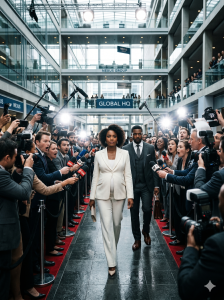
For illustrative purposes only
A cold fear tightened in my stomach. “What did they say?”
Chloe scrolled and read, her voice sharpening with disgust. “TransGlobal Airlines is aware of the video circulating on social media regarding Flight 408 out of Seattle. We are committed to a safe environment for all passengers and staff. Preliminary reports indicate the passenger became verbally abusive and exhibited signs of intoxication, prompting gate staff to request security assistance. We are fully cooperating with the Port Authority’s investigation into the passenger’s conduct.”
I stared at the ceiling, my vision blurring at the edges. They were escalating. They had nearly killed my child, stolen my chance to say goodbye to my father, and now they were reshaping me into an unstable, intoxicated aggressor to protect their bottom line. They believed they could bury me. They believed I was just another anonymous, powerless statistic they could sweep under corporate silence.
A sudden, sharp knock on my hospital room door cut through the stillness.
Before Chloe could respond, the door swung open.
A man entered. He looked completely out of place in the sterile hospital environment. Mid-fifties, tall and imposing, with thick silver hair swept back from a sharply defined face. He wore a tailored charcoal-gray Tom Ford suit that likely cost more than my car, and carried a worn antique leather briefcase that looked like it had survived years of war.
This was Arthur Sterling.
For twenty years, Arthur had been the apex predator of corporate defense law. He was the man Big Pharma, Big Tech, and major airlines called when disasters needed burying—when toxic spills, fatal defects, or systemic negligence threatened exposure. He was brilliant, ruthless, and entirely without moral hesitation—until his own daughter, disgusted by the source of her Ivy League tuition, changed her last name and cut him out of her life. That loss broke something in him. Three years ago, he left his elite firm, switched sides, and became a plaintiff’s attorney. He was now a man seeking redemption armed with intimate knowledge of how corporations destroyed people, because he had once helped them do it.
Arthur looked at Chloe. “I need you to leave the room, please, nurse. Doctor-patient privilege applies, but attorney-client privilege is absolute.”
Chloe stiffened. “Who the hell are you? She’s not supposed to have visitors.”
Arthur didn’t react. He reached into his jacket, pulled out a heavy embossed business card, and handed it over. “My name is Arthur Sterling. And as of sixty seconds ago, I am Ms. Harrison’s legal counsel. Now please. Give us the room.”
Chloe examined the card, then looked at me. I gave a small nod. She left quietly, the door clicking shut behind her.
Arthur remained standing at the foot of my bed. No comfort. No small talk. Only focus.
“Maya,” Arthur said, his voice a deep, gravelly baritone that filled the room. “I am very sorry about your father. And I am very sorry about what happened to you yesterday.”
“Did you see the video?” I asked, barely audible.
“I saw the video,” Arthur said, setting his briefcase onto the chair. “And I saw TransGlobal’s pathetic press release. They are assuming you are afraid. They are assuming you lack the resources to fight them. They have a two-billion-dollar war chest and attorneys prepared to drag you through depositions, subpoena your medical history, and frame you as unstable and aggressive.”
A cold sweat formed along my neck. “Can they do that?”
“They will try,” Arthur replied, stepping closer. “Right now, in Atlanta, twelve executives are running calculations. They are deciding how much it costs to make you disappear quietly. They will offer you a hundred thousand dollars and lifetime flight vouchers tied to a strict NDA. They expect you to accept it.”
He rested his hands on the rail of my bed, locking eyes with me.
“I used to sit in those rooms, Maya. I know how they think. They don’t see people. They see liabilities. Problems to neutralize.”
“I don’t want their money,” I said, anger rising through the fear. “I want them to admit it. I want Claire fired. I want that officer held accountable. I want an apology.”
Arthur shook his head slowly. “Corporations don’t apologize. They can’t. They don’t feel remorse. The only language they understand is financial damage.”
He placed a sleek silver pen and a thick legal document on the tray across my lap.
“We are not asking for an apology,” Arthur said quietly, intensity sharpening his voice. “We are filing for intentional infliction of emotional distress, assault, battery, civil rights violations, and gross negligence.”
I looked down at the papers. “For how much?”
Arthur Sterling smiled—cold, precise, final.
“Five hundred million dollars,” he said. “We take this to the public stage. But understand this, Maya. If you sign, it becomes war. They will attack your credibility, your family, everything around you. It will be the hardest fight of your life.”
His eyes shifted briefly to the fetal monitor beside me, still tracking my daughter’s heartbeat.
“Are you ready to make them bleed?” Arthur asked.
I thought of my father in a casket in Chicago. I thought of the zip-ties cutting into my wrists. I thought of Claire’s voice telling me to learn my place.
I picked up the pen.
“Where do I sign?” I asked.
Chapter 3
The executive boardroom of TransGlobal Airlines occupied the entire forty-second floor of a glass skyscraper in downtown Atlanta. It was built to impress—and to intimidate. Rare mahogany lined the walls, floor-to-ceiling windows overlooked the city like a controlled empire, and a single slab of Italian marble formed the conference table. It was a room where billions shifted hands, where policy was shaped in silence, and where human consequences were reduced to line items.
At 8:00 AM Monday, the room was tense enough to feel sealed shut.
Richard Caldwell, CEO of TransGlobal, stood at the head of the table, staring out at the skyline. Sixty-two, silver-haired, and composed like a man carved for magazine covers, he had built his reputation on ruthless efficiency. He did not believe in sentiment. People were data. Employees were costs. Customers were variables.
And right now, the variables were collapsing.
Twelve executives sat around the table. The CFO was visibly sweating. Legal was scrolling furiously through reports. But Richard’s attention was fixed on one person: Victoria Hayes, Vice President of Crisis Management.
Victoria was forty-four, immaculate in a cream Armani suit, dark hair cut into a severe bob. A single mother who worked eighty-hour weeks, she had risen by being colder and sharper than anyone who tried to stop her. She didn’t manage crises. She eliminated them.
“The stock opened down twelve percent,” Richard said, voice low and controlled. “That’s four billion dollars gone in a weekend.”
“The social metrics are catastrophic,” Victoria replied evenly, sliding a dossier across the table. “#BoycottTransGlobal is number one in forty countries. The NAACP has requested a federal investigation. Two major corporate partners have suspended contracts. And thirty minutes ago, Arthur Sterling filed in federal court.”
Richard turned slowly. “Sterling. Arthur Sterling is representing her?”
“Yes,” legal confirmed. “Five hundred million in damages. Jury trial.”
Silence spread through the room. Everyone knew Sterling. Once the most feared corporate defense attorney in aviation litigation, he now stood on the opposite side—and that made him dangerous in a different way.
“He’s posturing,” Richard said, lowering himself into his chair.
“I don’t think so,” Victoria replied. “He has the video. He has narrative control. Pregnant victim. Racial profiling allegations. If this reaches a Seattle jury, we don’t just lose money—we lose the brand.”
Richard leaned forward. “So what’s the move?”
Victoria opened the dossier. TransGlobal’s private investigators had already torn through Maya Harrison’s life—financials, digital history, personal records.
“We cannot defend this,” she said flatly. “Any apology is an admission. Any admission becomes liability. Sterling uses it to accelerate settlement pressure and regulatory scrutiny.”
She paused, scanning the room.
“We go on offense,” Victoria continued. “We change how the public sees her. We introduce doubt. Not about the event—but about her.”
Richard’s gaze sharpened. “How?”
“By weaponizing her past,” Victoria replied, flipping to a marked page in the dossier. “Maya Harrison is twenty-eight. She works as a mid-level project manager at a logistics firm in Chicago. By all objective measures, she is a model citizen. No criminal record, excellent credit, college educated. But no one is flawless.”
Victoria tapped a photograph on the page. It was a low-resolution, enlarged scan of an old police report from six years prior.
“When Maya was twenty-two, still in college, she was involved in a dispute with a landlord over an unreturned security deposit,” Victoria explained. “Police were called to the apartment complex. No arrests, no charges. The report simply notes that all parties were ‘highly agitated and requested to disperse.’ Additionally, three years ago, she had a minor disagreement at the DMV regarding a suspended license tied to an unpaid parking ticket. Again, no arrest, but a clerk documented her as ‘verbally combative.’”
The CFO frowned. “Victoria, that’s insignificant. That’s everyday life. Most people have argued with a landlord or a DMV clerk.”
“It doesn’t matter what it is,” Victoria replied, her tone sharpening. “It matters how we shape it. We leak these incidents through sympathetic, sensational media channels. We never call her a criminal. We use precise coded phrasing. We describe her as ‘historically erratic.’ We suggest a ‘documented pattern of volatility in high-stress environments.’ We construct an image of an unpredictable woman who weaponizes identity when she doesn’t get her way.”
The room fell silent. It was a calculated, deeply cynical strategy. One that leaned into the most entrenched racial bias in the country—the “Angry Black Woman” stereotype—and turned it into a corporate tool.
Victoria did not see herself as cruel. She rationalized it as protection for forty thousand employees. She told herself this was strategy, not morality. That Maya Harrison had simply become collateral in a larger system.
“What about the gate agent?” Richard asked, shifting in his seat but not objecting. “And the security officer?”
“Claire Miller and Thomas Vance,” Victoria said, closing the dossier. “We separate them from the narrative. Claire is placed on unpaid administrative leave pending an internal investigation. We issue a statement reaffirming zero tolerance for misconduct, while emphasizing she felt threatened. She becomes a controlled scapegoat, if necessary—but we maintain that Maya Harrison was the aggressor.”
Richard scanned the table. He saw hesitation, not resistance. Complicity filled the room more easily than courage.
“Execute it,” Richard said finally, voice flat and decisive. “Flood every channel. Drown her. Make Arthur Sterling regret ever taking this case.”
Two thousand miles away, in a luxury suite at the Four Seasons in downtown Seattle, I sat on the edge of a king-sized bed, staring at the faint glow of a MacBook Pro.
The room had been arranged by Arthur. He insisted I not return to Chicago. “The press is already outside your life,” he had said. “They will follow you until you break. Stay put until you’re medically cleared.”
I had been discharged from Seattle General twenty-four hours earlier. The doctors stabilized the fetal heartbeat and stopped the contractions, but my body felt wrecked—ribs aching, wrists wrapped in gauze over deep purple bruises, my spine throbbing with dull pain.
None of it compared to what was inside me.
On the laptop screen was a Zoom call—grainy, unstable, broadcast from a small church on Chicago’s South Side.
I was watching my father’s funeral.
My aunt held an iPad in the pews, trying to keep the feed steady. I saw the polished casket lined with white lilies. I heard the choir sing “Amazing Grace,” the sound breaking and stuttering through weak connection. I saw familiar faces—family, neighbors, people who had known him all my life.
I wasn’t there.
Not to hold his hand. Not to speak about him. Not to stand beside his casket and say goodbye. Not to place earth on his grave.
I was in a hotel room, trapped between a viral video and a corporate machine.
Tears slid silently down my face, dropping onto the keyboard. My hand rested on my swollen belly, feeling my daughter move gently beneath my palm.
“I’m so sorry, Daddy,” I whispered to the empty room, voice breaking. “I tried. I really tried to get there.”
The Zoom image suddenly froze. The casket pixelated, the audio collapsed into distortion, then cut out entirely. The screen went black.
Your host has ended the meeting.
It was over. He was gone.
A firm knock at the door startled me. I quickly wiped my face with my sleeve and shut the laptop.
“Just a minute,” I called, voice thick and uneven. I crossed the room slowly, pain flaring through my back, and checked the peephole before unlocking the door.
Arthur Sterling entered without hesitation, carrying his worn leather briefcase and two black coffees. He looked unchanged from the hospital—perfect suit, sharp gaze, controlled intensity.
“How are you holding up?” Arthur asked, setting the coffees down. No softness. No pretense. Just precision.
“I just watched them bury my father on a screen,” I said bitterly, turning toward the window and the gray Seattle skyline. “How do you think I’m holding up, Arthur?”
A brief flicker of empathy crossed his face—quick, restrained, buried.
“I’m sorry, Maya,” he said quietly. “But I need you focused. Grieving will have to wait. They’ve already started their counteroffensive.”
I turned back. “What do you mean?”
Arthur opened his briefcase and removed a stack of printed articles, dropping them onto the bed.
“TransGlobal’s PR team is feeding opposition research to aggressive outlets,” he said. “An hour ago, The National Observer ran a front-page attack. They found an old landlord dispute from when you were twenty-two. A DMV complaint. They’re using words like ‘combative,’ ‘erratic,’ and ‘pattern of aggression.’”
My stomach dropped as I picked up one of the pages. The headline screamed at me: VIRAL VICTIM OR AGGRESSOR? NEW DOCUMENTS REVEAL MAYA HARRISON’S HISTORY OF VOLATILE BEHAVIOR.
“That’s not true,” I said quickly, breath tightening. “My landlord refused to fix black mold. The DMV tried to charge me a fee I already paid. I wasn’t violent. I just stood my ground.”
“It doesn’t matter what happened,” Arthur said firmly. “It matters what they can make people believe happened. They’re reframing the video. They want the public to see an angry, unstable woman who provoked overwhelmed employees.”
“They’re gaslighting the entire country,” I whispered, letting the paper fall. “They’re turning me into a monster.”
“And it won’t stop,” Arthur said, pacing. “Their lead counsel is Preston Cole. He’s a mercenary. This morning, he filed to subpoena your entire medical history—from childhood records to your OB-GYN.”
My breath caught. I instinctively wrapped my arms around my stomach. “Why would they need that? What does my medical history have to do with what they did to me?”
“By weaponizing her past,” Victoria replied, flipping to a flagged page in the dossier. “Maya Harrison is twenty-eight. She works as a mid-level project manager at a logistics firm in Chicago. By all measurable standards, she is a model citizen—no criminal record, excellent credit, college educated. But perfection is not required. Only perception.”
Victoria tapped a grainy, enlarged scan of an old police report from six years earlier.
“When Maya was twenty-two, still in college, she was involved in a dispute with her landlord over an unreturned security deposit,” Victoria continued. “Police were called to the apartment complex. No arrests, no charges. The report only notes that all parties were ‘highly agitated and requested to disperse.’ Additionally, three years ago, she had a minor issue at the DMV involving a suspended license tied to a parking ticket. Again, no arrest—just a clerk noting she was ‘verbally combative.’”
The CFO frowned. “Victoria, that’s nothing. That’s everyday life. Most people have argued with a landlord or a clerk.”
“It doesn’t matter what it is,” Victoria said, voice sharpening. “It matters how we frame it. We leak these incidents through selective media channels. We never call her criminal. We use controlled language. ‘Historically erratic.’ ‘Pattern of volatility under stress.’ We construct an image of unpredictability, of escalation, of someone who turns situations into conflict.”
Silence settled over the table. It was a cold, deliberate strategy—built not on facts, but on framing. It leaned directly into the most deeply embedded stereotypes in the country and repurposed them as corporate defense.
Victoria did not think of it as cruelty. She thought of it as containment. Forty thousand employees. A balance sheet. A system to protect. Maya Harrison, in her mind, was an unfortunate variable inside it.
“What about the gate agent?” Richard asked, shifting slightly but not objecting. “And the security officer?”
“Claire Miller and Thomas Vance,” Victoria said, closing the file. “We isolate them. Claire is placed on unpaid administrative leave pending a formal internal review. We issue a statement reaffirming zero tolerance, while emphasizing she felt threatened. She becomes a controlled scapegoat if necessary, but we maintain that Maya Harrison was the aggressor.”
Richard scanned the room. No one challenged it. Only silence, and agreement without words.
“Execute it,” Richard said at last. “Flood every channel. Drown her. Make Arthur Sterling regret ever taking this case.”
Two thousand miles away, in a luxury suite at the Four Seasons in downtown Seattle, I sat on the edge of a king-sized bed, staring at a glowing MacBook screen.
The room had been arranged by Arthur. He had insisted I not return to Chicago. “The press is outside your building,” he had told me. “They will not stop. Stay here until you are cleared to travel.”
I had been discharged from Seattle General twenty-four hours earlier. The doctors had stabilized the baby’s heartbeat and stopped the contractions, but my body felt shattered—bruised wrists under gauze, aching ribs, a constant pull of pain through my spine.
None of it compared to what I was watching.
On the screen was a Zoom call, unstable and pixelated, streaming from a small church on Chicago’s South Side.
I was watching my father’s funeral.
My aunt held a phone in the pews, trying to keep the camera steady. I saw the polished casket lined with white lilies. I heard the choir through broken audio, fragments of “Amazing Grace” slipping in and out of signal. I saw familiar backs of heads—family, neighbors, people who had known him longer than I had known myself.
I wasn’t there.
Not to hold his hand. Not to speak. Not to stand at his grave. Not to say goodbye.
I was in a hotel room, suspended between a viral video and a corporate machine.
Tears slid silently down my face, falling onto the keyboard. My hand rested on my swollen belly, feeling my daughter move gently beneath my palm.
“I’m so sorry, Daddy,” I whispered to the empty room, voice breaking. “I tried. I really tried to get there.”
The screen froze. The casket pixelated, the audio collapsed into static, then cut out entirely.
Your host has ended the meeting.
It was over. He was gone.
A sharp knock at the hotel door made me flinch. I quickly wiped my face and shut the laptop.
“Just a minute,” I called, voice thick. I crossed the room slowly, pain flashing through my back, and checked the peephole before unlocking the door.
Arthur Sterling entered without hesitation, carrying his worn briefcase and two black coffees. He looked exactly as he had before—controlled, precise, relentless.
“How are you holding up?” Arthur asked, setting the coffees down. No softness. No delay.
“I just watched them bury my father on a screen,” I said bitterly, turning toward the window and the gray Seattle skyline. “How do you think I’m holding up, Arthur?”
A flicker of something human crossed his face, then vanished.
“I’m sorry, Maya,” he said quietly. “But you need focus now. Grief will have to wait. They’ve launched their counteroffensive.”
I turned sharply. “What do you mean?”
Arthur opened his briefcase and dropped a stack of printed articles onto the bed.
“TransGlobal’s PR team is feeding opposition research to aggressive outlets,” he said. “An hour ago, The National Observer ran a front-page attack piece. They dug up a landlord dispute from when you were twenty-two. A DMV complaint. They’re using words like ‘combative,’ ‘erratic,’ and ‘pattern of aggression.’”
My stomach dropped as I picked up the paper. The headline hit like a punch: VIRAL VICTIM OR AGGRESSOR? NEW DOCUMENTS REVEAL MAYA HARRISON’S HISTORY OF VOLATILE BEHAVIOR.
“That’s not true,” I said quickly. “My landlord refused to fix black mold. The DMV tried to charge me a fee I already paid. I wasn’t violent. I just stood up for myself.”
“It doesn’t matter,” Arthur said firmly. “It only matters what they can make people believe. They’re reframing the video. They want the public to see an angry, unstable woman who provoked overwhelmed employees.”
“They’re gaslighting the entire country,” I whispered, letting the paper fall. “They’re turning me into a monster.”
“And it will continue,” Arthur said, pacing. “Their lead counsel is Preston Cole. He’s a mercenary. This morning, he filed a motion to subpoena your entire medical history—from childhood records to your OB-GYN.”
My breath caught. I instinctively wrapped my arms around my stomach. “Why would they need that? What does my medical history have to do with what they did to me?”
“Because,” Arthur stopped and looked me dead in the eye, “they are going to try to prove that your premature contractions and fetal distress were not caused by Officer Vance slamming you against a podium. They are going to search for any pre-existing condition, any minor fluctuation in your blood pressure during your first trimester, to argue that your pregnancy was already high-risk and their actions had zero medical impact.”
I felt nauseous. The sheer, calculated cruelty of it was staggering. They were willing to dissect my body, my history, my pregnancy—anything—just to protect their numbers.
“Can they do that?” I asked, voice shaking with anger. “Can a judge actually allow that?”
“I will fight the subpoena, and I will likely win,” Arthur said, eyes sharp with focus. “But understand the psychological strategy. They want you exhausted. They want you afraid. They want you to accept a settlement. By the end of the week, they will offer a large sum in exchange for a nondisclosure agreement and a partial admission of fault.”
He stepped closer. “So I need to ask you again, Maya. Right now. Do you take the money and disappear? Or do you destroy them?”
I looked down at my bruised wrists. I remembered the metal podium. Claire’s voice. Learn your place.
And something in me hardened.
“I don’t want their money,” I said quietly. Then steadier. “I want to break them. I want to burn them to the ground.”
Arthur Sterling smiled—sharp, predatory.
“Good,” he said. “Because tomorrow we start depositions. And I am going to gut them.”
The conference room at the Seattle federal courthouse was nothing like Atlanta’s glass tower. Small. Windowless. Lit by a buzzing fluorescent strip. The smell of cheap cleaner hung in the air.
Officer Thomas Vance sat at the table.
He looked hollowed out. No posture, no presence. Just a man folded in on himself, staring at a scratch in the wood as if it could save him. His dress uniform hung slightly loose, as though he had lost weight he couldn’t afford to lose.
Across from him, I sat in a black maternity dress, trying to hold myself together. Arthur sat beside me, calm and unreadable.
Preston Cole sat next to Vance, already composed, already prepared.
“State your name,” Arthur said.
“Thomas Edward Vance,” he answered.
And the room began to close in.
“So you destroyed her life to save your own,” Arthur said, his voice dropping into a whisper that carried more force than any shout.
Claire shook her head rapidly, tears spilling now in uncontrolled streams. “No—no, I didn’t destroy anything. I just did what I was told. The system flagged her. Operations was pushing me. I was under pressure from every direction—”
“From a system that you activated,” Arthur cut in sharply, not raising his voice, which somehow made it worse. “From a decision tree you executed. From a process you chose to follow instead of stopping.”
Preston Cole finally stood. “This is turning into a character assassination, not a deposition,” he snapped. “My client is not responsible for airline algorithms or backend operations—”
Arthur turned on him instantly. “Your client entered false information into a federal passenger security system to justify the removal of a ticketed First Class passenger,” he said coldly. “That is not interpretation. That is action.”
Claire let out a broken sound, somewhere between a gasp and a sob. Her composure collapsed completely now. “I didn’t think it would go this far,” she whispered. “I didn’t think they’d actually—touch her. I thought she’d just move. I thought she’d take the voucher like everyone else does.”
Arthur took a step closer to the table again, quieter now, but more dangerous than before. “You thought she would be easy.”
Claire flinched as if she had been struck.
Arthur didn’t stop. “You saw a pregnant woman traveling alone and you decided she was disposable. Not because of evidence. Not because of safety. Because your system told you she was statistically least likely to resist.”
Claire shook her head weakly, almost childlike now. “I didn’t design it. I didn’t build it. I just—used it.”
“And you used it on her,” Arthur said.
Silence pressed down hard on the room. Even the court reporter had stopped typing for a moment.
Claire’s breathing turned shallow and uneven. “I didn’t mean for her to get hurt,” she said, voice cracking completely. “I swear, I didn’t mean that. I didn’t know he would slam her like that. I didn’t know she’d be bleeding. I just needed the seat cleared. I just needed to fix the overbooking. I was trying to keep the flight moving.”
Arthur studied her for a long moment, expression unreadable.
“That,” he said finally, “is not a defense.”
He stepped back, straightening his suit jacket with calm precision.
“You’ve confirmed under oath that you entered a false reason into a federal aviation system,” Arthur continued. “You’ve confirmed you initiated removal of a First Class passenger without lawful grounds. And you’ve confirmed you relied on an internal algorithm that disproportionately selects vulnerable passengers for involuntary bumping.”
Claire’s mouth opened, but no sound came out this time.
Arthur closed the binder slowly. “No further questions.”
The room stayed frozen even after he sat down. The air felt thinner, like something essential had been removed and nobody knew how to replace it.
Claire stared straight ahead, tears still falling silently, her entire professional identity collapsing in real time.
And for the first time since this began, it was no longer just my story versus theirs.
It was all of it—laid bare, recorded, and impossible to take back.
She slid the manila envelope across the table, stopping it directly in front of me.
“Inside this envelope is a legally binding settlement offer, drafted and signed by Richard Caldwell himself an hour ago,” Victoria said, her eyes fixed on mine. “It bypasses Arthur Sterling entirely. It is an offer of two hundred and fifty million dollars, tax-free. One hundred million will be placed into an offshore trust fund under your daughter’s name, accessible the day she turns eighteen. The remainder will be deposited into a private account for you. In addition, Claire Miller will be terminated immediately, without severance.”
The number hung in the air between us like something unreal, too large to feel fully real in a room that quiet. Victoria didn’t blink. She was watching me the way people watch for a fracture in glass.
I didn’t touch the envelope.
My hand stayed resting over my stomach, as if the paper itself might carry something that could reach through and harm my daughter. The reading room around us felt suddenly distant—muted footsteps, turning pages, the faint hum of the city pressed against glass.
“You’re trying to buy silence,” I said, my voice low and steady, though something underneath it was shaking. “After everything.”
Victoria didn’t deny it. She leaned in slightly, lowering her voice even further.
“I’m trying to stop this from becoming a total collapse,” she said. “Not just for the company. For you, too.”
I let out a quiet, humorless breath. “For me.”
“Yes,” she said quickly, almost eagerly. “You think you want war, Maya. But war doesn’t end when you win a court ruling. It follows you. It attaches to your child. It becomes your identity. I’ve seen it happen too many times.”
Her fingers tightened slightly on the table edge. For the first time, the composure cracked just enough to show fatigue underneath it.
“You have leverage now,” Victoria continued. “More than you’ll ever have again. Take it. Build a life your daughter can actually live in. Not one built inside a courtroom.”
I finally looked down at the envelope.
White. Heavy. Expensive in a way that wasn’t visible, but felt structural—like it had been engineered to reshape decisions.
I thought about Claire Miller’s face. About the podium. About the zip-ties cutting into my wrists. About the algorithm that decided I was disposable. I thought about my father’s funeral, frozen on a screen I never made it to.
Then I looked back at Victoria.
“And if I don’t?” I asked.
Victoria held my gaze for a long moment. When she answered, her voice was quieter.
“Then Arthur Sterling burns everything to the ground,” she said. “And he takes you with it—whether he means to or not.”
The words landed cleanly, without drama. That was what made them feel real.
I kept my hand on my stomach.
Outside the glass walls, Seattle stayed gray and indifferent, as if none of this was happening at all.
On the iPad screen, Richard Caldwell stepped up to the podium. The cameras erupted in a blinding cascade of flashes. The room fell into a sudden, expectant silence.
Caldwell adjusted the microphone with deliberate calm, scanning the sea of journalists as if he were still in control of what came next.
“Good morning,” he began, his voice steady, rehearsed, carefully softened for public consumption. “I want to address the events involving Flight 408 out of Seattle and the disturbing footage that has circulated over the past several days.”
Behind him, Victoria Hayes stood rigid, her expression locked in professional neutrality, though her eyes betrayed something tighter—calculation under strain.
Arthur leaned slightly closer to me in the back of the SUV, his voice low. “This is it,” he muttered. “He’s opening the narrative.”
On screen, Caldwell continued.
“First and foremost,” he said, “TransGlobal Airlines takes full responsibility for ensuring the safety and dignity of all passengers. What occurred at Gate D14 was a failure of internal communication and judgment at multiple levels.”
I felt my stomach tighten.
A failure of judgment. Not an assault. Not an algorithm. A failure of judgment.
Caldwell paused, letting the phrasing settle like a controlled release of pressure.
“We have terminated the employee directly involved in the gate-level incident,” he continued. “We are conducting a comprehensive internal review of our procedures, and we are fully cooperating with all relevant authorities.”
A murmur spread through the press corps. Cameras zoomed tighter.
Arthur’s jaw tightened beside me. “He’s cutting her loose,” he said quietly. “And insulating the system.”
On screen, Caldwell lowered his gaze slightly, shifting into what looked like remorse.
“Most importantly,” he said, “we extend our deepest apologies to Ms. Maya Harrison for the distress she experienced. While preliminary findings indicate a misinterpretation of passenger behavior during a high-pressure operational situation, we recognize the impact this event has had on her and her family.”
My grip tightened around my phone.
Misinterpretation.
High-pressure operational situation.
The language was surgical. Clean. Designed to erase intent.
Arthur exhaled through his nose, already moving on to strategy. “He’s trying to close liability without admitting structure,” he said. “They’re prepping the shield.”
On screen, Caldwell straightened.
“We want to be clear,” he added, “that TransGlobal Airlines categorically denies any systemic misconduct or algorithmic bias in our operations. Any suggestion to the contrary is factually incorrect.”
That was the line.
Arthur smiled faintly, almost imperceptibly. “There it is,” he whispered. “He just called it a myth.”
I looked at the screen, my pulse steadying into something colder than fear.
Caldwell was finishing now, thanking employees, reassuring shareholders, promising reform without consequence.
But I wasn’t listening anymore.
I was watching the room behind him.
Victoria Hayes had shifted ever so slightly, her hand tightening around the edge of the podium.
And for the first time since this began, I realized something simple and absolute:
They thought this press conference was the end of their story.
But Arthur was already typing.
And I was already standing up.
“Good morning,” Caldwell’s deep, resonant voice carried through the speakers. “I address you today with a heavy heart. Over the past three weeks, TransGlobal Airlines has been the subject of intense public scrutiny regarding an incident that occurred at Seattle-Tacoma International Airport involving one of our passengers, Ms. Maya Harrison.”
Caldwell paused, lowering his gaze to the prepared notes, his face arranged into an expression of deep sorrow. It was a performance worthy of an award.
“What happened to Ms. Harrison was unacceptable,” Caldwell went on, his voice saturated with manufactured emotion. “It violated our core values. Following a swift and comprehensive internal investigation, I can announce today that the gate agent involved, Claire Miller, has been terminated, effective immediately. Furthermore, we have severed all contracts with the private security firm responsible for the officer’s excessive use of force.”
Arthur sneered at the screen. “Throwing the pawns to the wolves to save the king.”
“We have also uncovered a deeply troubling issue within our automated booking software,” Caldwell continued, shifting into the most crucial portion of his address. “A rogue coding error, introduced by a former third-party contractor, inadvertently prioritized certain demographic profiles during overbooking scenarios. This was a catastrophic failure of oversight, but let me be absolutely clear: this was a glitch, not a policy. TransGlobal does not, and never will, tolerate discrimination in any form.”
“Now,” Arthur said quietly, setting his phones down.
On the iPad, the journalists inside the atrium began glancing at their devices. A wave of confusion moved through the crowd. The New York Times notification had just landed.
EXCLUSIVE: LEAKED SOURCE CODE REVEALS AIRLINE ALGORITHM INTENTIONALLY TARGETED MINORITIES FOR INVOLUNTARY BUMPING.
Caldwell noticed the change in energy. He hesitated, his eyes flicking toward Victoria Hayes, who was staring at her phone with unmistakable panic.
“Let’s go,” Arthur said, opening the SUV door.
We moved through the rear corridors of the headquarters, escorted by two large private security guards Arthur had hired. We bypassed security checkpoints and headed straight for the main atrium. The growing chaos of the press conference was audible even before we reached the doors.
Journalists were shouting over one another, phones raised high.
“Mr. Caldwell! The Times just published internal emails proving you personally signed off on the ‘Path of Least Resistance’ algorithm!”
“Mr. Caldwell, is it true the software was designed to target Black women because your data showed they were less likely to sue?”
Caldwell clutched the podium, his face flushed a deep red, the polished executive mask completely gone. “Those documents are stolen and taken entirely out of context! We are a diverse company! We…”
He stopped abruptly.
The double doors at the back of the atrium burst open.
Cameras snapped toward the movement almost instinctively. Reporters turned. The room fell into a stunned, breathless silence.
I walked down the central aisle of the atrium with Arthur Sterling a half-step behind me. The press parted as I advanced, eyes wide with disbelief. The white maternity suit glowed under the harsh lighting. I didn’t look at the cameras. My focus stayed locked on Richard Caldwell.
Caldwell looked as though he had seen a ghost. He physically stepped back from the podium.
I climbed the short set of stairs to the stage. Victoria Hayes looked close to collapse. The Head of Legal Affairs was already retreating.
I stepped behind the podium without asking. I simply pulled the microphone down to my level.
I faced the blinding lights, the wall of cameras broadcasting everything worldwide, then turned directly toward Richard Caldwell.
“My name is Maya Harrison,” I said, my voice carrying through the marble atrium, steady and clear, stripped of all fear. “I am not a glitch. I am not a coding error. I am a human being. And I am a mother.”
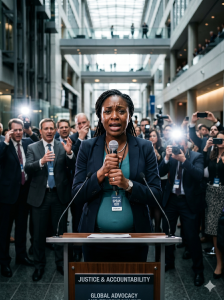
For illustrative purposes only
The silence was total. Only the rapid clicks of cameras filled the air.
“For three weeks, this corporation has tried to destroy my life,” I continued, each word measured and deliberate, striking like physical force. “They assaulted me. They nearly killed my unborn child. They kept me from burying my father. And then, they paid PR firms to dig into my past, trying to convince the world that I was an angry, violent Black woman who deserved to be abused.”
I reached into my pocket and pulled out my iPhone.
“Yesterday afternoon, Victoria Hayes, the Vice President of Crisis Management standing right behind me, begged me to meet her in secret,” I said, causing a visible wave of shock through the press. “She slid an envelope across a table and offered me two hundred and fifty million dollars to sign a non-disclosure agreement. She offered me generational wealth to stay quiet, to fire my lawyer, and to let Richard Caldwell stand up here today and lie to the American public about a ‘rogue coding error.’”
I turned my head toward Victoria. She was openly crying now, her face hidden in her hands.
“But I did not take their blood money,” I said, facing the cameras again, my voice rising with strength. “Because if I took that money, I would be telling them that their algorithm was right. Their algorithm, ‘The Path of Least Resistance,’ calculated that because I am a Black woman, because I was traveling alone, I was weak. It calculated that I would not fight back.”
I gripped the podium tightly.
“They calculated wrong.”
The atrium exploded into chaos. Journalists shouted questions over one another, the sound overwhelming. Cameras flashed in relentless bursts.
I didn’t respond. I didn’t need to. The damage was done.
Arthur stepped beside me, his hand firm on my shoulder. He delivered the final legal strike.
“Twenty minutes ago,” Arthur announced, his voice cutting through the noise, “I filed a formal petition with the United States Department of Justice, providing them with the complete, unredacted source code of TransGlobal’s discriminatory algorithm, along with sworn depositions proving executive complicity. We are no longer seeking a financial settlement. We are seeking federal indictments for criminal fraud and civil rights conspiracy against Richard Caldwell and the entire executive board.”
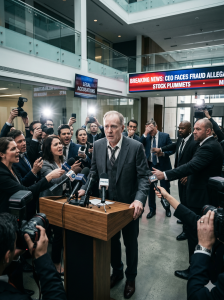
For illustrative purposes only
Caldwell grabbed his counsel’s arm, his face drained of all color, as if the life had been pulled from him. Security rushed the stage to escort executives away, but journalists surged forward, blocking exits, shouting questions like gunfire.
Arthur guided me gently down the stairs, shielding me as we moved through the press. We exited the way we had come, leaving the collapsing corporate spectacle behind.
Outside, the Atlanta air felt heavy and warm. I looked up. The gray clouds that had followed me for weeks were finally breaking apart, a shaft of sunlight cutting through.
My hand rested on my belly. The baby was still now. Calm.
We did it, Daddy, I thought, tears of exhaustion and relief sliding down my face. We stood our ground.
EIGHT MONTHS LATER
The grass at Oak Woods Cemetery on Chicago’s South Side was bright green, freshly revived after winter. The air carried a cool spring crispness and the scent of damp soil and blooming trees.
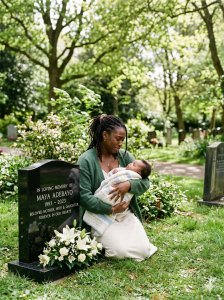
For illustrative purposes only
I knelt beside the polished black granite headstone. It read: Joseph Harrison. Beloved Father. A Man of Unyielding Strength.
I placed a bouquet of white lilies at its base.
“Hey, Daddy,” I whispered, running my fingers over the engraved letters. “I’m sorry it took me so long to come see you. It’s been a crazy year.”
I settled back on my heels, adjusting the blanket wrapped around the small bundle in my arms.
“But I didn’t come alone,” I smiled softly, a real, full smile.
I pulled the blanket back slightly, revealing a tiny face. Dark curls, round cheeks, and bright, determined eyes. She stared upward at the moving branches above.
“Daddy,” I said gently, voice breaking with emotion. “I want you to meet your granddaughter. Josephine.”
Josephine made a soft coo, waving a small fist in the air.
So much had changed in eight months. Everything had shifted.
The DOJ investigation into TransGlobal Airlines moved quickly and with force. Faced with overwhelming pressure and potential prison sentences, lower executives turned on leadership. Richard Caldwell was indicted on twenty-two counts including wire fraud, conspiracy, and civil rights violations. He awaited trial, stripped of power and legacy. Victoria Hayes accepted a plea deal and became a cooperating witness, effectively ending her corporate career.
The airline narrowly avoided collapse, but federal regulators forced a full restructuring of leadership and imposed massive fines. Hundreds of millions were distributed in restitution to passengers who had been targeted over the years.
But the real change wasn’t financial.
Two months earlier, Congress passed the Algorithmic Transparency and Passenger Protection Act following public outrage and Senate testimony. Informally, it became known as “Maya’s Law.” It banned the use of demographic and socioeconomic data in airline systems and required strict independent audits of transportation algorithms.
I never accepted a cent of TransGlobal’s settlement. Arthur Sterling, true to his word, handled the case pro bono, later collecting fees from punitive damages awarded by the court, securing his reputation as a leading plaintiff attorney of his era.
I returned to Chicago. I returned to my apartment. I returned to my life.
But I was no longer the same. Something inside me had hardened into clarity.
I looked down at Josephine. She wrapped her tiny hand around my finger with surprising strength. In the sunlight, the faint scars on my wrist were still visible.
They were scars, but not marks of defeat. They were proof of survival.
“She’s a fighter, Daddy,” I whispered, wiping away a tear. “Just like you.”
The wind moved through the trees, soft and steady, like a quiet answer.
I lifted Josephine into my arms, holding her close, and stood. I looked once more at the headstone, a deep sense of peace settling over me.
It was over. The nightmare had ended.
And for the first time in a long time, I was ready for whatever came next.
END
