


I tasted copper as my back slammed against the cold, unyielding marble floor of Le Petit Chêne.
I was eight months pregnant. My lower back pulsed with pain, and a sudden wave of dizziness had forced me into the nearest velvet chair in the restaurant’s waiting lounge. I wore a plain, modest maternity dress. No designer labels, no diamonds. In a place scented with old money and truffle oil, I was nearly invisible.
Until Beatrice Kensington entered.
She looked as though she had been sealed into Chanel. Cradling a trembling Pomeranian in one arm and a Birkin bag in the other, she glared at me from behind oversized sunglasses. She demanded I move because she preferred my corner for its “lighting.” When I calmly explained I was heavily pregnant and unwell, she scoffed. She told me the service entrance was around the back, assuming I was there to apply for a kitchen job. To her, I was just a Black woman in her way—I was ‘the help.’
I didn’t move.
Before I could react, her diamond-laden hand seized the back of my chair. Driven by pure entitlement, she jerked it backward with force.
I hit the floor with a nauseating thud. A surge of unbearable pain shot up my spine and wrapped around my heavy abdomen like fire. As I curled into myself, gasping and crying out for my baby, Beatrice stood there, victorious. She brushed off her manicured hands, stepped over my trembling legs, and took the stolen seat, muttering about my “dramatics.” I felt a warm, horrifying dampness spreading beneath me on the marble.
Then, the restaurant’s heavy mahogany doors burst open.
Governor Arthur Sterling and Mayor Marcus Vance rushed in, surrounded by armed security. These were men who commanded armies and budgets. But in that moment, they looked utterly terrified.
The Governor pushed past stunned billionaires and dropped to his knees in the pooling bl**d beside me. He shouted for a trauma team, his voice breaking with raw fear. Beatrice’s smug expression vanished, replaced by stunned disbelief. She stammered, asking why the Governor was helping someone like me.
The Governor cornered her in the chair, his voice laced with venom. He leaned in and whispered a truth that shattered her reality: The pregnant woman she had just a**aulted was Maya Brooks. The CEO of the Brooks Syndicate. The woman who owned the commercial block beneath them—and the shadow bank holding the primary debt on her husband’s collapsing hedge fund.
As paramedics secured an oxygen mask over my face and the fetal monitor showed a terrifying flatline, my vision faded into darkness. But I made a silent promise. If my daughter survived, Beatrice Kensington wouldn’t just pay. She would be erased completely.
WHAT HAPPENED NEXT BROUGHT THE CITY’S ELITE TO THEIR KNEES…
PART 2: The Flatline of My Empire
The anesthesia’s darkness wasn’t restful. It was heavy, suffocating, and chillingly cold. It dragged my awareness into a void where the searing agony in my spine and the burning pain in my abdomen dulled into a terrifying numbness. Yet even there, the memory of impact lingered. I could still feel the crack of my tailbone against the marble floor of Le Petit Chêne. I could still smell Beatrice Kensington’s overpowering floral perfume—a scent my mind now marked as the warning of d*ath.
Slowly, painfully, reality began to return. Sound came first—not the chaos of an emergency room, but a slow, mechanical hiss-click, hiss-click. The sharp scent of iodine and antiseptic stung my nostrils.
I tried to swallow, but my throat felt raw, scraped and bruised from the intubation tube forced down my airway to keep my lungs working.
I blinked. Once. Twice. My heavy eyelids lifted to reveal a blurred view of beige walls and a reinforced glass window overlooking the sprawling lights of Los Angeles. The city shimmered like scattered diamonds in the night. Night. How long had I been gone?
I shifted slightly, and a blinding, searing pain tore through my lower abdomen—different from the contractions I’d felt before. This was sharp, surgical, precise. An emergency C-section.
I gasped, the sound escaping as a weak, broken wheeze. My trembling hand moved instinctively to my stomach, searching for the familiar weight that had anchored me for eight months.
My fingers met gauze. Tape.
My stomach was flat.
The life that had moved inside me just hours ago was gone.
Cold, primal panic seized me. I was Maya Brooks—a woman who controlled financial empires, who could dismantle corporations with a single call. I commanded billions. But in that bed, staring at the ceiling, I was powerless. Wealth could summon the best surgeons. It could clear traffic for emergency convoys. But it could not make a failing heart beat.
“My baby,” I rasped, my voice unrecognizable. “Where is she?”
A figure shifted in the dim room.
Governor Arthur Sterling stepped into the light. He looked exhausted—his expensive suit wrinkled, stained with my bl**d. His tie was gone, collar undone, and dark circles hung beneath his eyes.
He came to my side, his face torn between relief and sorrow.
“Maya,” he said softly, his voice thick with emotion. His hand covered mine.
“Arthur,” I pressed, forcing the words out. “Where is my daughter?”
He swallowed, glancing away for a brief second, unable to meet my eyes.
That hesitation shattered me.
“She’s alive,” he said quickly, seeing the terror in my face. “Maya, she’s alive.”
A broken breath left me. Relief hit so hard it blurred my vision. Tears spilled down my cheeks. Alive. She was alive. Hope surged through me, fragile but bright.
But then his grip tightened.
“But she’s in the Neonatal Intensive Care Unit,” he continued quietly. “Level 4.”
The hope vanished instantly, replaced by crushing dread. Level 4—the most critical level.
“It was… a catastrophic placental abruption,” he explained, voice unsteady. “The trauma from the fall… the force… it separated the placenta. She was without oxygen for several minutes. She’s very small. And she’s fighting for her life.”
Fighting for her life.
Because of a chair. Because of a woman who believed the world belonged to her. Because Beatrice Kensington saw my presence—my existence—as something beneath her.
“The doctors…” I began, my voice trembling uncontrollably. “What do they say?”
“They’re saying the next forty-eight hours are critical,” Arthur answered, his thumb gently brushing the back of my hand. “She’s on a mechanical ventilator. She can’t breathe on her own. They’ve placed her in a medically induced coma to protect her brain from the hypoxia. The best pediatric neurosurgeons in the state are monitoring her around the clock.” He hesitated, attempting a reassuring smile that didn’t quite form. “If anyone can make it through this, Maya, it’s your daughter.”
I shut my eyes, tears spilling freely, hot and fast into my hair. I pictured my tiny, fragile girl. She should have been safe inside me—shielded, protected by my warmth and heartbeat. Instead, she was surrounded by machines, fighting a battle she should never have had to face. Beatrice Kensington had torn that safety away with one violent, entitled, a**aultive pull of a velvet chair.
And in that moment, the crushing grief began to fade, quickly replaced by something else.
It was a cold, calculated, absolute rage.
Not loud or explosive. I was far beyond that. This was precise, controlled fury—the kind that didn’t just want to hurt someone, but to dismantle them piece by piece, dollar by dollar, until nothing remained but ruin, humiliation, and regret.
Beatrice Kensington thought she was putting ‘the help’ in place. She believed she was untouchable, protected by her husband’s hedge fund, her Dior wardrobe, and her elite country club circles. She believed basic decency didn’t apply to her because her Beverly Hills zip code shielded her from consequences.
She was about to learn how the real world worked when she pushed the wrong woman onto a marble floor.
“I want to see her,” I said, my voice flattening into something cold and controlled. The tears still fell, but the panic had vanished, replaced by sharp clarity.
“You can’t,” Arthur said gently, glancing at the bandages across my torso. “You just had major surgery, Maya. You lost a lot of bl**d. You need to stay flat for at least twelve hours, or you could rupture the internal stitches.”
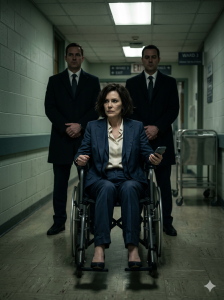
“I don’t care about the stitches, Arthur,” I snapped, my eyes opening, hard and unyielding. “Get me a wheelchair. Now.”
He studied me, recognizing the shift. He had seen that same expression across negotiation tables when billions were at stake. He didn’t argue. He nodded and stepped out to get the head nurse.
It took both Arthur and a visibly anxious nurse to lift me from the bed. The pain was blinding—sharp, overwhelming, nauseating. My legs trembled, weak and unreliable. But I bit down on my lip until I tasted copper again, refusing to make a sound, and let them lower me into the padded wheelchair.
Arthur pushed me out of the private suite and down the quiet, sterile corridors of Sinai Hospital. Two state troopers followed closely behind, their expressions unreadable, hands near their belts.
Mayor Marcus Vance stood outside the NICU doors, pacing while speaking rapidly into a secure line. He ended the call the moment he saw me approaching.
“Maya. Thank God,” Vance exhaled. “The press is swarming the hospital. We’ve locked things down, but information is leaking. They know something serious happened at Le Petit Chêne, and they’re hunting for names.”
“Let them hunt,” I replied calmly. “I have more important matters than public perception.”
Arthur pushed the doors open, and we stepped into a different world. The NICU was dimly lit, designed to mimic the womb. The air was carefully controlled. Soft mechanical breaths and steady monitor beeps filled the space. We passed rows of incubators.
Finally, Arthur stopped at a private pod in the far corner.
I looked through the clear enclosure.
My breath caught.
She was so small. So painfully small. My daughter lay surrounded by wires, tubes, and sensors. Her chest rose and fell with the help of a ventilator. Her skin was fragile, translucent brown, and a tiny knit cap covered her head.
A pulse monitor glowed red around her tiny foot, feeding data to the screen above. The line was slow.
Too slow.
My hand trembled as I pressed it against the plastic, wishing I could give her my strength, my heartbeat.
“Her name is Aria,” I whispered, tears falling again. “Aria Brooks.”
I stared at the monitor, silently pleading. Fight, my love. Fight. I’ll take care of everything else.
When I finally forced myself to look away, I turned the wheelchair toward the hallway. Arthur and the Mayor stood nearby, watching quietly.
The tears were gone. My face was still. The mother had cried. The CEO remained.
“Arthur,” I said, my voice empty of emotion.
“Yes, Maya.”
“Where is my phone?”
He retrieved my secured phone from his jacket—cleaned of the bl**d—and handed it over.
I unlocked it. Missed calls and urgent messages flooded the screen. I ignored them all and dialed a restricted number.
Two rings.
“Brooks Syndicate, Executive Office. This is Elias.”
Elias—my COO, my right hand, the most formidable corporate lawyer on the West Coast.
“Elias,” I said sharply. “It’s Maya.”
“Boss,” he replied, tension breaking through his usual composure. “We’ve heard rumors. The team is panicking. Are you—”
“I’m alive,” I cut in. “My newborn daughter is in a Level 4 NICU because of Beatrice Kensington.”
Silence.
Then, his voice returned—cold and decisive.
“Give me the order, Boss.”
I glanced at my watch. 3:15 AM. Six hours until markets opened in New York.
“Kensington Capital,” I said. “They applied for a $150 million mezzanine loan from us last week. Is it signed?”
“The paperwork is ready,” Elias answered quickly. “But you haven’t approved it. They’re entirely dependent on it. Without it, they can’t meet margin calls. They’ll default.”
I looked back at the incubator. At my daughter fighting for her life.
“Cancel it,” I said. “Deny the loan. Burn it.”
“Done,” Elias replied instantly. “Next?”
“They leveraged their Beverly Hills home and their Hamptons estate as collateral,” I continued. “Call Vanguard and Chase. Wake their CEOs if needed. Remind them who they owe. I want Kensington Capital’s credit lines frozen immediately under ‘risk reassessment.’”
Arthur and Vance stood in stunned silence, watching everything unfold.
“I want them cut off, Elias,” I said quietly. “Every source of capital gone by sunrise. I want their cards declined, their staff unpaid, their lives unraveling. I want them to feel exactly what she made me feel.”
“Consider it handled,” Elias said. “I’m initiating everything now.”
I ended the call and placed the phone in my lap. The process had begun.
I turned to the Mayor.
“Marcus,” I said, meeting his eyes.
He straightened immediately. “Yes, Maya.”
“Beatrice Kensington completely unprovoked, a**aulted a visibly pregnant woman,” I said with precision, setting the narrative. “I want her arrested immediately. Not a quiet summons from a lawyer in a tailored suit. I want her dragged out of bed. I want her walked out of her Beverly Hills mansion in handcuffs, in front of every local and national news camera in California.”
Mayor Vance gave a grim nod, fully understanding. “The District Attorney is already preparing the warrant for aggravated felony a**ault. The Beverly Hills Police tactical unit will be at her gates at exactly 6:00 AM.”
“Make sure they don’t knock politely,” I added quietly.
I leaned back into the padded wheelchair, my body finally beginning to feel the full weight of the surgery, the heavy bl**d loss, and the crash of adrenaline. The sharp, burning pain in my abdomen remained a constant reminder of the violence done to me.
But the machinery of destruction was already turning. The trap had been perfectly laid.
Beatrice Kensington believed she was untouchable. She thought she ruled her small, protected world of wealth and privilege. By sunrise, as light crept over her soon-to-be-seized estate, she would understand—with devastating clarity—that she had pulled a velvet chair out from under the wrong woman.
I slowly rolled back toward the incubator. The room was quiet except for the soft mechanical rhythm of the ventilator. But the silence felt fragile, like it could shatter at any moment.
I placed my hand against the warm plastic. Just breathe, Aria. Just keep breathing.
Then the silence broke.
It began with a single, sharp warning tone from the monitor. Then it escalated into a continuous, piercing alarm that froze my bl**d.
BEEEEEEEEEEEEEEEEEEP.
The screen, once showing a weak green rhythm, flashed violently into critical red.
At the same moment, my phone buzzed in my lap. I looked down, dread filling my chest.
A message from Elias.
Phase One Complete. The Kensington family is locked out. They have nothing.
I looked back at the monitor. The line marking my daughter’s heartbeat was falling—fast. The numbers dropped. Forty. Thirty. Twenty.
The collapse of my empire was finished, but the collapse of my world was only beginning.
PART 3: The Cost of a Crown
The piercing, continuous cry of the Code Blue alarm in the Neonatal Intensive Care Unit didn’t just fill the room—it seemed to fracture the air itself. It was a relentless, mechanical scream that vibrated through my body and struck something deep and instinctive within me.
BEEEEEEEEEEEEEEEEEEP.
At the exact moment the alarm sounded, my phone vibrated again. I looked down, my vision sharp with terror. The screen lit up my pale, tear-streaked face.
A message from Elias.
Phase One Complete. The SEC is raiding Kensington Capital now. They are officially liquidated. The family is locked out. They have nothing.
I stared at the message, and for a brief, agonizing second, reality split in two. In my lap was the undeniable triumph of Maya Brooks, the CEO. I had erased a generational empire before sunrise. I had reduced my enemies to nothing.
But when I lifted my gaze to the monitor above my daughter’s incubator, I saw the undeniable defeat of Maya Brooks, the mother.
The green, uneven line that had marked Aria’s fragile heartbeat—my focus, my hope—was gone.
In its place was a solid, merciless red line.
Flatline.
The numbers were crashing at impossible speed. Heart rate dropping past twenty. Oxygen levels falling into single digits.
“No,” I whispered, the word barely escaping. “No, no, no. Not now. I cleared everything for you. You can’t leave me now.”
I tried to rise from the wheelchair. I didn’t care about the fresh incision, the stitches, the bl**d loss. The instinct to reach her, to protect her, overpowered everything.
But my legs gave out instantly. A surge of white-hot pain tore through my body. I fell back into the chair with a heavy impact, gripping the armrests so tightly my nails nearly tore through the padding.
“Code Blue! NICU Bed 4! Pediatric trauma team to Bed 4, stat!”
A frantic voice rang out over the hospital intercom, echoing through the sterile halls beyond the pod.
Suddenly, the heavy double doors were thrown open with force. The quiet sanctuary of the NICU was instantly shattered by a surge of movement. Four neonatal nurses and two senior pediatric trauma surgeons rushed in, operating with the sharp, synchronized precision of a military unit under fire. They didn’t look at me. They didn’t acknowledge the billionaire in the wheelchair. To them, I didn’t exist. Their entire focus was on the failing, fragile patient inside the incubator.
“Move, please, clear the access points!” the lead surgeon commanded, pushing my wheelchair back to reach the incubator.
I didn’t resist. I couldn’t. I was frozen, overwhelmed by the nightmare unfolding before me.
The surgeon tore open the side access ports of the incubator without hesitation. There was no time left for gentleness.
“She’s profoundly bradycardic! Heart rate is gone. She’s in full cardiac arrest,” the lead nurse shouted, her gloved hands flying over the ventilator controls. She adjusted settings rapidly, forcing higher levels of oxygen into Aria’s failing lungs.
“Start chest compressions! The tube is secure, but we’re not getting perfusion,” the surgeon ordered, his voice tight, sweat forming beneath his cap.
I watched in horror as he placed two fingers at the center of my daughter’s chest. Her entire body was smaller than his hand. Her ribs looked impossibly delicate.
He pressed down. Hard. In rhythm.
One, two, three, four…
Each compression jolted her tiny body. It looked brutal, almost unbearable to witness. But it was the only thing keeping blood flowing to her oxygen-deprived brain.
“Push one milligram of epinephrine now! Get it into the central line!” the surgeon barked, never slowing his pace.
“Epi is in,” another nurse confirmed, injecting the medication into the IV lines attached to Aria’s arm.
“Come on, Aria,” the first nurse urged, her voice breaking slightly. “Come on, sweet girl, fight for us.”
I sat ten feet away, trapped in my own helplessness. The irony pressed down on me. I had spent my life building power—control over outcomes, over people, over entire systems. I could buy institutions. I could influence governments.
But none of it mattered here.
As my daughter’s body convulsed under those compressions, the truth became undeniable. Money meant nothing. Power meant nothing. My empire—everything I had built—could not buy a single heartbeat.
I would have traded it all. Every dollar. Every asset. I would have burned my entire empire to the ground without hesitation if it meant she could breathe, could open her eyes. The revenge I had just set in motion against Beatrice Kensington suddenly felt meaningless. What did it matter if she lost everything… if I lost my daughter? The price of my crown was unbearable.
“Vitals are still dropping. No spontaneous cardiac activity,” the second nurse reported, panic creeping into her voice. “She’s not responding to the epi.”
No. The word echoed inside me again and again. No. I destroyed everything for you. You cannot leave me now. You are a Brooks. We don’t give up. We don’t lose.
“Another round of epi! Flush the line!” the surgeon shouted. “Charge the pediatric paddles! Get the cart here now! We’re losing her!”
The sharp, rising whine of the defibrillator filled the room. It didn’t belong in a place like this. It sounded like war. Like finality. Like humanity trying to force life back with electricity.
Miles away from the chaos inside Sinai Hospital, the sun had not yet risen over the immaculate grounds of the Kensington estate in Beverly Hills.
Inside the vast mansion, the air felt heavy with dread.
Beatrice Kensington lay awake in her enormous bedroom. Wrapped in expensive Egyptian cotton sheets, the fabric felt suffocating rather than comforting. She hadn’t slept at all. Her eyes stared blankly at the painted ceiling above.
Every time she closed them, the scene replayed. The scrape of the chair. The sound of the fall. The spreading pool of dark liquid.
And then the moment that haunted her most—Governor Arthur Sterling dropping to his knees, hands in the bl**d, tending to the woman she had dismissed as ‘the help.’
“It was a mistake,” Beatrice whispered into the darkness, her voice unsteady. She pulled the silk covers tighter around herself, shivering despite the perfectly controlled temperature. “A misunderstanding. She didn’t look important. She was dressed so plainly. How was I supposed to know?”
Her face, tightened by cosmetic work, barely showed the panic beneath—but her heart raced uncontrollably.
She tried to rationalize it. In her world, people like her didn’t face consequences. At worst, they dealt with lawsuits—quiet settlements handled by expensive lawyers, buried under strict non-disclosure agreements.
“Richard will fix it,” she murmured, eyes squeezed shut. “He knows the Mayor. He plays golf with the District Attorney. We’ll write a check. A donation. It will disappear. It always does.”
But the look in the Governor’s eyes wouldn’t leave her.
She is Maya Brooks.
The name hadn’t meant anything at first. But the reaction of the most powerful men in the state told her everything she needed to know.
Unable to endure the suffocating silence of the bedroom any longer, Beatrice threw off the silk covers. She swung her legs over the edge of the massive California king bed, her bare feet landing on the plush Persian rug. She slipped into a silk, floral robe, her hands trembling so badly she struggled to tie the sash.
She needed a distraction. She needed her morning espresso. She needed her assistant managing the press fallout. She needed to feel control again—to feel like the unquestioned queen of her carefully constructed world.
She stepped into the vast marble hallway. The silence echoed around her.
Normally, by 5:30 AM, the house would already be alive with quiet activity. The chef preparing breakfast. The housekeeping staff tending to the chandeliers. The estate manager reviewing the day’s schedule.
Now, it felt like a mausoleum.
“Maria?” Beatrice called sharply, slipping into her usual commanding tone. “Maria, where is my espresso? And why aren’t the lights set properly?”
No reply.
A chill crept up her spine as she made her way down the sweeping staircase, her footsteps soft against the cold stone floor. She headed straight for the chef’s kitchen.
It was empty.
The expensive espresso machine sat dark and unused. The lights were off.
At the center of the pristine white island sat a single piece of heavy stationery.
Beatrice grabbed it, irritation tightening her expression.
Mrs. Kensington, the note read in the estate manager’s neat but hurried handwriting. The payroll company informed us at 3:00 AM that all direct deposits failed due to fully frozen accounts. The staff has chosen to leave immediately until this financial issue is resolved. All keys and access fobs have been left behind.
Beatrice stared at the paper, the words blurring as her mind struggled to process them.
Bounced? Frozen accounts?
“That’s impossible,” she said aloud, though a cold sweat formed on her forehead. “We have millions in liquid assets. The Cayman accounts alone—this has to be a banking error.”
She tossed the note aside and stormed toward the east wing, where her husband’s private office was located.
Richard Kensington was a man who thrived under pressure. He controlled billions, maneuvering through volatile markets with cold precision. He was always in control.
But when Beatrice pushed open the heavy office doors, that was not the man she saw.
Richard was slumped over his desk. The room was dark except for the glow of six monitors arranged around him. His shirt was soaked through with sweat. His tie lay discarded on the floor beside a broken glass.
Every screen was filled with plunging red numbers.
He gripped a phone so tightly his knuckles were white.
“What do you mean you’re calling the loans, David?!” Richard shouted, his voice cracking with panic. “You can’t do that! We have a thirty-day grace period! The collateral is solid! The Bel-Air property covers everything! The Hamptons estate is leveraged!”
Beatrice stood frozen, watching as her husband unraveled.
“A risk reassessment?!” he yelled. “In the middle of the night?! David, listen to me. The Brooks Syndicate loan is closing today. The liquidity is coming. I just need twelve hours!”
The voice on the other end was muffled, but its finality was unmistakable.
Richard’s face went pale.
“They… they canceled the term sheets?” he whispered, his voice hollow. “When? Why? It was already done.”
Another short response.
Slowly, he lowered the phone. It slipped from his hand and hit the desk with a dull sound.
He didn’t move. He just stared at the screens as his empire collapsed in real time.
“Richard?” Beatrice said cautiously, stepping closer. “What’s happening? Why did everyone leave? Why is the bank calling?”
Richard’s head snapped up.
His bloodshot eyes fixed on his wife. They weren’t the eyes of a loving husband, nor even those of an angry man. They were hollow, lifeless—like an animal that had just realized who had left the gate open for the predators.
He shot to his feet so abruptly that his heavy leather chair toppled backward, crashing onto the hardwood floor.
“What did you do?” Richard whispered, his voice low, raw, and dangerous.
Beatrice instinctively stepped back, fear gripping her for the first time in twenty years of marriage. “I… I don’t know what you’re talking about, Richard. The market is volatile—you said that yourself—”
“Don’t lie to me!” Richard roared, lunging across the desk. His hand swept blindly, grabbing a heavy brass paperweight, and he hurled it with brutal force.
It smashed into the bookshelf behind her, missing her by inches and exploding into shards of wood and metal.
Beatrice screamed, raising her hands to shield her face, pressing herself against the doorframe.
“David from Chase told me exactly what happened!” Richard shouted, his face twisted with fury and panic. “He told me the Brooks Syndicate pulled the bailout. He told me Vanguard froze all our credit lines. He told me my name is on a blacklist being circulated to every major financial institution on the planet!”
He moved around the desk slowly, fists clenched, advancing toward her like a man delivering a sentence.
“And do you know why, Beatrice?” he hissed, voice trembling. “Do you know why everything I built just exploded? Because I’ve been labeled ‘financially toxic.’ Because my ignorant, entitled wife decided to play God at Le Petit Chêne.”
Beatrice backed into the doorframe, gasping for air.
“It was just a chair!” she cried, tears finally breaking free. “She was just some Black woman in a cheap dress sitting in my section! I didn’t know! She didn’t look important!”
The silence that followed was crushing.
Richard stopped just feet away, staring at her in disbelief, like a man realizing he was already at the bottom of the ocean.
“A cheap dress,” he repeated quietly, letting out a hollow laugh that bordered on a sob. “A cheap dress. Beatrice, you are unbelievably blind.”
He dragged his hands through his soaked hair.
“That ‘Black woman in a cheap dress,’” he said slowly, emphasizing every word, “is Maya Brooks.”
Beatrice blinked through tears, the name still not fully sinking in.
“The Brooks Syndicate,” Richard continued, his voice rising. “The shadow bank holding the core debt of my entire fund. The woman who practically owns the governor you spend your time trying to impress. The one holding the municipal bonds for this city.”
Beatrice shook her head desperately. “No. People like that don’t look like her. They don’t act like her. They don’t sit in waiting rooms. This is a mistake.”
“It’s not a mistake!” Richard shouted, slamming his fist into the doorframe beside her. “She operates in the shadows, destroying corporations while you play social games! She holds a hundred and fifty million dollars of my debt, and you threw her onto a marble floor while she was pregnant?!”
Beatrice collapsed to the floor, sobbing, her silk robe pooling around her.
“We’ll sue her,” she said frantically. “We’ll say she tripped. We have lawyers. The best in the city.”
“We have nothing!” Richard yelled, gesturing wildly. “Look at the screens! The accounts are frozen! The credit lines are gone! The offshore trusts are locked down! She didn’t just damage our reputation—she erased us overnight!”
He pointed directly at her.
“We are bankrupt, Beatrice. Worse—we’re in massive debt, and everything we own is being seized. My firm is finished. The SEC will audit everything. My life is over. And it’s because you couldn’t tolerate someone who didn’t look like you sitting in a chair.”
Beatrice sat on the floor, sobbing uncontrollably. The reality finally broke through her lifelong shield of privilege.
She wasn’t facing a scandal.
She was destroyed.
The jets, the fashion shows, the galas—everything built on fragile leverage—gone with a single call from a hospital bed.
“What do we do?” she whispered, staring at the floor. “Richard… what do we do now?”
Before he could answer, a sound cut through the silence.
A distant siren.
Then more.
Growing louder. Closer.
They weren’t passing by—they were coming here.
Both of them froze.
The heavy thrum of helicopter blades began shaking the reinforced windows.
A blinding white spotlight swept across the lawn, flooding the office with harsh light.
“Oh my god,” Richard whispered, stepping toward the window.
Beatrice stumbled after him, looking out.
Her blood ran cold.
The wrought-iron gates had been smashed open by an armored vehicle. Twisted metal hung from broken hinges.
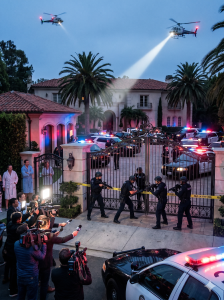
Black SUVs flooded the driveway, lights flashing, joined by police cruisers and state vehicles.
They tore across the grounds, stopping in formation at the entrance.
Armed officers poured out, fully geared, weapons raised, moving with precision.
And behind them—
News vans.
Reporters rushed forward, cameras ready, capturing everything.
“They brought the press,” Richard said hollowly. “She wants everyone to see this.”
“No!” Beatrice cried, backing away. “This can’t be for me! Call the Mayor! Call Arthur!”
“They’re the ones who sent them!” Richard shouted. “You attacked the woman who funds them! You’re not protected—you’re expendable. They’re going to make you the example!”
BOOM. BOOM. BOOM.
The heavy, rhythmic pounding on the solid oak front doors echoed through the empty mansion like cannon fire. Each удар shook the crystal chandeliers hanging in the foyer.
“Beverly Hills Police Department! Open the door immediately!” a commanding voice boomed through a bullhorn, cutting through the thick walls. “We have a felony warrant for the arrest of Beatrice Kensington! Open the door now or we will breach the entrance!”
Beatrice spun wildly in the office, like a trapped animal searching for escape.
“I have to hide,” she babbled, tugging at her hair. “I can’t go out there. Not like this. Not in a robe. Not without makeup. I can’t let them see me. I’ll be ruined.”
“It’s over, Beatrice,” Richard said quietly, the fight gone from his voice. He returned to his desk, set his chair upright, and sank into it. His eyes stayed fixed on the red numbers flashing across his screens. “Go downstairs. Don’t make them break the doors. That’s just more damage we can’t afford.”
“You’re not coming with me?” she cried, betrayal filling her voice. “You’re my husband!”
“I’m staying here,” Richard said flatly. “Waiting for the SEC. If Maya Brooks set this in motion, federal agents are next. I’m going to prison, Beatrice. Enjoy your perp walk.”
The pounding grew louder, now joined by the splintering crack of wood under a battering ram.
CRASH.
The front doors gave way, slamming inward. The thunder of boots flooded the foyer.
“Clear the first floor! Team two, upstairs! Secure the target!”
Beatrice froze. Her mind blank. Her world collapsing.
Footsteps pounded down the upstairs hallway.
The office doors were kicked open, splintering at the lock.
Three armed officers stormed in, rifles raised.
“Hands where I can see them! Now!” the lead officer shouted, aiming directly at her chest.
Beatrice whimpered, raising her shaking hands, tears streaming.
Two detectives followed behind. One pulled out a pair of steel handcuffs, the metallic clink echoing sharply.
“Beatrice Kensington,” he said coldly, without a trace of respect. “You are under arrest for Aggravated Felony Aault, Aault on a Pregnant Person, and Reckless Endangerment. Turn around and place your hands behind your back.”
“Please,” she sobbed. “Let me change. Let me get shoes. Let me call my lawyer. You don’t understand, I’m Beatrice Kensington—”
“I don’t care who you are,” the detective cut in, grabbing her shoulder and turning her around. “Turn around. Now.”
He forced her wrists together. The cuffs snapped shut, biting into her skin.
Click. Click. Click.
The sound echoed like a final lock sealing her fate.
“You have the right to remain silent,” he recited, pushing her toward the door. “Anything you say can and will be used against you in a court of law…”
They didn’t let her dress. Didn’t let her put on shoes.
They marched her down the staircase. Her bare feet slipped against the cold marble. She sobbed loudly, her cries echoing through the house she no longer owned.
Outside, the cool morning air hit her face—
Followed instantly by the blinding flash of cameras.
“Mrs. Kensington! Over here!”
“Did you know she was a billionaire when you attacked her?!”
“What about the baby on life support?! Did you mean to kill her?!”
Reporters shouted, cameras pushed forward, capturing every tear, every expression of terror, every fragment of her collapse.
She tried to hide her face, but the detectives held her upright, forcing her into view.
The once untouchable socialite, stripped of everything, stood barefoot in a torn robe, completely broken.
Back inside the Neonatal Intensive Care Unit at Sinai Hospital, none of it mattered.
The room was chaos.
“Charge is ready at ten joules!” a nurse shouted, holding the pediatric paddles.
“Clear!” the surgeon commanded.
Everyone stepped back.
The paddles were placed against my daughter’s tiny chest.
The button was pressed.
THUMP.
Her small body jerked violently from the shock.
I gasped, clutching my chest as if the current had passed through me. I covered my mouth, trying to hold back the sob rising from my throat.
The doctors dropped the paddles and stared at the monitor.
The room went silent—
Except for the endless, piercing tone.
BEEEEEEEEEEEEEEEEEEP.
Everyone in the room stared at the monitor. I stared at it too, my entire world reduced to those glowing pixels.
The red line stayed completely flat. Straight. Silent. Unforgiving.
Seconds passed. Five. Ten. It felt like centuries inside that sterile space.
The lead trauma surgeon released a heavy, defeated breath. His shoulders sagged as the adrenaline drained from him. With a gloved hand, he slowly pulled his surgical mask down beneath his chin.
He glanced at the clock on the wall.
He lifted his hands, his mouth opening—ready to say the words that would officially end everything. He was about to call the time of d*ath.
I closed my eyes, tears slipping freely, ready to give in to the darkness. I had given up everything—and still lost.
“Wait,” a nurse whispered suddenly, her voice sharp enough to cut through the silence. She pointed at the screen, her hand trembling. “Look.”
My eyes flew open, my heart halting.
The endless alarm faltered.
The flat red line broke.
A tiny green spike flickered onto the screen.
Then another.
Then another.
The alarm stopped—replaced by a slow, uneven, but unmistakably real rhythm.
Beep… beep… beep.
The room filled with a collective gasp.
“We have a pulse,” the surgeon said, gripping the incubator, disbelief in his eyes. “It’s weak—but it’s there. Spontaneous heartbeat. Oxygen levels are starting to rise.”
I folded forward in my wheelchair, burying my face in my hands as sobs tore through me. Not grief—relief. Pure, overwhelming relief.
The monitor continued its fragile rhythm.
Beep… beep… beep.
My daughter, Aria Brooks, had faced the edge—and come back.
The doctors moved quickly, stabilizing her, adjusting everything. But I stayed still, listening to that sound, knowing that while Beatrice Kensington sat in a cell, my daughter was alive.
PART 4: Checkmate in General Population
For seventy-two long hours, the mechanical hiss of the ventilator had been the only sound anchoring my broken existence. I hadn’t left the NICU. I hadn’t slept more than a few restless minutes at a time. I was a mother at the limit of endurance—yet still running a global financial empire from a hospital wheelchair. I survived on bitter coffee and relentless adrenaline, watching every flicker of the monitor as if it controlled my own heartbeat. Every dip sent my chest into panic. Every nurse’s movement made me brace for the worst.
But on the fourth morning, as sunlight filtered through the hospital blinds and spilled gold across the room, something changed.
The frantic alarms softened.
The machines settled into a steady rhythm.
It was the sound of survival.
Dr. Aris Thorne entered the room. The man who had kept my daughter alive.
For the first time, he wasn’t wearing that grim, guarded expression.
He was smiling.
“Her oxygen saturation has held at ninety-eight percent for six hours,” he said gently. “Her heart rate is stable. The latest echocardiogram shows no permanent damage.”
I gripped the arms of my wheelchair, afraid to believe him. Afraid hope might be taken again.
“Does that mean…” I started, my voice breaking.
He nodded. “It means she fought—and she won.”
He stepped to the incubator, his movements careful and steady.
“We’re taking her off the ventilator,” he said. “She’s ready to breathe on her own.”
I covered my mouth, tears blurring my vision as the nurses carefully removed the tube from her throat, replacing it with a small nasal line.
For a few endless seconds, she lay still.
Then her chest rose.
A small, fragile breath.
Then another.
And another.
A weak but unmistakable cry filled the room.
It broke something open inside me.
It was the most beautiful sound I had ever heard.
“Ms. Brooks,” the nurse said softly, tears in her eyes as she opened the incubator, “would you like to hold your daughter?”
She was utterly unable to speak. Words deserted me completely. I simply nodded over and over, my chest rising and falling with silent, overpowering sobs. Because of my severe surgical injuries, I couldn’t lean forward in the chair. The nurse carefully and gently lifted Aria’s tiny, fragile body, still threaded with wires, from the warmed mattress.
She placed my daughter softly against my bare chest, directly over the steady rhythm of my own heart.
The instant her warm, delicate, living skin touched mine, everything beyond the walls of that hospital room disappeared. The corporations I commanded, the billions moving through global markets, the immense influence I held, the total financial ruin of the Kensingtons—none of it mattered. It all faded into nothing. There was only this small, miraculous weight resting against me.
Aria’s tiny hand instinctively reached up. Her fragile fingers curled into the fabric of my worn hospital gown, holding on. Her uneven breathing gradually aligned with the steady cadence of my heartbeat.
I wrapped my trembling arms around her, forming a protective barrier of flesh and bone.
“I’ve got you,” I whispered into her small knit cap, pressing my tear-streaked face against her head. “Mommy’s got you. Nobody will ever, ever hurt you again.”
Twenty miles south of the quiet, pristine luxury of Sinai Hospital, Beatrice Kensington was being forced to confront the harsh, inescapable reality of her new life.
The harsh fluorescent lights inside the Century Regional Detention Facility in Lynwood never truly went dark. They hummed constantly, an unrelenting, mechanical buzz that drilled into her mind without pause.
Beatrice sat curled on a thin, uneven mattress on the lower bunk of a crowded six-person cell. She was swallowed by an oversized orange county jumpsuit, its coarse fabric reeking of bleach, sweat, and despair. Her once-perfect blonde hair, now unkempt and greasy, exposed inches of gray roots.
She hadn’t showered in three days. She hadn’t eaten the gray, shapeless food pushed through the metal slot. She trembled uncontrollably, her knees pulled tight to her chest.
“Hey. Snow White.”
The voice was rough and hostile, coming from the bunk above.
Beatrice flinched, refusing to look up, her eyes fixed on the stained concrete floor.
“I’m talking to you, rich b*tch,” the inmate snapped. A rolled-up pair of dirty socks struck Beatrice on the side of the head.
She whimpered softly, finally lifting her gaze.
The woman across from her was Carla—a hardened criminal with tattoos climbing her neck and a cold, predatory stare.
“You’re in my light,” Carla said flatly.
“I… I’m just sitting here,” Beatrice stammered, her voice shaking uncontrollably. “I’m not doing anything wrong.”
“Your crying is irritating,” Carla replied bluntly, dropping from the top bunk with a heavy thud. She moved closer, looming over Beatrice. “You’ve been at it since they dragged you in. Stop.”
“You don’t understand,” Beatrice sobbed, clinging to a fading sense of entitlement. “I don’t belong here. I live in Beverly Hills. My husband is a hedge fund manager. This is all a mistake.”
Carla laughed harshly, the other inmates joining in. The sound echoed off the concrete walls.
“Beverly Hills?” Carla mocked, leaning in close. “Your husband’s locked up for fraud. We saw it on TV. You’ve got less than we do.”
Beatrice recoiled, her back hitting the cold wall. The truth struck harder than any blow.
“And we know why you’re here,” another inmate added from the corner. “You shoved a pregnant woman because she was Black and in your chair.”
The atmosphere shifted instantly—cold, hostile, heavy. Even here, there were lines you didn’t cross. And she had crossed one of the worst.
“You think you’re better than us?” Carla whispered, grabbing Beatrice’s collar and pulling her forward. “You think money made you untouchable?”
“Please,” Beatrice begged, tears streaming down her face. “Please don’t hurt me. I have nothing left.”
Carla studied her for a long moment, then shoved her back with disgust.
“You’re right. You’re nothing,” she spat, wiping her hands on her pants. “Keep quiet, keep your head down, and maybe you’ll last. Now move.”
Beatrice scrambled away, retreating into the darkest corner of the cell. She curled into herself, shaking, surrounded by the stench of decay and hopelessness.
For the first time, she truly understood what consequences meant.
It took eight long months for the relentless legal system of Los Angeles County—nudged along by my unseen influence—to reduce the once-proud Kensington legacy to nothing.
Aria was finally home, safe and out of danger. She was still small for her age and required specialized pediatric care along with constant, careful monitoring, but she was thriving in a way that felt nothing short of miraculous. She had inherited my dark, watchful eyes—and an unyielding, fierce will to live that filled me with a deep, protective pride every single day.
Over those same eight months, I had worked with calculated precision, dismantling what remained of Richard Kensington’s fraudulent empire piece by piece. Every hidden asset, every offshore shell company, was uncovered and liquidated, ensuring that the institutional investors he had deceived were repaid in full.
Richard himself, shattered and unwilling to face a very public federal trial against my legal team, had accepted a sweeping plea deal. He was now serving a twenty-five-year sentence in a maximum-security federal prison in Florence, Colorado.
And today, Beatrice would finally face her reckoning.
I stood in the vast, marble-lined foyer of my downtown penthouse, adjusting the crisp cuffs of my tailored charcoal-gray Tom Ford suit. A single diamond tennis bracelet glinted at my wrist beside my platinum Patek Philippe. There would be no soft, understated attire today. No hint of vulnerability. Today, I wore power like armor. I wasn’t walking into court as a victim—I was stepping in as judgment itself.
Elias stood near the private elevator, holding his familiar leather portfolio.
“The motorcade is ready downstairs, Boss,” he said quietly. His voice remained professional, but there was a sharp edge of satisfaction beneath it.
“Good,” I replied calmly. “Let’s finish this.”
Outside the Los Angeles County Courthouse, the scene had escalated into something far beyond a spectacle. The story—of a privileged socialite whose own actions had dismantled her empire—had spread worldwide.
As my black Maybach rolled to a stop, flanked by security SUVs, the crowd surged. Cameras flashed relentlessly. Reporters shouted over one another, pushing forward in a chaotic wave.
I ignored all of it.
I moved up the courthouse steps with steady, deliberate composure, each step measured, controlled—like someone claiming exactly what was theirs.
Inside Courtroom 4B, tension hung thick in the air.
The gallery was filled with familiar faces—executives from my company, political figures aligned with my influence, and Mayor Marcus Vance seated prominently in the front row.
I walked down the aisle, the sharp rhythm of my heels echoing across the room.
Beatrice Kensington was already seated at the defense table.
For a moment, I barely recognized her. The past eight months had stripped her down to something unrecognizable. She was gaunt, fragile, her once-polished appearance replaced by exhaustion and fear. Her hair, now uneven and gray, framed a face marked by stress and sleepless nights.
As she heard my approach, she turned slowly.
Our eyes met.
Gone was the arrogance. Gone was the entitlement. What remained was emptiness—complete and irreversible defeat. She didn’t see me as beneath her anymore. She saw exactly who had brought her here.
I held her gaze without expression, then took my seat behind the prosecution.
“All rise,” the bailiff called, his voice cutting cleanly through the silence.
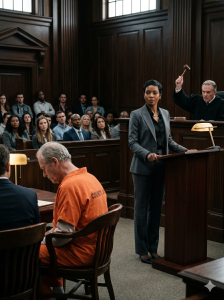
Judge Marcus Davis took his seat behind the high wooden bench. He glanced down at the towering stack of documents before him, his expression stern and unyielding. With Beatrice left completely without financial means to build a defense, and with the high-definition security footage of the violent a*sault impossible to dispute, her exhausted public defender had persuaded her to enter a blind plea. She had admitted guilt to every felony charge, throwing herself entirely on the mercy of the court.
“Case number 449-B,” Judge Davis began, his voice firm. “The defendant, Beatrice Kensington, has entered a plea of guilty to Aggravated Felony A*sault and Reckless Endangerment. Before sentencing, does the victim wish to address the court?”
“Yes, Your Honor,” I said, my voice cutting clearly through the silence.
I rose smoothly, fastening my suit jacket, and walked with measured precision to the podium at the center of the room. I carried no notes. I didn’t need them. Every word had been forming in my mind for eight long months.
I looked respectfully at Judge Davis, then turned my gaze directly toward Beatrice Kensington.
She visibly recoiled in her chair, trembling beneath the weight of my stare.
“Your Honor,” I began, my voice steady, layered with months of fear, trauma, and controlled fury. “Eight months ago, I entered Le Petit Chêne as a pregnant mother. I was in pain, exhausted, and only seeking a few minutes to sit and rest.”
I paused, letting the silence settle.
“The woman at that table didn’t see a pregnant woman in need,” I continued, my tone sharpening. “She didn’t see a person. She saw a Black woman in a simple dress—someone she believed was beneath her. She saw an inconvenience.”
Beatrice shut her eyes tightly, tears slipping down her hollow cheeks.
“She didn’t just take a chair,” I said, lifting a finger and pointing toward her. “She used force to assert dominance. She believed her wealth, her status, and her identity placed her beyond consequences.”
I lowered my hand, gripping the podium firmly.
“Because of that entitlement, my daughter was born prematurely. She went into cardiac arrest. She fought for months to breathe inside an incubator while this woman returned home concerned about appearances.”
I drew a steady breath, forcing down the rising emotion.
“I stand here not only as a CEO, but as a mother who nearly lost her child because of the toxic arrogance that exists in elite circles. Her wealth meant nothing. Her superiority was a lie. And her cruelty nearly cost a life.”
I met the judge’s gaze.
“I ask the court to show her the same mercy she showed me on that floor. None.”
I stepped away and returned to my seat.
The courtroom fell into complete silence. Even the faint hum of the ventilation system seemed amplified. Judge Davis remained still for a long moment, eyes fixed on Beatrice.
“Mrs. Kensington, stand,” he ordered.
Beatrice struggled upright, supported by her public defender. She looked hollow, like something already erased.
“Beatrice Kensington,” the judge said, his voice firm with finality, “your actions were malicious, unjustifiable, and rooted in a sense of entitlement that has no place in this society. You nearly caused the death of a child over a trivial inconvenience.”
He lifted the gavel.
“You discarded your freedom, your future, and your family’s legacy over a chair. I hope you reflect on that during your incarceration.”
A broken cry escaped her.
“It is the judgment of this court,” he declared, “that you serve the maximum sentence permitted. Fifteen years in the California Department of Corrections, without parole.”
BANG.
The gavel struck. The sound echoed like a final verdict carved into stone.
“Take her away.”
This time, Beatrice didn’t resist. She didn’t scream. The strength had already been drained from her.
Her legs gave out, and the bailiffs lifted her, dragging her sobbing form toward the exit. She didn’t look back. She stared forward into the void of what remained of her life.
The doors closed behind her.
It was finished.
I stood, smoothing my skirt. Elias stepped beside me.
“We won, Boss,” he said quietly.
“We survived, Elias,” I corrected. “There are no winners in a trauma ward. But the board is clear. And the message is delivered.”
I walked out of the courtroom and into the bright California sunlight.
The press erupted again, shouting questions, demanding statements.
I ignored them all.
I entered the quiet, armored interior of my waiting Maybach. The door shut, cutting off the noise instantly.
“Home, Marcus,” I said.
“Yes, Ms. Brooks.”
The car pulled away smoothly.
I leaned back, closing my eyes as the tension that had gripped me for months finally began to ease.
My phone vibrated softly.
I opened it. A message from my nanny. A photo.
Aria lay on her playmat, dressed in a soft yellow onesie. Her bright eyes looked directly at the camera, her small fingers gripping a plush toy.

A real smile spread across my face, breaking through the cold exterior I had carried for so long.
Beatrice Kensington had believed she could decide who mattered.
Now she sat behind concrete walls, stripped of everything.
And I was going home—to my daughter.
I had learned what power truly meant. It wasn’t status, wealth, or appearance. It was the relentless ability to protect what mattered most.
I locked my phone and looked out at the city passing by.
My empire remained. Stronger than ever.
But I had changed.
Harder. Colder toward enemies. Yet more aware than ever of how fragile life truly is.
The board was cleared. The queen remained. And the princess was safe.
